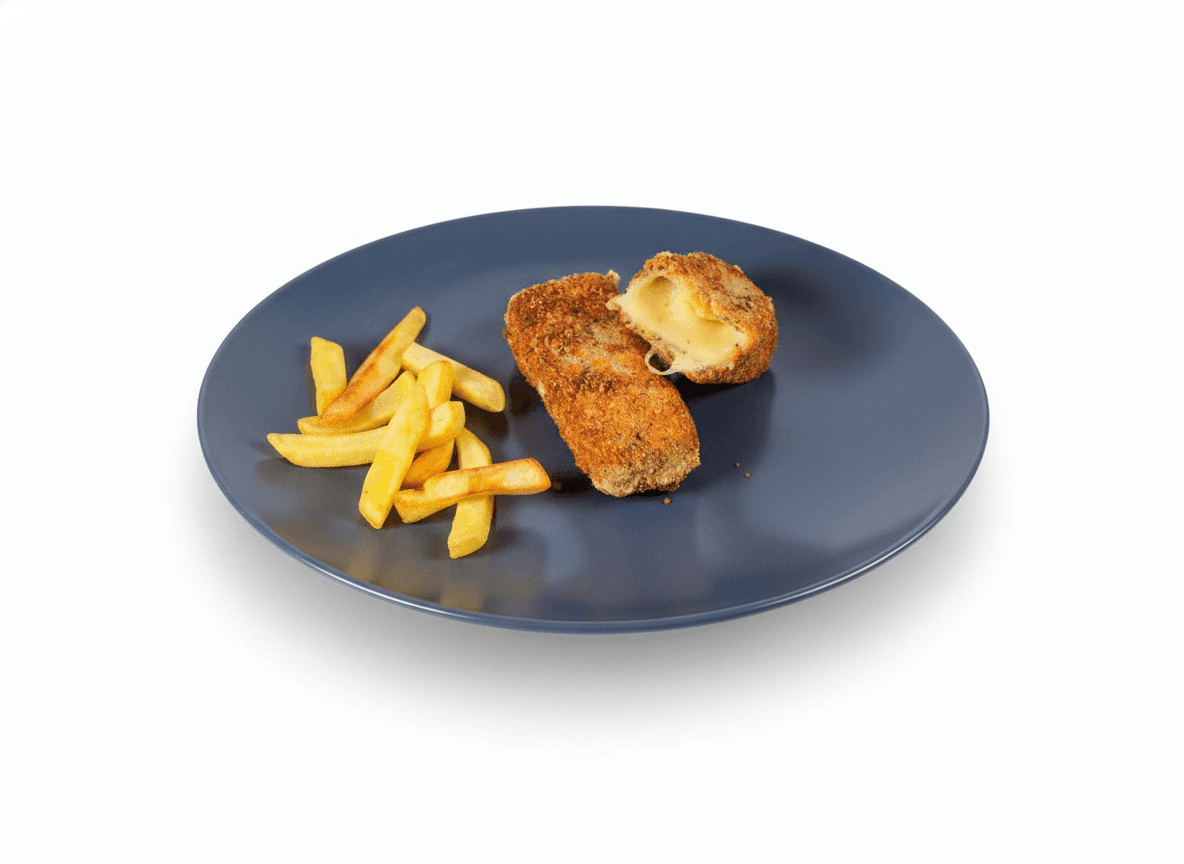
Cașcaval Pane
Cașcaval Pane·(kahsh-kah-vahl pah-neh)
Cămara: Afternoon Snacks & Pantry Hacks
It is the ultimate after-school equalizer—a visceral memory of walking into a kitchen heavy with the scent of hot oil and the salty tang of melting cheese. This isn't your average bar-food mozzarella stick, but a foundational pillar of Romanian comfort eating that demands a sit-down and a little respect. The genius here lies not in imported luxury, but in a grandmother's ruthless technique: a reinforced double-breading and a stint in the freezer to ensure the crust turns to golden armor before the molten center can breach the walls.
Before you start
You can prepare large batches of breaded cheese in advance for quick weeknight cooking.
Once double-breaded, store the slices in a freezer bag for up to three months and fry them directly from frozen whenever the craving hits.
Ingredients
- semi-hard cheese block (Muenster, young Provolone, or Cașcaval)12 oz
- all-purpose flour1/2 cup
- eggs2 large
- fine plain breadcrumbs1 cup
- salt1/4 tsp
- black pepper1/4 tsp
- neutral oil1 cup
Method
- 01
Set up a standard breading station with three shallow bowls.
Place the flour in the first bowl, the vigorously beaten eggs with a pinch of salt and pepper in the second, and the fine breadcrumbs in the third.
- 02
Execute the double-breading technique to build an impenetrable seal.
Coat a slice of cheese completely in flour, submerge it entirely in the egg, and press it firmly into the breadcrumbs. Crucially, dip it back into the egg and into the breadcrumbs a second time to ensure every crevice is armored.
- 03
Freeze the breaded cheese slices uncovered for at least thirty minutes.
This essential temperature manipulation gives the crust a head start in the hot oil, allowing it to solidify before the cheese reaches its melting point and causes a blowout.
- 04
Heat a half-inch of neutral oil in a heavy-bottomed skillet over medium heat.
Wait until the oil is shimmering at roughly 350°F; high heat will bitterly scorch the crumbs while leaving the cheese cold.
- 05
Shallow-fry the cheese for roughly two minutes per side until deeply golden.
Carefully lower the frozen slices into the hot oil, working in batches to avoid crowding the pan and dropping the oil temperature.
- 06
Turn the cheese gently using a spatula or blunt silicone tongs.
Never pierce the crust with a fork, which will instantly release the pressurized, molten cheese into the hot oil.
- 07
Drain briefly on a paper towel and serve immediately.
Give it exactly thirty seconds to rest before eating, allowing you to catch it while the center remains delightfully elastic and rich.
Notes
Strictly avoid coarse breadcrumbs like Panko.
Large jagged crumbs leave microscopic gaps in the breading matrix, creating weak points where molten cheese will inevitably escape during frying.
The thickness of the cheese is non-negotiable.
If the cheese is cut thinner than three-quarters of an inch, it will liquefy and burst before the crust has time to brown properly. If it is cut too thick, the center will remain solid.
From Cook Romanian in America.