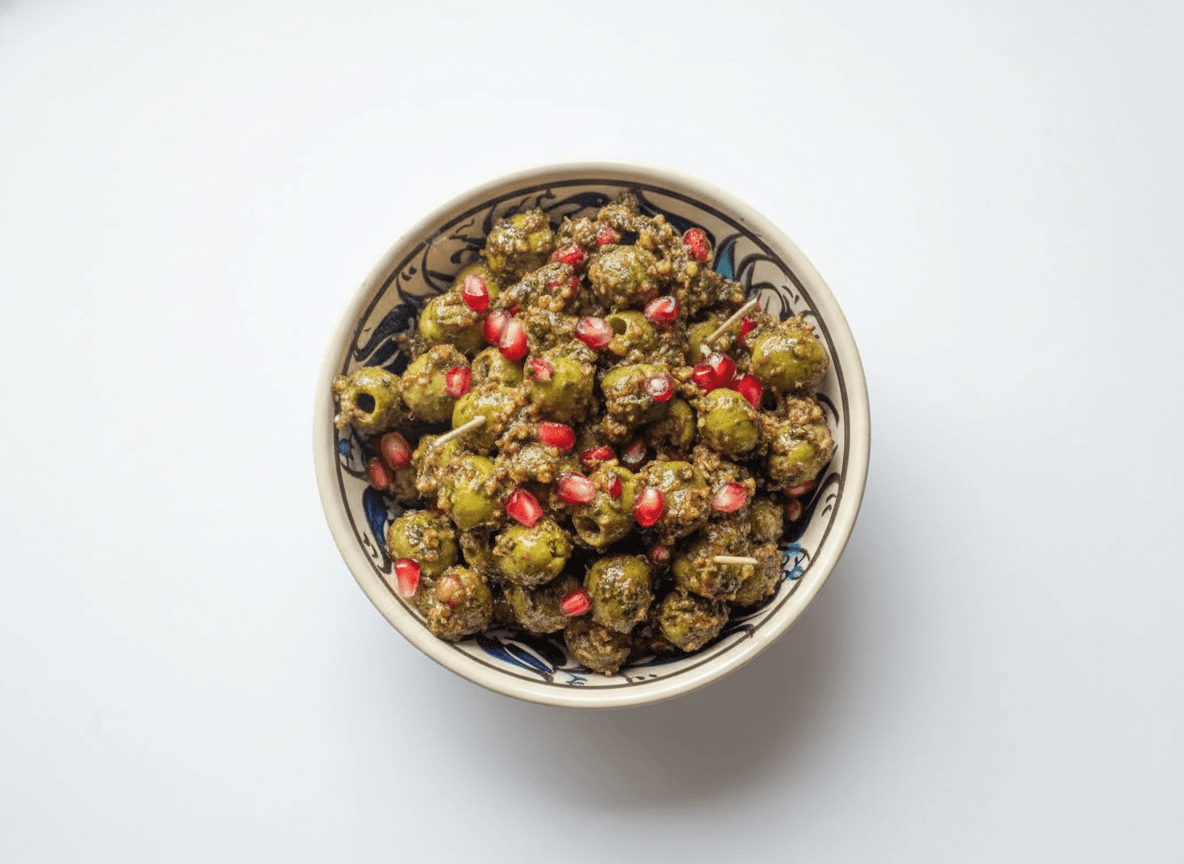
Zeytoon Parvardeh
زیتون پرورده·(zey-toon par-var-deh)
The Modern Mehmooni (Weekend Feasts and Ta'arof)
Forget the bastardized, pan-Mediterranean blog versions laced with Greek oregano and red wine vinegar. Authentic Zeytoon Parvardeh hails from Gilan—the lush, rain-swept Caspian coast of Northern Iran—and relies on an exact alchemy of sweet walnuts, tart pomegranate molasses, and earthy local herbs. To replicate those wild-foraged Iranian herbs in an American kitchen, we use a specific blend of mint and cilantro spiked with musky golpar. But the real grandmother secret here is the technique: dry-toasting the walnuts before grinding them. It kills the bitter tannins and releases their natural oils, giving you a creamy, cohesive marinade that tastes exactly like home.
Ingredients
- pitted green olives1 lb
- raw walnuts1 1/2 cup
- pomegranate molasses4 tbsp
- unsweetened pomegranate juice2 tbsp
- garlic3 clove
- fresh mint leaves1/4 cup
- fresh cilantro leaves1/4 cup
- dried mint1 tsp
- golpar1 tsp
- extra virgin olive oil2 tbsp
- fresh pomegranate arils1/4 cup
- saltto taste
- black pepperto taste
Method
- 01
Soak the olives to strip out the excess brine.
American jarred olives are aggressively salty and will ruin the balance of the dish. Submerge them in a bowl of cold water for 15 to 20 minutes, then drain and pat them completely dry with a clean towel.
- 02
Dry-toast the walnuts to release their oils.
Do not skip this. Place a dry skillet over medium-low heat, add the raw walnuts, and toast for 4 to 6 minutes, tossing frequently until fragrant. This kills the bitter tannins in the skin and guarantees a creamy, cohesive paste. Let them cool to room temperature.
- 03
Pulverize the walnuts, garlic, and herbs.
In a food processor, pulse the cooled walnuts and garlic cloves until the mixture looks like coarse sand. Add the fresh mint, fresh cilantro, dried mint, and golpar, pulsing again until the herbs are finely minced and integrated.
- 04
Emulsify the paste with pomegranate and oil.
Pour in the pomegranate molasses, pomegranate juice, and olive oil. Run the machine for a few seconds until a thick, dark-brown, cohesive paste forms.
- 05
Toss the olives in the marinade.
Transfer the paste to a large mixing bowl and fold in the dried green olives, stirring until every single olive is heavily coated. Do not blindly add salt—taste an olive first, then add salt or a crack of black pepper only if it needs it.
- 06
Let it marinate in the fridge before serving.
Stir in half of the pomegranate seeds, pack the mixture into a glass container, and chill for at least 4 hours—overnight is even better. Garnish with the remaining pomegranate seeds and serve at room temperature alongside flatbread.
Notes
Sourcing Golpar.
Also known as Persian hogweed or angelica seeds, this musky, aromatic spice is non-negotiable for true authenticity. You will need to hit up a Middle Eastern market, but it is the trigger for that grandmother's kitchen nostalgia.
Dialing in the molasses.
Commercial pomegranate molasses varies wildly. If your store-bought bottle is overwhelmingly sweet, balance it with a splash of fresh lemon juice or sour orange juice to restore the tart, acidic backbone of Gilani cuisine.
From Cook Persian in America.