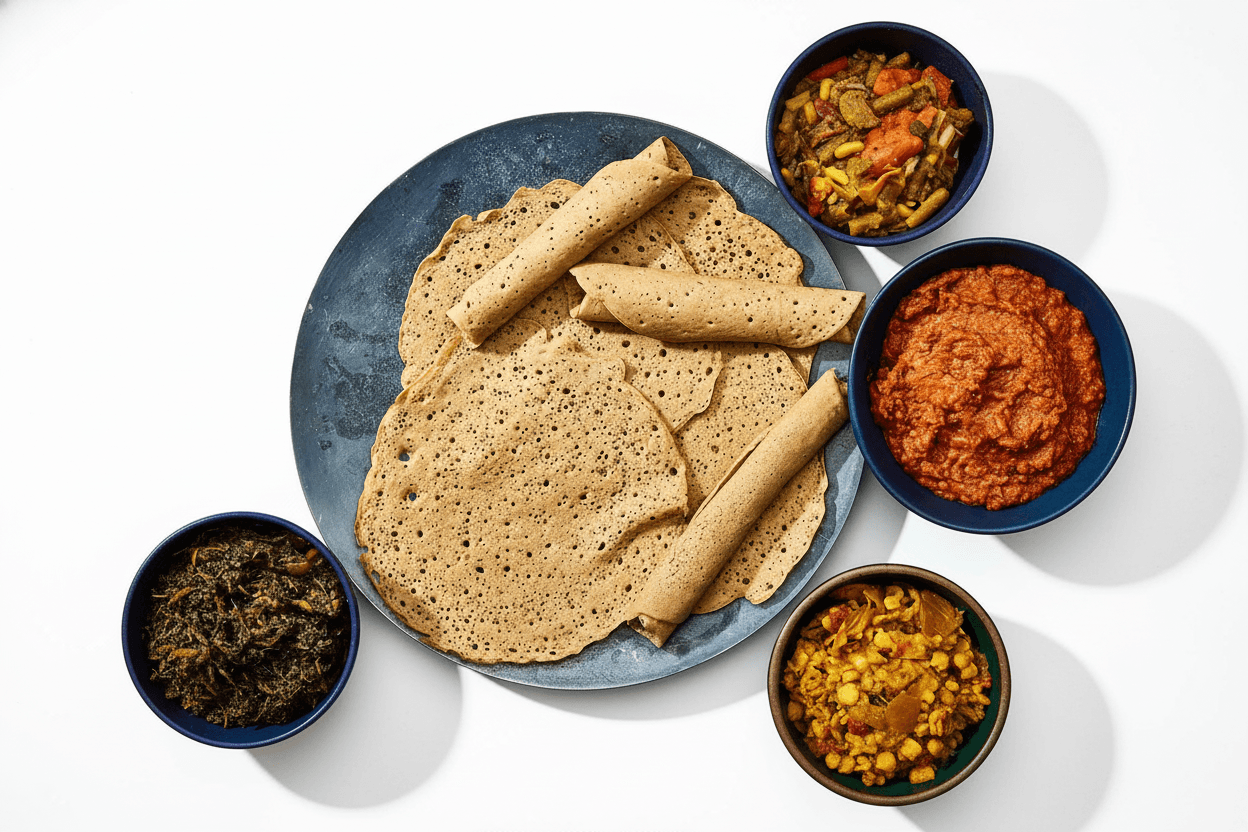
Yemeteshebo Injera
የመጥበሻ እንጀራ·(ye-met-be-sha in-je-ra)
The Injera Reality: Bread Hacks and Fermentation
Real injera takes three days, a wild sourdough starter, and a massive clay griddle. For the diaspora living in an American suburb on a busy weeknight, that simply isn't happening. But when the craving for spicy doro wat hits, you need the bread. This is the grandmotherly hack that saves the day: skillet injera. Using a standard frying pan, grocery store yeast, and a brilliant structural trick called the absit—a cooked dough binder that guarantees a soft, rollable flatbread—you get the unmistakable, sour, spongy tang of the homeland in under an hour. It is not the ancient way, but it is the real way people cook today.
Ingredients
- teff flour1 cup
- all-purpose flour1 1/2 cup
- instant active dry yeast1 tsp
- kosher salt1 tsp
- warm water3 cup
- apple cider vinegar1 tbsp
- baking powder1/2 tsp
Method
- 01
Whisk the dry base with most of the water.
In a large bowl, whisk the teff flour, all-purpose flour, yeast, salt, and 2 1/2 cups of the warm water until completely smooth.
- 02
Let the batter ferment.
Cover the bowl with a damp towel and let it rest in a warm spot for at least 1 hour, or up to 24 hours if you have the time.
- 03
Create the absit.
Bring the remaining 1/2 cup of water to a rolling boil in a small saucepan, then immediately whisk in exactly 1/2 cup of your resting batter.
- 04
Gelatinize the paste.
Whisk vigorously over the heat for 1 to 2 minutes until it seizes into a dense, translucent porridge, then remove from the heat and cool for five minutes.
- 05
Reintegrate the binder.
Spoon the cooled absit back into the main batter bowl and whisk vigorously until cohesive and completely lump-free.
- 06
Trigger the chemistry.
Just before cooking, whisk in the apple cider vinegar and baking powder to instantly activate the batter and create foamy bubbles.
- 07
Heat and season the skillet.
Heat a 10-inch or 12-inch non-stick skillet over medium-high until a drop of water dances on the surface, then wipe the pan very lightly with an oiled paper towel.
- 08
Pour the spiral.
Ladle a half cup of batter into the pan in a continuous spiral from the outside rim inward, quickly tilting the pan to fill any gaps.
- 09
Let the eyes form uncovered.
Cook without the lid for 30 to 45 seconds to allow the bubbles to aggressively burst across the surface as the edges begin to dry.
- 10
Cover and steam the bread.
Place a tight-fitting lid on the skillet, lower the heat to medium, and steam for 60 to 90 seconds until the top is fully opaque and springy.
- 11
Remove the injera without flipping.
Carefully slide the finished flatbread onto a platter and stack them under a clean kitchen towel to trap the residual heat and keep them soft.
Notes
Wipe away lid condensation immediately.
If moisture pools on the inside of your lid while steaming, quickly wipe it away with a towel so water does not drip back onto the injera and ruin its spongy texture.
Expect the first one to fail.
Your first pour is a sacrifice to gauge the stove. If the bottom burns before the top steams, lower the heat. If the eyes do not form, turn it up.