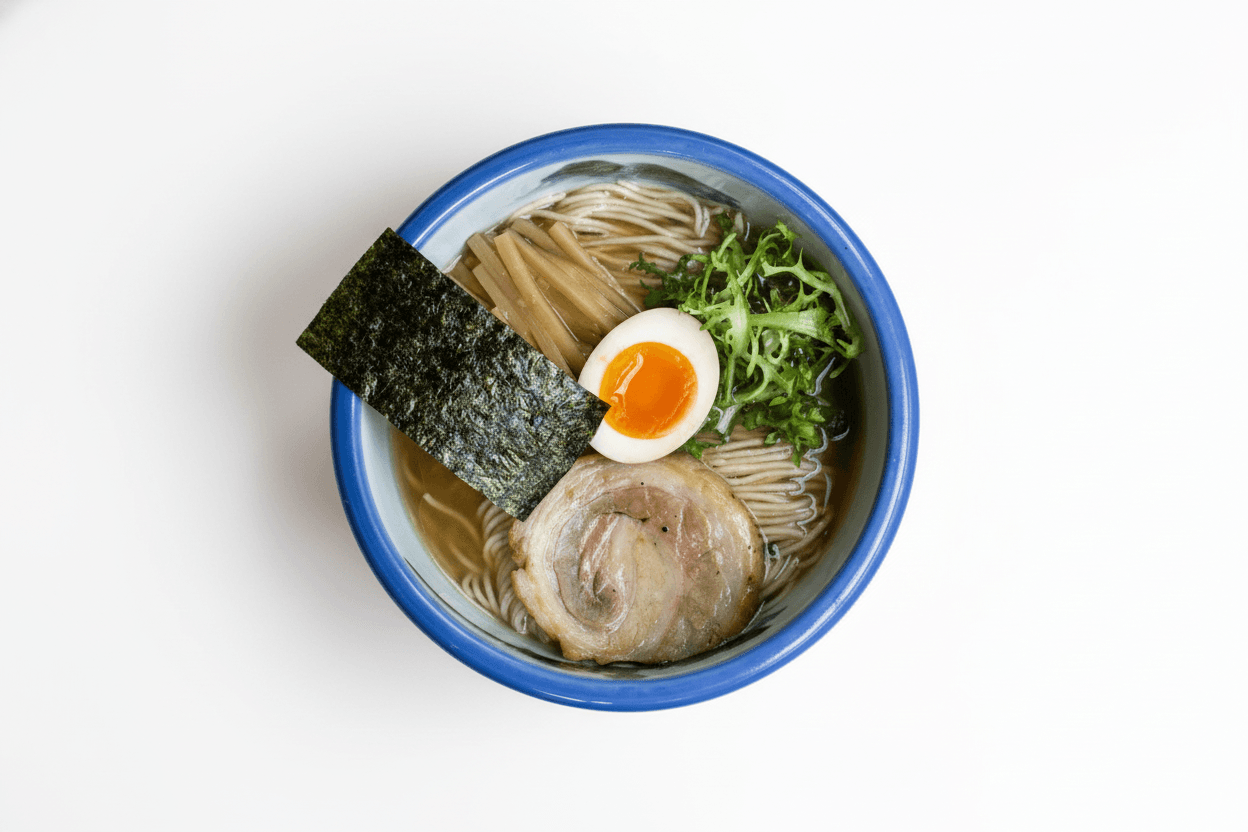
West Coast Yuzu Shio Ramen
柚子塩ラーメン·(yuzu shio rāmen)
Chapter 3 — The Bowls: Composed Assembly
There is a specific, uncompromising rhythm to a late-night ramen shop meal. The West Coast Yuzu Shio is a beautiful synthesis of strict Tokyo chintan discipline, the soft waters of the Pacific Northwest, and the floral bite of California Meyer lemons substituting for native yuzu. This isn't a quick weeknight dinner; it's a demanding weekend devotion to the grammar of ramen—a broth kept at an agonizingly gentle sub-simmer to maintain glass-like clarity, a tare heavily spiked with cold-infused citrus, and alkaline noodles boasting a defiant snap. You build it with military precision, and when you finally taste it, you'll know exactly what the counter at Little Tokyo tastes like.
Before you start
Bake the baking soda into kansui.
Spread standard baking soda on a foil-lined sheet and bake at 350°F for exactly one hour to convert it into sodium carbonate, the strong alkali required for proper noodle texture.
Cure the perfect ramen egg.
Boil cold eggs for exactly 6 minutes and 30 seconds, plunge into an ice bath, peel, and marinate in soy and mirin for a mandatory 12 hours to achieve the jammy bullseye yolk.
Prepare the cold-sliced chashu.
Braise a rolled pork belly until tender, but chill it entirely overnight before slicing; warm pork shreds, while cold pork yields perfect structural rounds that melt cleanly upon assembly.
Synthesize the alkaline noodles.
Dissolve the baked baking soda and salt into water, mix into the flours, step on the bagged dough to compress it, then sheet and cut to 1.2mm.
Extract the chintan broth.
Vigorously blanch the chicken bones for 10 minutes to purge impurities, rinse clean, then submerge in soft water with aromatics, maintaining a strict 176–194°F sub-simmer for two hours for glass-like clarity.
Construct the yuzu shio tare.
Burn off the alcohol from the mirin and sake, dissolve the salt and usukuchi shoyu, then let the mixture cool entirely to room temperature before whisking in the Meyer lemon juice and zest.
Steep the aroma oil.
Gently heat cold chicken fat, cleaned niboshi, and scallions to a bare 176–194°F for 20 minutes to extract the aromatics without drawing out bitter tannins.
Ingredients
- chicken carcasses2 1/2 lb
- chicken wings14 oz
- kombu10 g
- leek1 large
- fresh ginger3 slice
- garlic1 small
- filtered water3 l
- sea salt2 1/2 tsp
- usukuchi shoyu2 tbsp
- mirin1 1/2 tbsp
- sake1 tbsp
- kombu water50 ml
- Meyer lemon juice3 tbsp
- Meyer lemon1 whole
- chicken fat100 ml
- niboshi20 g
- scallion1 med
- bread flour390 g
- whole wheat flour10 g
- water130 ml
- baked baking soda4 g
- salt4 g
- eggs4 large
- white vinegar1 tbsp
- pork belly1 lb
- mizuna1 cup
- nori4 sheet
Method
- 01
Pre-warm the bowls.
Fill heavy ceramic ramen bowls with boiling water, let them sit for a minute to absorb the heat, then dump the water and wipe them bone-dry so they don't leech heat from the soup.
- 02
Build the base.
Pour two tablespoons of the yuzu shio tare and two teaspoons of the aroma oil into the bottom of the warm, empty bowl.
- 03
Create the emulsion.
Ladle the near-boiling tori chintan broth into the bowl, allowing the force of the liquid hitting the tare and oil to create a momentary micro-emulsion.
- 04
Execute the noodle fold.
Boil the alkaline noodles for exactly 90 seconds, shake them completely dry in a strainer to avoid diluting the soup, and slide them into the broth, folding them over once to create a neat wave.
- 05
Construct the landscape.
Arrange the cold-sliced chashu along the left perimeter, the halved jammy egg on the right, tuck a nori sheet in the back, and place a high mound of mizuna in the dead center.
- 06
Deliver the final zest.
Hold a microplane directly over the steaming bowl and swipe the fresh Meyer lemon peel three times, creating an intense, floral cloud of citrus aroma that hits the diner before they even pick up their chopsticks.
Notes
Respect the separation of church and state.
A common home-cook sin is seasoning the broth in the pot; ramen broth must remain deliberately under-salted, relying entirely on the highly concentrated tare in the bowl for its salinity and complex umami.
Agitation dictates clarity.
While a heavy tonkotsu demands split trotters and a violent rolling boil to emulsify fats into a milky-white suspension, a true tori chintan requires rigorous temperature control and a bare tremor to prevent the proteins from permanently clouding the liquid.