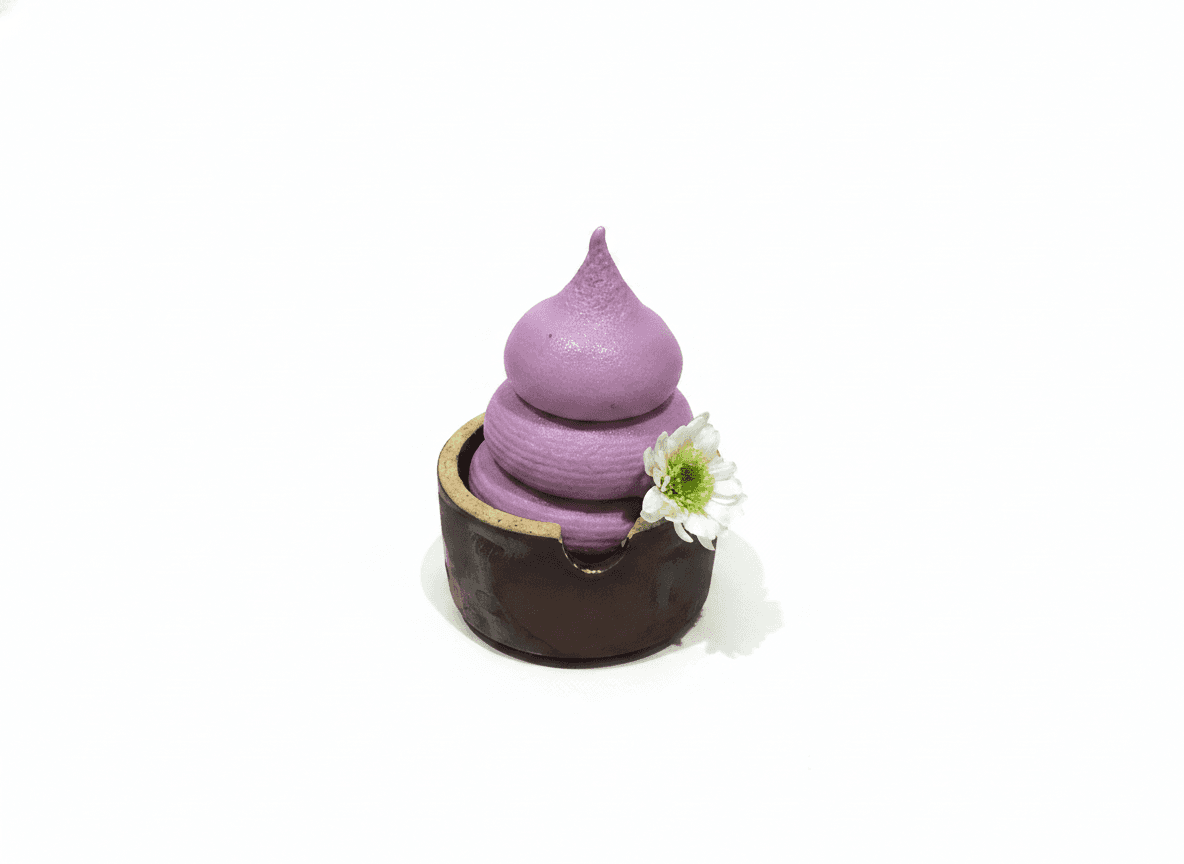
Ube & Okinawan Sweet Potato Custard
Chapter 5 — Drinks & Desserts
A proper bowl of tonkotsu ramen coats the palate in a glorious, heavy slick of pork fat, demanding a hard reset at the end of the meal. This is the definitive conclusion: an obsessive, project-oriented marriage of two diaspora staples. We employ the dense, yolk-heavy grammar of Filipino leche flan—spiked with the profound, earthy vanilla notes of ube—and crown it with the honeyed, slow-roasted starch of Japanese beni-imo. Execute this with the same quiet, exacting patience you afforded your eighteen-hour broth, and your guests will finish their night in stunned, perfect silence.
Ingredients
- Okinawan sweet potato1 large
- heavy whipping cream3 tbsp
- mascarpone cheese2 tbsp
- granulated sugar1 cup
- filtered water1/4 cup
- large egg yolk8
- sweetened condensed milk14 oz
- evaporated milk12 oz
- ube halaya1/2 cup
- vanilla extract1 tsp
- ube extract1/2 tsp
- kosher salt1 pinch
Method
- 01
Roast the sweet potato low and slow to activate its natural enzymes.
Wrap the pricked sweet potato in foil and roast at 300°F for 90 minutes to 2 hours. This prolonged, gentle heat maximizes the time the tuber spends in the amylase activation zone, converting its complex starches into sweet maltose.
- 02
Process the roasted sweet potato into a perfectly smooth puree.
Once cool enough to handle, scoop the vivid purple flesh and push it through a fine-mesh tamis or sieve to remove all fibrous strings. Gently fold in the heavy cream and mascarpone by hand until it resembles a thick buttercream, then cover and refrigerate.
- 03
Forge a dark, bitter caramel to cut the immense fat of the custard.
Combine the sugar and water in a scrupulously clean stainless saucepan over medium-high heat. Do not stir, as this induces crystallization; simply swirl the pan. Pull it from the heat exactly when it hits dark mahogany and begins to smoke, immediately pouring a thin, even layer into the bottom of six 6-ounce ceramic ramekins.
- 04
Build a dense, completely airless ube custard matrix.
In a large glass bowl, gently break the cold egg yolks with a spatula using slow, circular motions. Do not whip—air bubbles are the enemy of a glass-smooth texture. Stir in the condensed milk, then add the evaporated milk, ube halaya, vanilla extract, ube extract, and kosher salt, mixing until unified.
- 05
Strain the custard base to remove all structural impurities.
Pass the lavender liquid through a fine-mesh chinois lined with a layer of cheesecloth. This catches the chalazae from the eggs and any undissolved yam fibers from the halaya, ensuring the final product will melt on the tongue.
- 06
Bake the custards in a carefully insulated water bath.
Divide the base evenly among the caramel-lined ramekins and cover each tightly with foil to prevent a rubbery skin from forming. Place them in a roasting pan, fill the pan halfway up the sides of the ramekins with boiling water, and bake at 325°F for 45 to 55 minutes until the edges are set but the center retains a slight wobble.
- 07
Chill the custards thoroughly to set the structure and dissolve the hard caramel.
Remove the ramekins from the water bath, cool to room temperature, and refrigerate for a minimum of 12 hours. Do not rush this step, or the caramel will remain hardened to the bottom of the glass.
- 08
Unmold and crown with the sweet potato puree.
Run a thin paring knife tightly around the inside edge of each ramekin, invert onto a dessert plate, and give it a firm downward shake to break the vacuum. Top the unmolded flan and its cascading dark caramel with a clean quenelle of the chilled beni-imo puree.
Notes
Whole eggs are strictly forbidden in this matrix.
Egg whites coagulate at lower temperatures and create a spongy, diner-style texture. True luxury demands the structural density of pure yolks.
Know your tubers and respect their botanical differences.
Ube and Okinawan sweet potatoes are entirely distinct. Rely on the ube halaya for the custard's earthy, aromatic base, and use the beni-imo—identified by its beige skin and magenta flesh—strictly for the roasted topping.