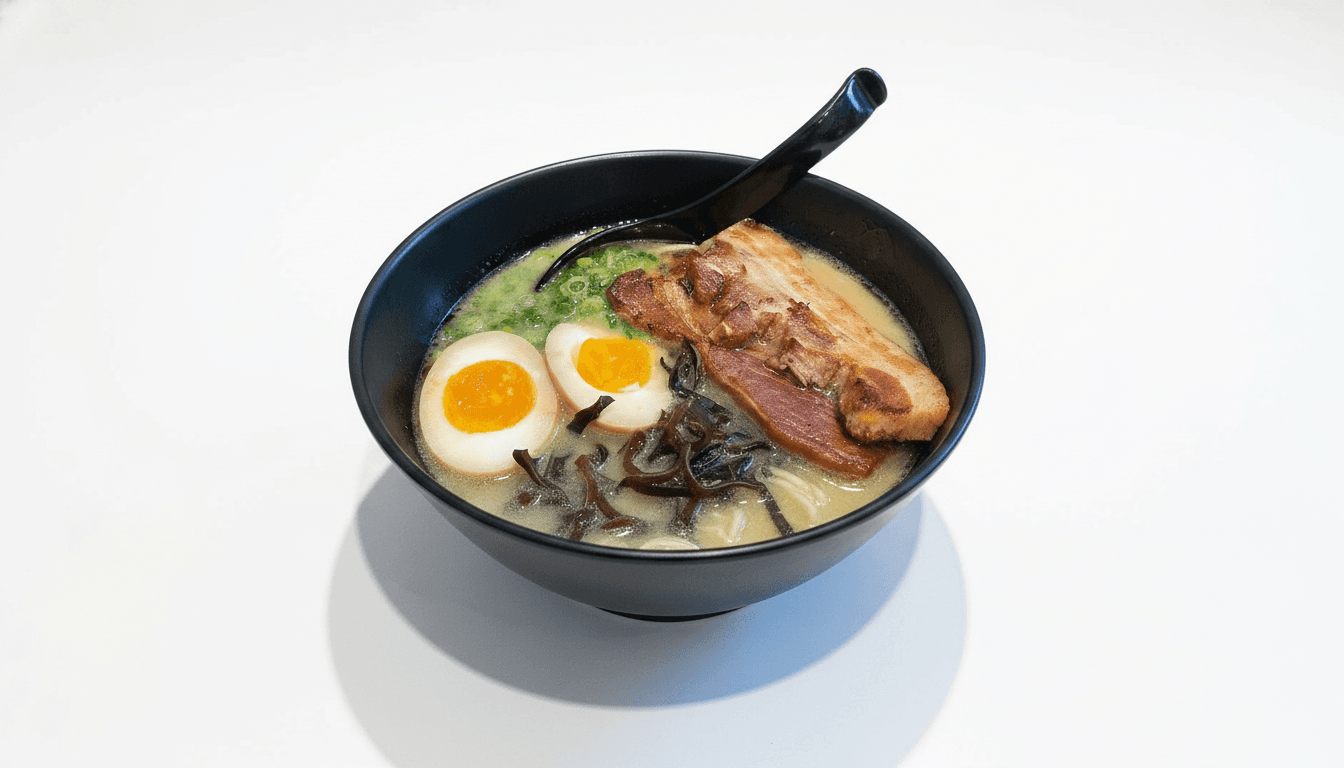
Tsuna-Kotsu Ramen
鮪骨ラーメン·(tsuna-kotsu rāmen)
Chapter 3 — The Bowls: Composed Assembly
Born from the refuse of Brooklyn fish markets and validated by the ramen purists of Shin-Yokohama, tsuna-kotsu is a masterclass in culinary violence. It takes discarded tuna heads and subjects them to a brutal, rolling boil until the fat and collagen shatter into a milky, soul-coating emulsion. This is a formidable weekend project that demands deep respect for the craft—heavy bones, absolute pH control, and a beautifully layered tare. Get it right, drop in that twelve-hour egg, and the payoff tastes exactly like the late-night counter in Little Tokyo.
Ingredients
- tuna bones, collars, and heads5 lb
- onion1 large
- garlic2 med
- ginger1 med
- water1 gal
- kombu15 g
- water1 cup
- sea salt1/2 cup
- light soy sauce2 tbsp
- sake2 tbsp
- mirin1 tbsp
- bread flour400 g
- cake flour100 g
- baked baking soda5 g
- salt5 g
- water135 g
- eggs4 large
- soy sauce1/2 cup
- mirin1/2 cup
- water1/2 cup
- tuna belly1 lb
- neutral oil2 cup
- garlic clove1 small
- thyme1 small
- scallions1 med
- toasted sesame seeds1 tbsp
- yuzu kosho2 tsp
Method
- 01
Roast the cleaned tuna bones on heavy baking sheets at 450°F for forty minutes.
You must drive out the trimethylamine; get them sizzling and deeply charred on the edges to transform any potential fishiness into deep, roasted umami.
- 02
Transfer the roasted bones to a large pot, cover with cold water by at least two inches, and bring to a violent, rolling boil.
Do not reduce to a simmer. This brutal mechanical agitation is mandatory; it is the physical engine that forces the melting tuna fat to emulsify with the extracted gelatin. Clarity here is a failure of emulsion.
- 03
Add the halved onion, garlic heads, and ginger after four hours of relentless boiling.
Keep the pot boiling for another six to eight hours, replenishing with boiling water every hour to keep the bones submerged. In the final two hours, stop adding water and let it reduce until the liquid is milky, opaque, and viscous like heavy cream.
- 04
Strain the broth through a fine-mesh sieve, pressing the solids firmly to extract every last drop of fat and gelatin.
Do not skim the fat, because the fat is the flavor. Leave the broth entirely unseasoned; the home cook will be tempted to salt the stock pot, but you must rely exclusively on the tare.
- 05
Steep the kombu in one cup of cold water for four hours, then gently heat to 140°F before discarding the kelp.
Dissolve the sea salt, light soy sauce, sake, and one tablespoon of mirin into this warm dashi. This concentrated shio-kombu tare is the sole source of seasoning for your bowl.
- 06
Bake standard baking soda on a foil-lined sheet at 350°F for exactly one hour to create your alkaline powder.
Dissolve five grams of this baked baking soda and five grams of salt into 135 grams of water, then slowly drizzle into the combined flours in a stand mixer.
- 07
Transfer the dry, coarse dough into a heavy-duty bag and step on it to compress it into a sheet, then run it through a hand-crank pasta machine until you can cut extra-fine, straight noodles.
Dust generously with cornstarch and let sit in the fridge for twenty-four hours so the alkaline flavor mellows and the texture firms.
- 08
Lower cold eggs into boiling water for exactly six minutes and thirty seconds, then immediately shock them in an ice bath.
Peel and submerge the eggs in a marinade of a half cup each of soy sauce, mirin, and water for exactly twelve hours. The bullseye-yolk is the point.
- 09
Submerge the salted tuna belly, smashed garlic, and thyme in neutral oil and bake at 180°F for forty-five minutes to one hour until incredibly tender.
Chill the tuna completely in the oil. You must cold-slice and never warm-slice; warm confit will shatter, so slice it cold and let the heat of the broth warm it in the bowl.
- 10
Warm your serving bowls with boiling water, dry them perfectly, and add two tablespoons of tare to the base of each.
Drop the fresh noodles into rapidly boiling water for forty-five seconds to achieve a firm snap (katame).
- 11
Pour twelve ounces of scalding hot tsuna-kotsu broth over the tare to mix the seasoning into the emulsion, then vigorously drain the noodles and fold them neatly into the soup.
Top with cold-sliced maguro confit, a halved ajitama, scallions, sesame seeds, and a mandatory dab of yuzu kosho on the lip of the bowl to slice through the heavy fat.