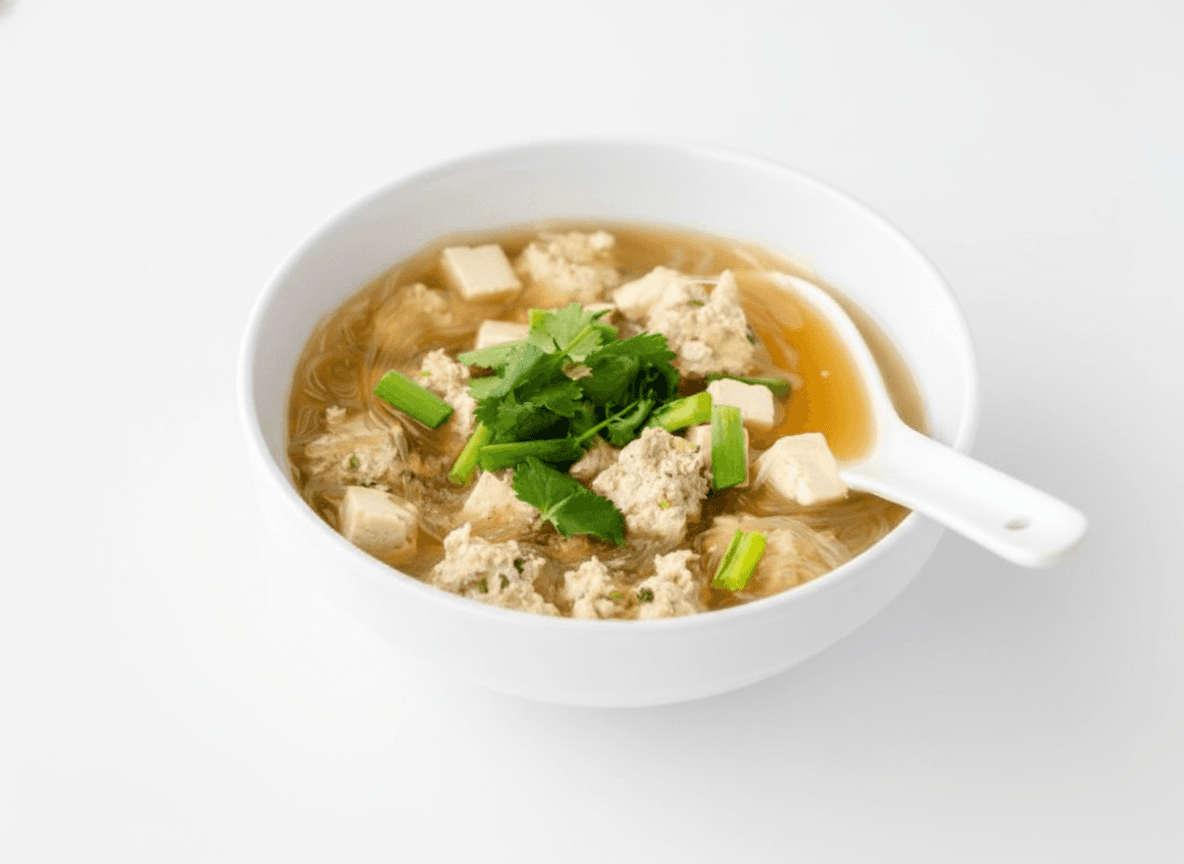
Tom Jued Woon Sen
ต้มจืดวุ้นเส้น·(tom jued woon sen)
Thai Morning Comforts & The Healing Pot
If Pad Thai is the flashy export, Tom Jued is the quiet anchor of the family table. It translates to 'bland soup,' but in a Thai home, 'bland' means pure, restorative, and profoundly comforting. This isn't the Hollywood version of Thai food. It’s the pot simmering on a Tuesday night to soothe the stomach and cleanse the palate between bites of fiery curry. The magic lies in three non-negotiables: a pounded paste of white pepper and cilantro stems, a pinch of funky preserved cabbage to spike the pork meatballs, and the patience to skim the broth until it runs crystal clear.
Before you start
Fry the garlic and oil in advance.
If not using store-bought, slowly fry 2 tablespoons of minced garlic in 3 tablespoons of neutral oil over medium-low heat until just golden. Stop early, as it will continue to cook and darken in the hot oil.
Ingredients
- ground pork1/2 lb
- garlic3 med
- whole white peppercorns1/2 tsp
- cilantro stems1 tbsp
- Thai light soy sauce1 tbsp
- Tung Chye1 tbsp
- sugar1/2 tsp
- dried mung bean glass noodles1 1/2 oz
- water5 cup
- Knorr pork bouillon cube1 small
- daikon radish1 small
- Napa cabbage2 cup
- carrot1 med
- Thai light soy sauce2 tbsp
- fish sauce1 tbsp
- egg tofu1 small
- Chinese celery1 med
- scallions2 med
- cilantro leaves1/4 cup
- fried garlic and garlic oil2 tbsp
- ground white pepper1/4 tsp
Method
- 01
Tame the noodles.
Submerge the dried glass noodles in room-temperature water for 10 to 15 minutes until pliable, then drain and snip them in half with kitchen shears so they aren't impossibly long to eat. Soaking in cool water is the native secret to preventing them from overcooking and bloating later.
- 02
Make the "Three Buddies" paste.
In a mortar and pestle, aggressively pound the garlic, whole white peppercorns, and cilantro stems until you have a coarse, fragrant paste. This is the foundational Sam Kler that gives traditional Thai food its soul.
- 03
Marinate the pork.
Transfer the aromatic paste to a mixing bowl with the ground pork, 1 tablespoon of the light soy sauce, the sugar, and the minced Tung Chye. Knead it aggressively with your hands until the meat becomes slightly sticky, then let it sit for 10 minutes.
- 04
Build the clear broth.
Bring the water to a rolling boil in a medium pot. Add the bouillon cube and daikon slices. Wet your hands slightly, pinch off rustic, marble-sized pieces of the marinated pork, and drop them directly into the boiling water.
- 05
Execute the grandmother's skim.
Immediately reduce the heat to medium-low to maintain a gentle simmer; a violent boil will emulsify the pork fat and ruin your crystal-clear broth. Skim the grey foam off the surface with a fine-mesh skimmer for about 3 to 5 minutes until the broth runs clear and the meatballs float.
- 06
Layer the vegetables and season.
Add the carrots and the thicker white stems of the Napa cabbage. Season the broth with the remaining 2 tablespoons of light soy sauce and the fish sauce. Simmer for 3 minutes until the carrots are tender. The broth should taste slightly overly seasoned right now.
- 07
Watch the final minute.
Gently slide in the sliced egg tofu, the leafy cabbage greens, and the drained glass noodles. Let the soup simmer for exactly 1 to 2 minutes until the noodles turn completely translucent, then immediately kill the heat. Do not walk away, or the noodles will bloat and ruin the texture.
- 08
Garnish and serve.
Off the heat, stir in the Chinese celery, scallions, and cilantro. Ladle the hot soup into a large communal serving bowl, drizzle generously with the fried garlic and its oil, and finish with a heavy dusting of ground white pepper.
Notes
Source true mung bean starch noodles.
Sweet potato noodles (often used for Korean japchae) will become heavy and entirely miss the delicate, slippery texture required here. Check the ingredient list to ensure they are 100% mung bean starch.
Tung Chye is the secret ingredient.
This fermented Tianjin cabbage comes in small earthenware jars or plastic tubs at the Asian market. It provides an irreplaceable, funky umami depth to the meatballs. If you omit it, the soup will still be good, but it won't taste like grandma's.
From Cook Thai in America.