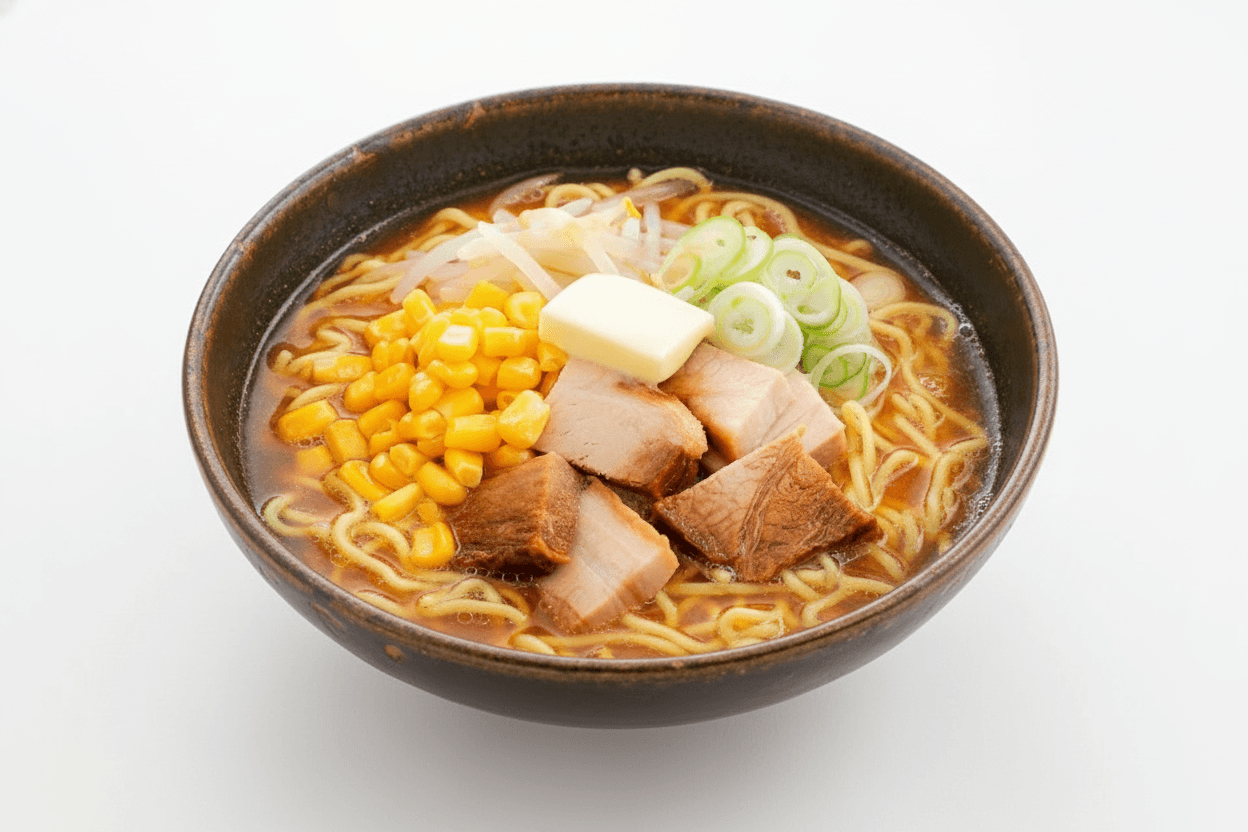
The Wok-Fired Sapporo Miso Assembly
札幌味噌ラーメン·(sapporo miso rāmen)
Chapter 3 — The Bowls: Composed Assembly
It’s freezing in Hokkaido, and you need a bowl that fights back. True Sapporo miso ramen is an exercise in culinary violence and precise thermal control. You don’t gently simmer this; you blast aromatics in smoking lard, sear the miso paste to strip its raw edge, and force an emulsion in the wok with roaring pork broth. The thick layer of rendered fat floating on top isn't a garnish—it's structural insulation designed to trap the heat. This is the methodical assembly that makes your eighteen-hour weekend project of boiling bones and baking baking soda worth every goddamn second.
Before you start
Whisk together the Master Miso Tare.
In a mixing bowl, combine the shiro miso, aka miso, sesame oil, soy sauce, mirin, sake, ichimi togarashi, and ground sansho pepper. Whisk until perfectly smooth. Store this in an airtight container in the refrigerator overnight to allow the complex flavors to meld. This yields enough tare for 6 to 8 bowls of ramen.
Ingredients
- shiro miso (white miso)100 g
- aka miso (red miso)100 g
- sesame oil2 tbsp
- soy sauce2 tbsp
- mirin1 tbsp
- sake1 tbsp
- ichimi togarashi1 tsp
- ground sansho pepper1/2 tsp
- pure rendered pork lard2 tbsp
- fatty ground pork2 oz
- fresh garlic1 tsp
- fresh ginger1 tsp
- yellow onion1/4 med
- mung bean sprouts2 oz
- milky-white tonkotsu broth14 oz
- raw alkaline noodles1 portion
- chashu pork belly2 slice
- ajitsuke tamago1 large
- sweet corn kernels2 tbsp
- unsalted butter10 g
- scallion1 med
Method
- 01
Warm your bowl and establish temperature control.
Ramen is a game of seconds. Fill your ceramic ramen bowl with boiling water for 5 minutes, then dump it and wipe the bowl completely dry. Keep your tonkotsu broth at a bare simmer on a back burner, and bring a large pasta pot of unsalted water to a rapid, violent boil for the noodles.
- 02
Heat the lard until it smokes.
Place a heavy carbon steel wok or enameled cast-iron Dutch oven over the highest heat your stove can produce. Add the pork lard and let it melt until it is shimmering and just barely beginning to smoke. Do not substitute cooking oil; the rendered pork fat is a structural necessity.
- 03
Sear the pork and blast the aromatics.
Throw the ground pork into the smoking lard and let it sear to develop a crust before stirring. Add the grated garlic and ginger to let the aromas bloom violently, then toss in the sliced onions and bean sprouts. Toss rapidly to coat the vegetables in the fat, charring the edges while keeping the centers crisp.
- 04
Bake the miso paste in the smoking fat.
Push the meat and vegetables up the sides of the wok to expose the center. Drop 3 to 4 tablespoons of your pre-made Master Miso Tare directly into the hot lard. Allow the paste to fry and sear until the sound changes from a high-pitched crackle to a low, heavy sizzle, roasting away the raw fermented edge.
- 05
Force the emulsification with boiling broth.
Ladle 14 ounces of the boiling tonkotsu broth directly into the wok, where it will spit and roar. Stir aggressively with a ladle; the vigorous boiling action forces the lard, the heavy pork stock, and the roasted miso to physically emulsify into a creamy, opaque soup. Turn off the heat immediately.
- 06
Boil the alkaline noodles for exactly ninety seconds.
Drop your alkaline noodles into the rapidly boiling unsalted water. Because of the high pH, they cook fast and need to retain a distinct snap to stand up to the heavy soup. Drain them aggressively in a basket strainer, shaking out every single drop of water so it does not dilute the broth.
- 07
Construct the architecture of the bowl.
Pour the boiling, emulsified soup and all the wok-fired vegetables into the pre-warmed ceramic bowl. You should see a distinct layer of golden lard floating on top. Neatly fold the drained noodles into the soup. Arrange the cold-sliced chashu, lean the two halves of the egg against the pork, mound the sweet corn on the side, and place the butter directly over the corn. Finish with scallions and serve immediately. The first sip should induce a sweat, coat your lips in collagen, and elicit one thought: YES, THIS IS EXACTLY WHAT LITTLE TOKYO TASTES LIKE.
Notes
Master the violent rolling boil of the tonkotsu broth.
This is a multi-hour weekend project. Bone selection (split trotters and neck bones) and the initial 15-minute blanch are essential to discard blood and oxidized impurities. The violent agitation of a rolling boil is what mechanically whisks the melting fat into the water—do not simmer. Maintain the water line with boiling water to keep the temperature up. The result should be a milky-white, opaque liquid; it should absolutely not be clear.
Rely on the tare for all of your seasoning.
The home cook is always tempted to over-season the broth pot. Redirect that instinct. The tonkotsu broth must remain fundamentally under-salted, serving only as a vessel for texture and fat. The actual salinity and complex regional flavor live entirely in the layered miso tare.
Bake your baking soda for authentic alkaline noodles.
Alkaline pH is the secret to a noodle with proper snap that won't turn to mush in boiling soup. If you cannot source liquid kansui, spread standard baking soda on a foil-lined baking sheet and bake at 350°F for exactly 1 hour. This thermal decomposition converts it into the sodium carbonate you need.
Always cold-slice your chashu pork belly.
After braising low and slow, the pork belly must be chilled overnight in the refrigerator. Warm pork belly will shred and fall apart under a knife. Cold slicing yields the perfectly uniform, thin rounds seen at Daikokuya, which melt instantly upon hitting the hot soup.
Chase the bullseye yolk for the marinated egg.
The bullseye yolk is the entire point. Execute a strict 6-minute and 30-second boil, immediately plunge the egg into an ice bath to arrest cooking, peel, and submerge in your umami marinade for a minimum of 12 hours.