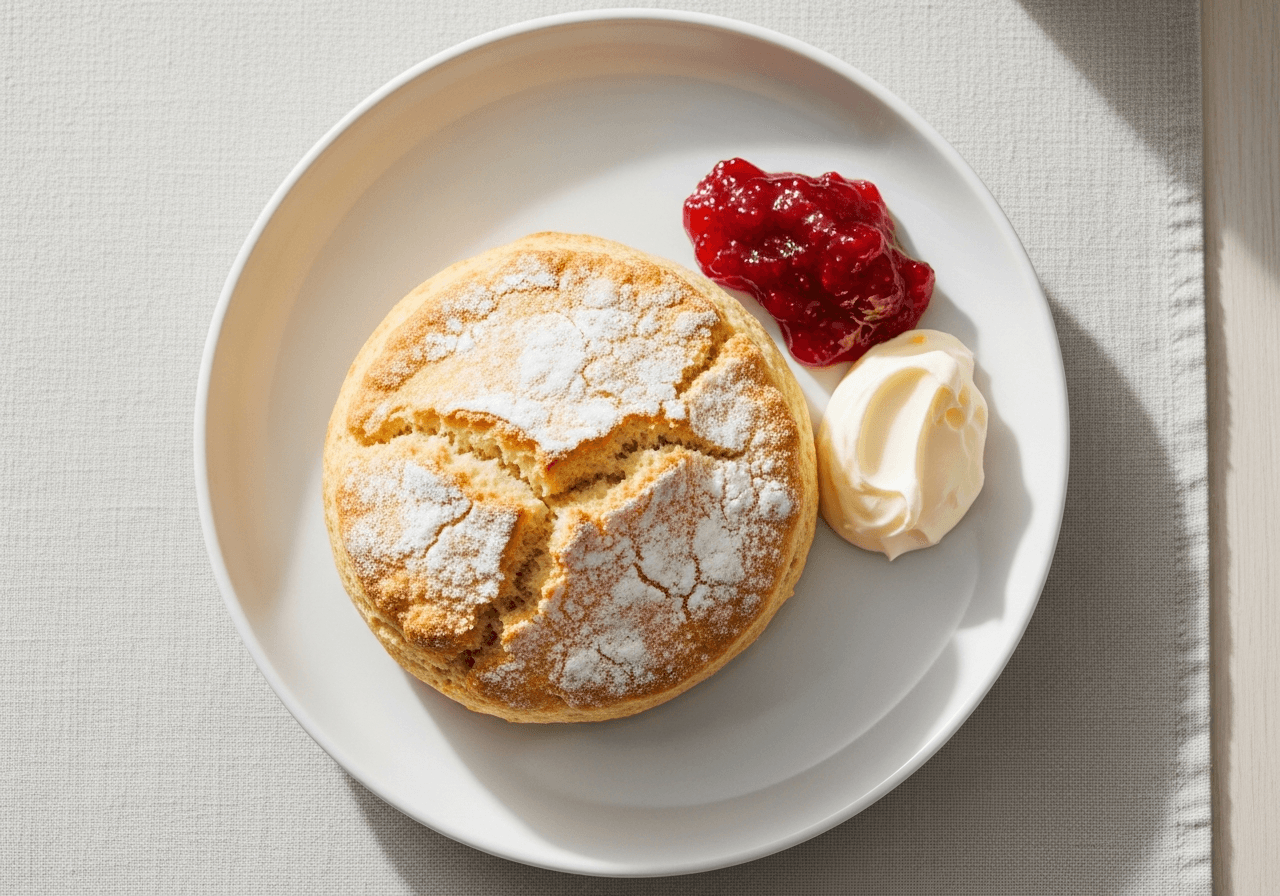
The Proper Irish Buttermilk Scone (Not a Wedge)
Scónaí Bláthaí·(skoh-nee blaw-hee)
"Cupan Tae" & The Biscuit Tin (Afternoon Rituals)
American coffeehouse chains committed a crime against the scone, mutating it into a dense, sugary, dry-as-dust wedge. A genuine Irish scone is a different animal entirely: round, faintly sweet, and incredibly tender. It relies on the volatile chemistry of acidic buttermilk hitting baking soda in a fiercely hot oven. If you want that authentic, light-as-air crumb your grandmother perfected, there are only three rules: freeze your butter, mix with a light hand, and whatever you do, never twist the cutter.
Before you start
Freeze the butter.
Place the stick of butter in the freezer for at least 10 minutes before starting to ensure it grates cleanly without melting.
Ingredients
- all-purpose flour3 1/2 cup
- baking soda1 tsp
- aluminum-free baking powder2 tsp
- kosher salt1 tsp
- granulated sugar3 tbsp
- unsalted Irish butter6 tbsp
- golden raisins1/2 cup
- cultured buttermilk1 1/2 cup
- large egg1 large
- large egg1 large
- coarse sugar1 tbsp
Method
- 01
Preheat the oven to 425°F and line a baking sheet with parchment paper.
Placing the rack in the upper third of a fiercely hot oven provides the heat shock necessary for a rapid rise.
- 02
Whisk the dry ingredients and grate in the frozen butter.
Combine the flour, baking soda, baking powder, salt, and granulated sugar in a wide bowl, then use the large holes of a box grater to shred the butter directly into the mix.
- 03
Toss the butter with your fingertips and stir in the raisins.
Lightly coat the butter shreds in the flour using only your fingertips so your body heat doesn't melt the fat, then stir in the golden raisins.
- 04
Combine the buttermilk and egg, then mix the dough using the claw method.
Whisk 1 1/4 cup of the buttermilk with one egg, pour it into a well in the flour, and use your hand shaped like a rigid claw to quickly bring the wet and dry mixtures together into a shaggy dough. Add the remaining 1/4 cup of buttermilk only if it refuses to bind.
- 05
Pat the dough out on a floured surface to a 1 1/2-inch thickness.
Turn the sticky dough out and gently pat it into a rough circle with your hands; overworking it or using a rolling pin will develop the gluten and destroy the tender crumb.
- 06
Stamp out the scones by pressing a round cutter straight down without twisting.
Dip a 2 1/2-inch cutter in flour, press it directly down, and pull it straight back up. Twisting seals the edges of the dough and physically locks the scone down so it cannot rise. Gather the scraps gently and repeat.
- 07
Brush the tops with egg wash, sprinkle with coarse sugar, and bake for 12 to 16 minutes.
Keep the egg wash from dripping down the sides, which also impedes the rise. Bake until golden brown and hollow-sounding when tapped on the bottom.
- 08
Cool slightly and serve warm with Irish butter and jam.
A proper scone is a vehicle, not a standalone dessert; split it horizontally and slather it generously.
Notes
The Golden Rule of Cutting
Never twist your biscuit cutter. Twisting drags the dough and seals the edges, preventing the scones from rising beautifully in the oven. Press straight down, pull straight up.
The Cold Butter Trick
Freezing the butter and grating it on a box grater bypasses the tedious "rubbing in" method. It guarantees the fat stays perfectly cold, ensuring a flaky texture even on a rushed weeknight.