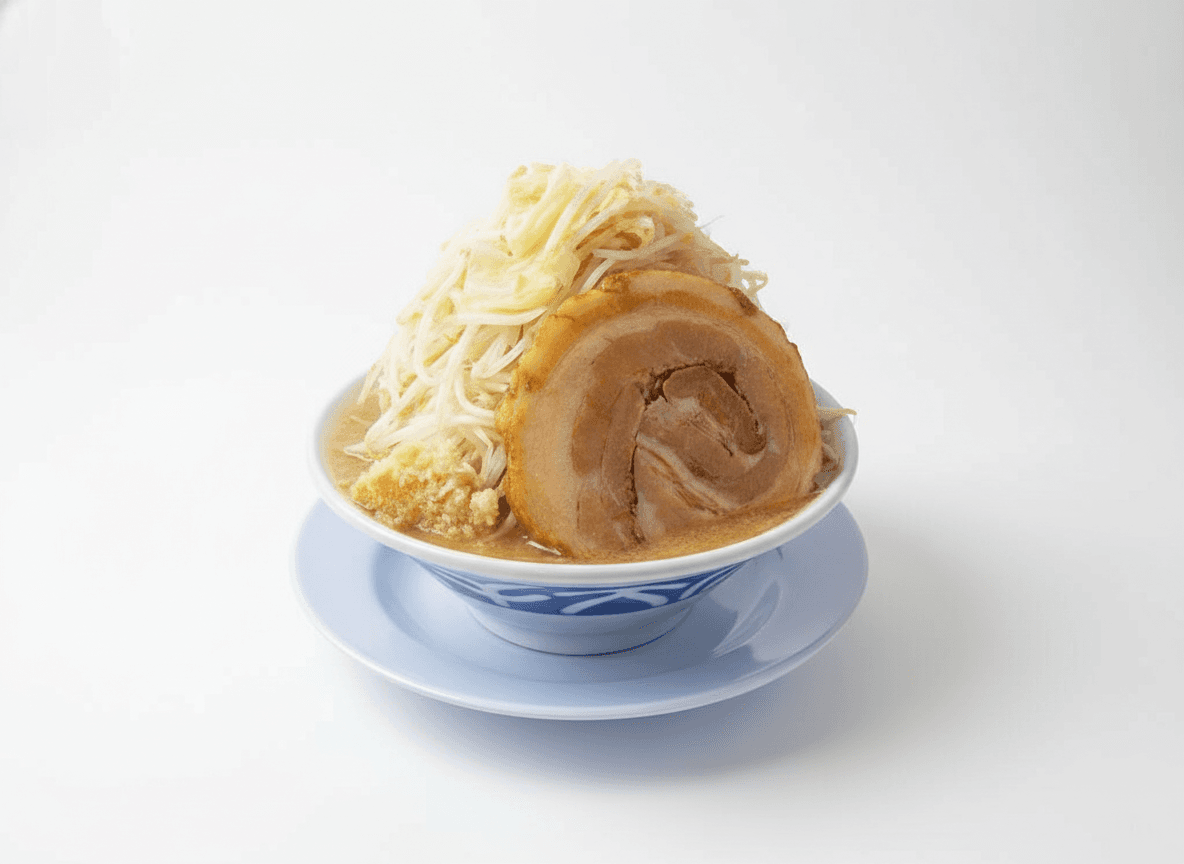
The Jiro-Style 'Blunt-Force' Tonkotsu
家二郎·(ie-jirō)
Chapter 3 — The Bowls: Composed Assembly
There is a specific kind of beautiful madness in dedicating three days to a single bowl of soup. This is not the delicate, translucent broth of a refined Tokyo shio; this is a blunt-force instrument of pork fat, alkaline chew, and raw garlic meant to unapologetically punch you in the mouth. It demands a violent, rolling boil to shatter and emulsify trotters and back fat into a milky-white suspension, a deeply fermented soy tare where all the seasoning actually lives, and low-hydration noodles engineered with alkaline salts just to survive the bath. For the cook willing to submit to the long, exacting rhythm of the ramen shop, this is exactly what 11 p.m. in Little Tokyo tastes like.
Before you start
Bake the baking soda for exactly one hour at 350°F on a foil-lined tray.
This thermal reaction drives off water and carbon dioxide, converting mild sodium bicarbonate into highly caustic, alkaline sodium carbonate, which gives ramen noodles their essential snap.
Simmer the soy sauce, mirin, water, brown sugar, and MSG until completely dissolved, then cool.
In ramen-shop grammar, the broth is an unseasoned canvas of texture; the intense salinity and umami live entirely here in this concentrated tare.
Boil the cold eggs for exactly 6 minutes and 30 seconds, plunge into an ice bath, peel, and submerge in diluted tare.
Dilute a half-cup of your prepared tare with a half-cup of water. The eggs require a strict 12-hour soak in the refrigerator to achieve the perfect gelled bullseye-yolk.
Ingredients
- baking soda1/2 cup
- koikuchi soy sauce2 cup
- mirin1/2 cup
- water1/4 cup
- brown sugar2 tbsp
- MSG2 tbsp
- eggs4 large
- pork trotters2 lb
- pork neck bones3 lb
- pork back fat1 lb
- pork belly block2 lb
- garlic1 med head
- onion1 med
- ginger2 oz
- bread flour500 g
- salt5 g
- water175 g
- cabbage1 med head
- bean sprouts1 lb
- garlic16 med clove
- cornstarch1/4 cup
Method
- 01
Cover the trotters and neck bones with cold water, bring to a rapid boil for 15 minutes, then drain and vigorously scrub every bone under cold running water.
This initial blanch is non-negotiable. Skipping it traps coagulated blood and marrow impurities that will sour and ruin the final broth; the bones must be pristine.
- 02
Return the clean bones to the pot with the back fat, pork belly, and five liters of water, and maintain a violent, rolling boil.
Do not simmer. The violent kinetic agitation is what shatters the rendering fat, allowing the gelatin from the trotters to permanently suspend it into an opaque, milky-white emulsion.
- 03
Remove the tender pork belly after two hours of boiling and submerge it directly into the undiluted cold tare to marinate.
The pork bleeds its meaty juices into the tare while absorbing the dark soy profile. Chill the meat completely overnight; attempting to warm-slice the chashu will cause it to shred into an unpresentable mess.
- 04
Boil the remaining bones and fat for another 6 to 8 hours, topping off with boiling water hourly, and add the halved garlic head, onion, and ginger in the final hour.
Scoop out the rendered blocks of back fat, chop them finely, mix with three tablespoons of tare, and reserve for topping. Strain the finished milky-white broth and discard the spent bones.
- 05
Dissolve five grams of the baked baking soda and the salt in the warm water, mix into the bread flour until shaggy, then aggressively knead and pass through a pasta machine.
The 35 percent hydration dough will look like dry pebbles initially. Only through repeated sheeting and laminating will the stiff gluten network align into smooth, dense noodles, which you will cut into thick strands and dust with cornstarch.
- 06
Blanch the roughly chopped cabbage in boiling water for 90 seconds, adding the bean sprouts for the last 30 seconds, then drain.
The vegetable mountain must remain crisp to provide vital structural and textual contrast against the aggressive fat of the tonkotsu.
- 07
Pour a ladle of boiling unseasoned broth over three tablespoons of tare in a warmed bowl, fold in the boiled noodles, fanned cold-sliced chashu, and halved egg.
Crown the center with a massive pile of the warm blanched vegetables, spoon the hot, seasoned back fat directly over the peak, and finish with a large spoonful of raw minced garlic at the base. Serve immediately.
Notes
Handle the baked baking soda with extreme care.
Once baked, sodium bicarbonate becomes caustic sodium carbonate. Avoid touching it with wet bare hands or inhaling the fine dust.
Pair with a crisp, cold Japanese lager.
The intense, emulsified volume of a Jiro bowl demands an ice-cold beer to repeatedly cut the fat and reset the palate.