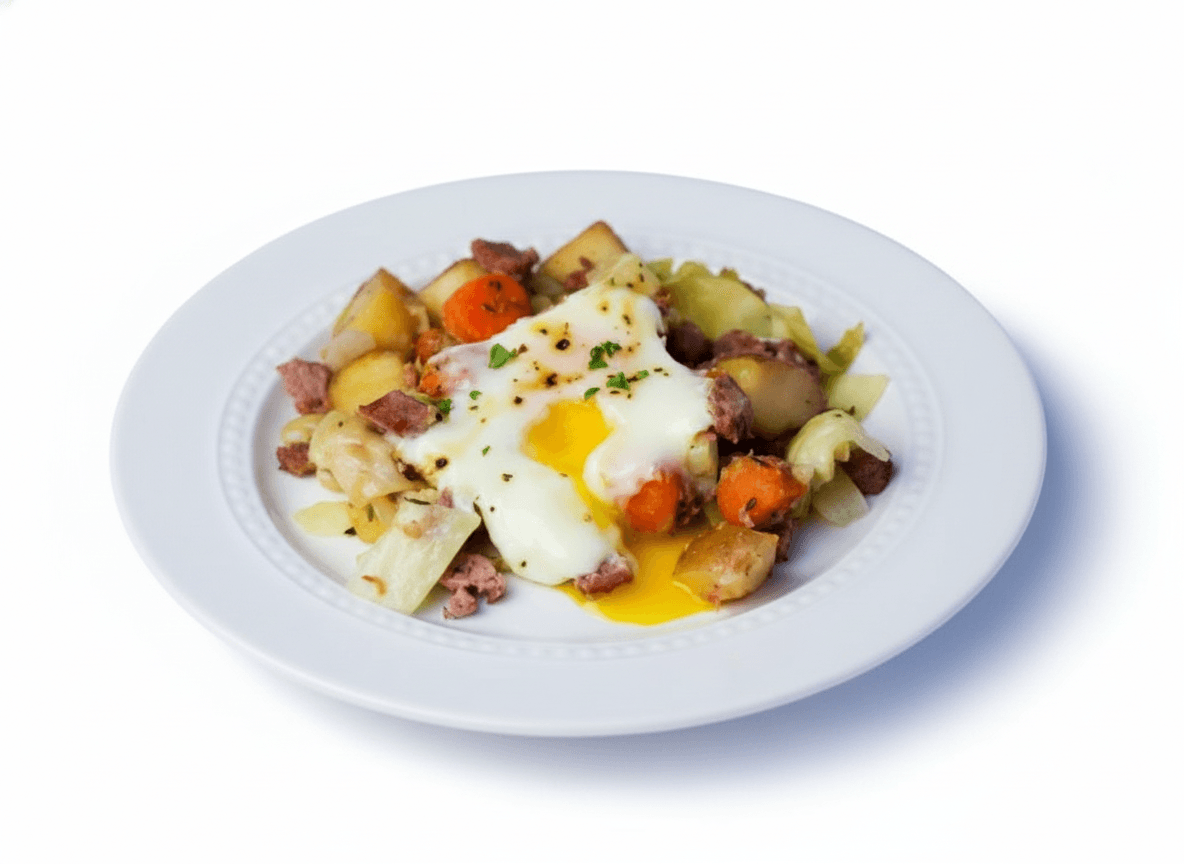
The Diaspora Hash
Mairteoil Shaillte agus Prátaí·(MAR-tyol HAL-chuh ah-gus PRAW-tee)
The New York Crucible (Corned Beef and the Irish-American Synthesis)
If there’s a dish that tells the story of the Irish in America, it is not the boiled Sunday dinner itself, but what happens in the cast-iron skillet the morning after. Born in the tenements of New York, where Irish immigrants discovered Jewish kosher butchers curing brisket exactly like the salted pork of their homeland, this hash is a masterpiece of survival and cultural synthesis. This isn’t the mushy paste from a wartime tin—it is towering, violently crispy, and fiercely comforting, relying on absolute simplicity and the iron discipline to leave it alone while the crust builds.
Before you start
Pre-cook the potatoes.
Raw potatoes will turn into a steaming, sticky mess. If you don't have leftover boiled potatoes from last night's dinner, boil whole or diced potatoes in salted water until just fork-tender. Drain them and let them dry completely—moisture is the absolute enemy of a good crust.
Ingredients
- Russet or Yukon Gold potatoes3 cup
- corned beef brisket2 cup
- yellow onion1 large
- Irish salted butter4 tbsp
- neutral vegetable oil1 tbsp
- black pepper1/2 tsp
- large eggs4 large
- fresh parsley2 tbsp
Method
- 01
Sweat the alliums.
Place a large, heavy skillet—preferably a 12-inch cast iron—over medium-high heat and add the butter and oil. Once the butter is foaming, toss in the onion and sauté for 3 to 4 minutes until translucent but not browned.
- 02
Coat the hash.
Dump the completely dry, diced potatoes and cubed corned beef into the skillet, then sprinkle aggressively with black pepper. Toss everything briefly with a wooden spoon so the potatoes and meat are thoroughly coated in the shimmering onion-butter fat.
- 03
Press it down and walk away.
Using a heavy spatula, press the mixture down firmly into an even, flat layer across the bottom of the skillet, then drop the heat slightly to medium. Now, step away and do not touch, stir, or nudge the hash for 5 to 6 minutes while the Maillard reaction builds a thick, golden crust.
- 04
Flip and repeat.
Slide your spatula under a section of the hash and flip it over; it should be deeply browned and crispy. Repeat around the pan, flipping in large sections, press it down flat again, and let it cook completely undisturbed for another 5 minutes.
- 05
Steam the eggs.
Once the hash is crispy on multiple sides, use the back of a spoon to make four small wells in the mixture and crack an egg directly into each. Cover the skillet with a lid, drop the heat to medium-low, and let the eggs steam for 4 to 6 minutes until the whites set but the yolks remain runny.
- 06
Garnish and serve.
Pull the skillet from the heat, scatter fresh parsley over the top, and serve immediately straight from the cast iron.
Notes
The rule of non-interference.
The single greatest error a home cook makes is stirring the hash. It takes nerve to let it sit in a hot pan for six solid minutes, but that is exactly how the grandmothers built the crust.
A warning on cabbage.
If you want to include leftover cabbage from a Sunday boiled dinner, squeeze it entirely dry in a clean kitchen towel before adding it to the skillet. Cabbage holds a tremendous amount of water and will steam your potatoes into mush.
Hold the salt.
Corned beef is inherently salty from the brining process, and Irish butter brings its own sodium. Wait to taste the finished hash before adding any extra salt.
From Cook Irish-American Food.