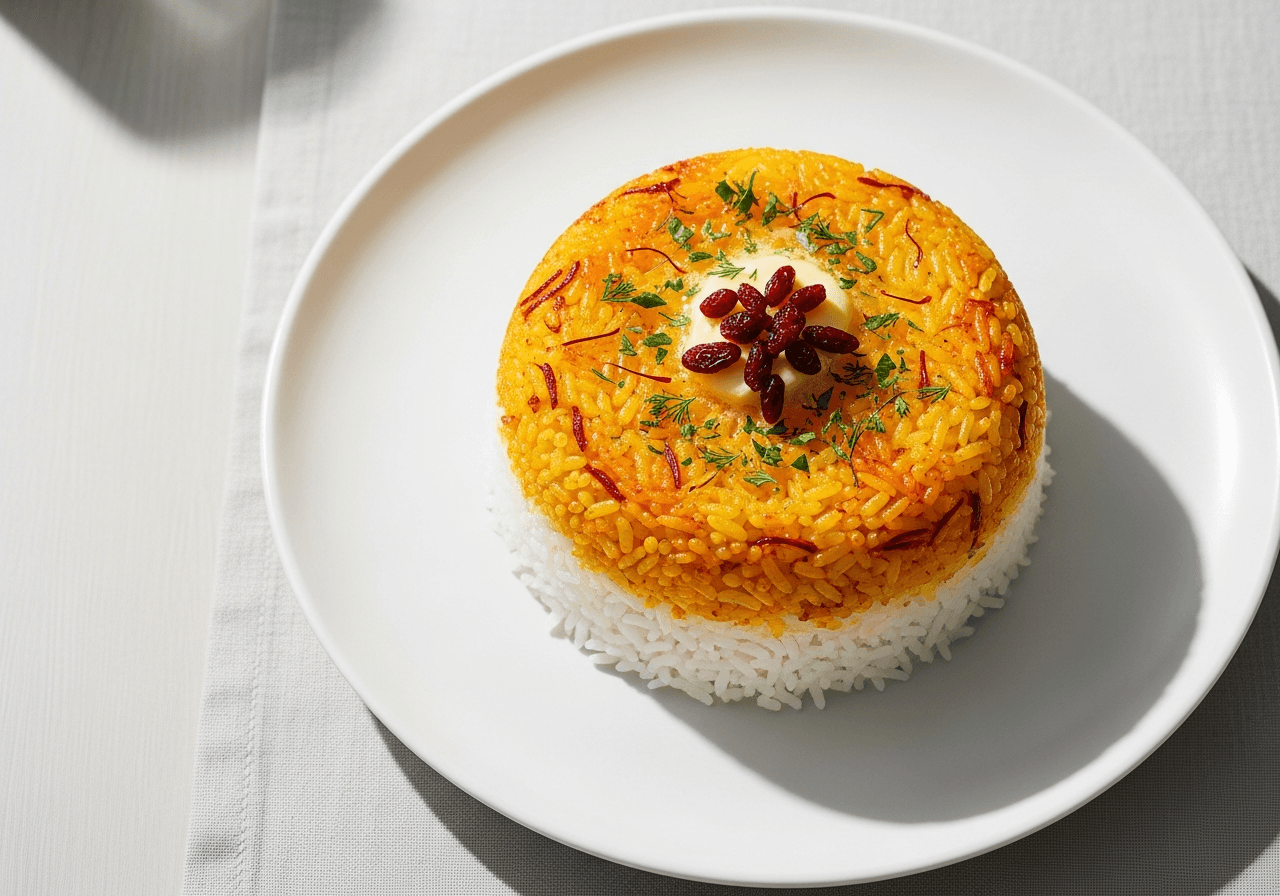
The 30-Minute Weeknight Kateh
کته زعفرانی·(ka-teh za-fe-ra-ni)
Berenj & Tahdig (The Sacred Art of Persian Rice)
While restaurants obsess over the elaborate, multi-day pageant of Chelo, the grandmothers of the lush, rain-swept Caspian coast quietly turn to Kateh to feed their families on a Tuesday night. It is the unspoken hero of the Persian kitchen—a sticky, comforting, fiercely flavorful one-pot method that skips the colander entirely. By stealing a little of the par-cooked rice and mixing it with bloomed saffron for the bottom layer, the home cook achieves a shatteringly crisp, restaurant-worthy tahdig with half the effort and all the authenticity.
Before you start
Wash the rice thoroughly.
Place the rice in a medium bowl, cover with cold water, swirl vigorously, and drain the cloudy starch away. Repeat three to four times until the water runs mostly clear. This is the uncompromising difference between a fluffy, cohesive mound and a solid brick of starch.
Bloom the saffron.
Grind the saffron threads into a fine powder—a tiny pinch of sugar in a mortar helps act as an abrasive. Steep in the hot, but not boiling, water until it yields a neon-crimson liquid.
Ingredients
- white Basmati rice3 cup
- cold water4 1/2 cup
- kosher salt1 1/2 tsp
- unsalted butter4 tbsp
- neutral oil2 tbsp
- premium saffron threads1/4 tsp
- hot water2 tbsp
- plain whole milk yogurt2 tbsp
Method
- 01
Bring the rice to a rapid boil.
In a four-quart non-stick pot, combine the washed rice, cold water, salt, and two tablespoons of the butter. Place over medium-high heat, stirring gently just once or twice to distribute the fat without breaking the delicate grains.
- 02
Let it bubble uncovered until steam craters form.
Cook until almost all the water is absorbed into the rice and the surface looks like a pockmarked lunar landscape. This takes about 10 to 15 minutes.
- 03
Build the tahdig foundation.
Turn off the heat momentarily. Transfer about a cup and a half of the al-dente, par-cooked rice into a separate bowl and mix it thoroughly with the bloomed saffron, the remaining two tablespoons of melted butter, the neutral oil, and the yogurt. Press this vibrant yellow mixture firmly and evenly into the bottom of the empty non-stick pot.
- 04
Mound the remaining rice and vent.
Gently scoop the remaining white rice on top of the packed saffron layer, shaping it into a slight pyramid pulled away from the walls of the pot. Use the handle of a wooden spoon to poke four or five holes straight down through the rice to the bottom, allowing steam to escape.
- 05
Wrap the lid and walk away.
Wrap the lid of your pot securely in a clean kitchen towel to catch condensation. Cover the pot tightly. Turn the heat to medium-high for three minutes to jumpstart the crust, then drop to the lowest possible setting and let it steam uninterrupted for 45 to 60 minutes.
- 06
Invert and reveal the crust.
Remove the pot from the heat. Dip the hot bottom briefly in a sink containing an inch of cold water to shock and loosen the tahdig. Remove the towel-wrapped lid, place a platter upside down over the pot, and swiftly flip the whole thing over so the rice drops out like a golden cake.
Notes
The thirty minute promise applies strictly to your active time in the kitchen.
The steaming phase requires 45 to 60 minutes of uninterrupted, low heat to forge the tahdig. Use this time to prepare a stew, bathe the kids, or simply pour yourself a drink.
Do not skip the towel.
Known as a damkoni, the towel absorbs the condensation that gathers on the lid. Without it, water drops back onto the rice, ruining both the texture of the grain and the crispness of your crust.
From Saffron in the Suburbs.