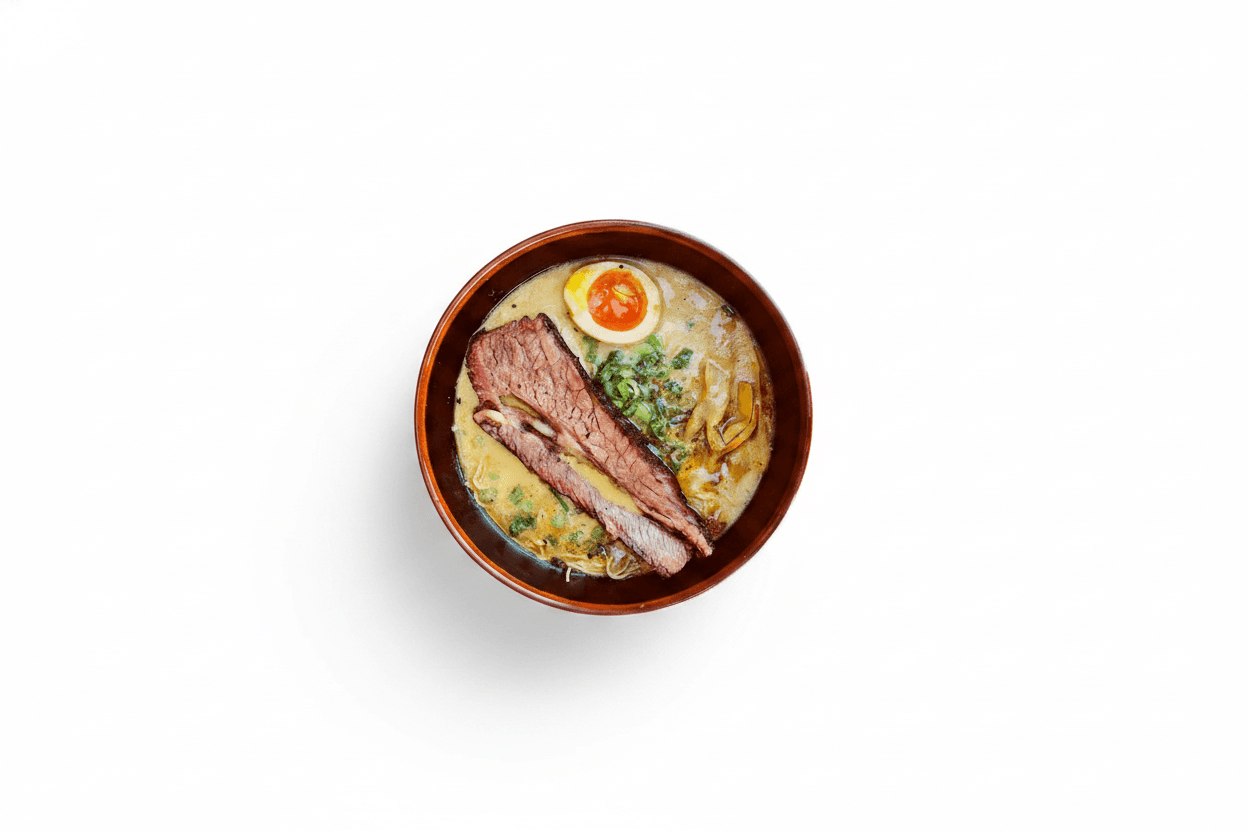
Texas Smoked Brisket Tsukemen
つけ麺·(tsu-ke-men)
Chapter 3 — The Bowls: Composed Assembly
This is not a Tuesday night dinner. It is a profound homage to the cooks manning heavy steel stockpots in the back alleys of Tokyo and the smokehouses of Lockhart. True flavor is built through deliberate extraction and an unapologetic respect for the rules. We're taking the heavy, peppery bark of Central Texas smoked brisket and forcing it to play by the strict, uncompromising grammar of an eighteen-hour Japanese ramen shop. It is an obsessive weekend project of violent emulsions, alkaline chemistry, and layered tare. And when you finally drag a cold, snappy noodle through that smoky, milky-white broth, you'll know exactly why you surrendered your weekend.
Before you start
Bake the baking soda to convert it to an alkaline salt.
Spread 1/2 cup standard baking soda evenly on a foil-lined baking sheet and bake at 350°F for exactly 1 hour. It converts to caustic sodium carbonate. Let cool and store in an airtight jar.
Steep the tare ingredients overnight.
Combine 1 cup Japanese soy sauce, 1/4 cup mirin, the kombu piece, and the cleaned niboshi in a jar. Let steep in the fridge for 24 hours prior to simmering.
Chill the brisket completely.
The smoked brisket must be completely chilled in the refrigerator overnight. Never slice warm brisket for this bowl, or it will disintegrate into pulled beef.
Ingredients
- pork trotters3 lb
- pork neck bones3 lb
- beef marrow bones2 lb
- onion1 large
- heads garlic2 large
- knob ginger1 large
- Japanese soy sauce1 cup
- mirin1/4 cup
- kombu1 piece
- niboshi1/2 cup
- brown sugar2 tbsp
- baking soda1/2 cup
- bread flour475 g
- tapioca starch25 g
- warm water200 g
- baked baking soda7 1/2 g
- sea salt7 1/2 g
- eggs4 large
- water1/2 cup
- soy sauce1/2 cup
- mirin1/4 cup
- white vinegar1 splash
- Texas smoked brisket1 lb
- lime1 med
- chili crisp2 tbsp
Method
- 01
Execute the essential blanch on the bones.
Place the pork trotters, neck bones, and beef marrow bones in a massive stockpot and cover with cold water. Bring to a rapid boil and let it boil violently for 10 minutes to expel coagulated blood and impurities, then dump the entire contents of the pot into a clean sink.
- 02
Scrub every single bone clean.
Under cold running water, scrub away the black marrow lines from the spines and any remaining blood. This obsessive cleaning is the difference between a foul, muddy soup and a profound ramen shop broth.
- 03
Shatter the fat into a violent emulsion.
Return the pristine bones to a clean stockpot with exactly 6 qt of fresh water. Bring to a rolling boil and maintain this violent agitation—do not reduce to a simmer—for 18 hours. This mechanical blending suspends the fat into the collagen. Replenish with boiling water every hour to keep bones submerged, dropping in the onion, garlic, and ginger at hour 12.
- 04
Strain the milky-white tonkotsu.
At hour 18, the broth should be thick, opaque, and milky-white. Strain through a fine-mesh chinois, pressing the remaining matter with a ladle. Store in the fridge overnight until it sets into a dense rubber-like gelatin.
- 05
Concentrate the seasoning vector.
Pour the steeped tare liquid into a saucepan and bring to a very gentle simmer. Hold at 176°F for 10 minutes—do not let it boil, or the kombu turns bitter. Strain out the solids and whisk in the brown sugar until dissolved.
- 06
Hydrate the alkaline noodle dough.
Dissolve 7 1/2 g of your baked baking soda and the sea salt into 200 g of warm water. With a stand mixer running on low, slowly drizzle the alkaline water into the bread flour and tapioca starch until it resembles coarse, dry sand. Form into a tight ball and rest for 1 hour.
- 07
Laminate and cut the noodles.
Pass the dough through a pasta sheeter on the widest setting. Fold it in half and pass it through again, repeating this lamination 5 times until incredibly smooth. Roll to a thick setting and cut into extra-thick Gokubuto strands, dusting heavily with cornstarch before refrigerating.
- 08
Chase the bullseye yolk.
Plunge 4 cold eggs directly into boiling water with a splash of vinegar for exactly 6 minutes and 30 seconds. Immediately transfer to an ice bath to shock. Peel and submerge in the marinade of water, soy sauce, and mirin for exactly 12 hours.
- 09
Cold-slice the brisket.
Using a sharp carving knife, cut the fully chilled smoked brisket into perfect, 1/4-inch thick rectangular slabs.
- 10
Boil and wash the noodles.
Drop the fresh noodles into a massive pot of unsalted boiling water for 5 to 6 minutes. Drain and immediately rinse them vigorously under cold running water to stop the cooking and lock in the dense, snappy alkaline texture.
- 11
Compose the dipping broth.
Heat 3 cups of the solidified tonkotsu-gyukotsu gelatin in a saucepan until it returns to a rolling boil. In a heated serving bowl, pour 3 tablespoons of the tare and ladle in 1 1/2 cups of the boiling broth. Drop in a few small cubes of cold brisket to warm through.
- 12
Build the final plate.
Fold the cold, washed noodles elegantly on a separate plate. Fan the cold-sliced Texas brisket against the noodles and place a cleanly halved marinated egg alongside. Serve with a lime wedge and chili crisp.
Notes
Do not salt the broth pot.
The home cook will be tempted to season the simmering liquid. Seasoning lives in the tare, not the broth. The broth exists purely for texture and unseasoned meat essence. Salt the tare heavily; leave the broth alone.
Clarity is the enemy.
This is a paitan broth. If you simmer gently for clarity, you have failed. The rolling boil must be violent enough to mechanically emulsify the fat and marrow into a milky-white suspension.
Handle baked baking soda with care.
Thermal degradation creates sodium carbonate, which is a caustic skin irritant. Do not handle it with wet hands.