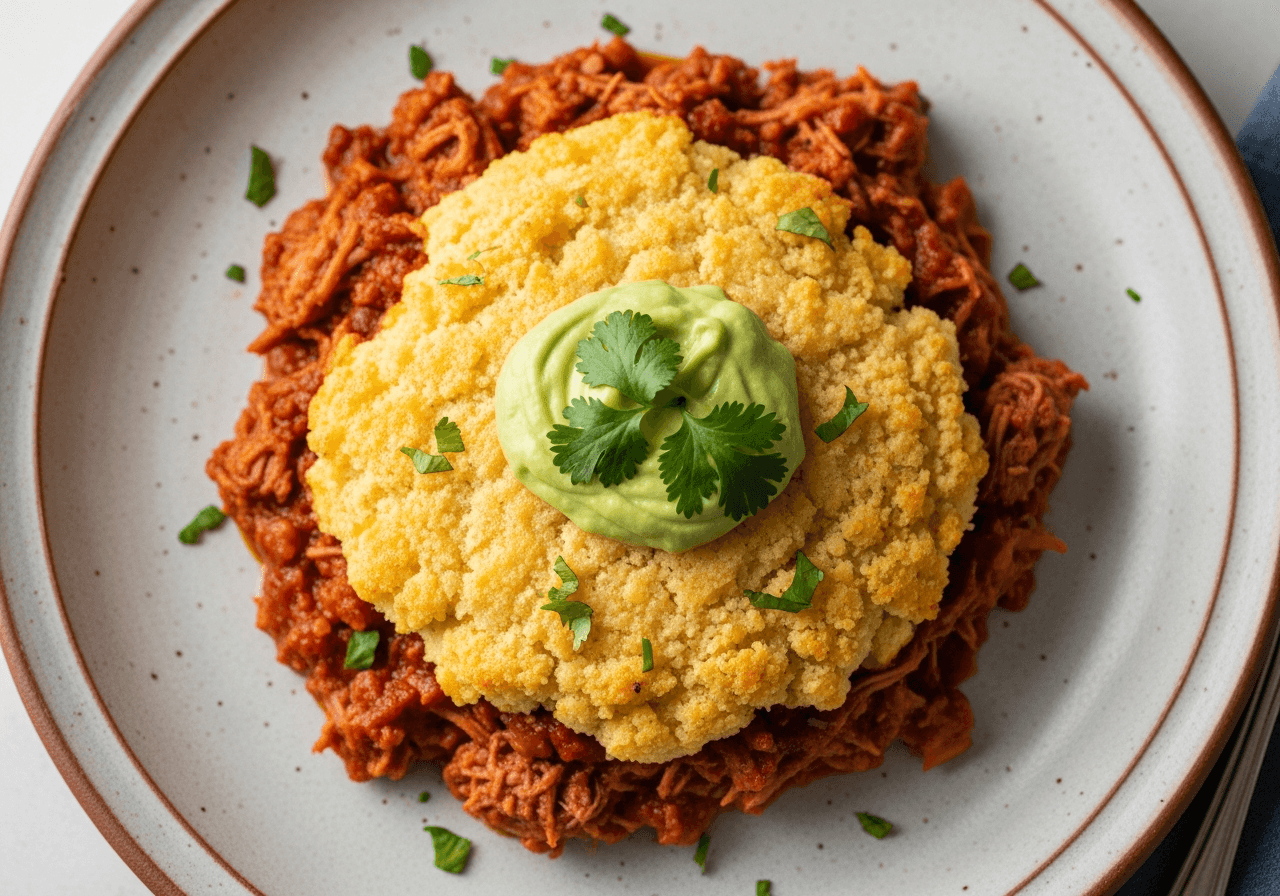
Tejano-Style Tamale Casserole
Tamal de Cazuela Estilo Tejano·(tah-MAHL deh cah-SWEH-lah es-TEE-loh teh-HAH-noh)
La Tamalada: The Sacred Rituals of Holiday Gatherings
Growing up, the tamalada was a sacred, all-day ritual where an army of relatives hovered over massive pots, spreading masa onto hundreds of corn husks. But on a random Tuesday in the suburbs, you don't have six hours. The Tamal de Cazuela is the ancestral answer to the weeknight dinner—not that gritty, sweet cornbread shortcut found on mainstream food blogs, but real, authentic nixtamalized masa, whipped with lard and layered with rich, spiced meat. The absolute secret to making this taste exactly like the homeland is the grandmother's float test: whipping the fat until it's so aerated that a pinch of dough bobs in water. That simple science is the difference between a dense brick and the fluffy, steamy tamal of your childhood memories.
Before you start
Soak the corn husks.
Submerge the dried corn husks in a bowl of very hot water for 10 minutes to soften. Shake off the excess water before using.
Preheat the oven.
Preheat the oven to 400°F (200°C) before beginning the guisado.
Ingredients
- pork lard1 cup
- masa harina2 cup
- baking powder1 1/2 tsp
- fine sea salt1 tsp
- chicken broth2 1/2 cup
- neutral oil1 tbsp
- white onion1 med
- garlic3 med clove
- ground beef1 lb
- chili powder1 tbsp
- ground cumin1 tsp
- red enchilada sauce15 oz
- diced green chiles4 oz
- Oaxaca cheese1 cup
- dried corn husks6 large
Method
- 01
Build the streamlined guisado.
Heat the oil in a skillet over medium-high heat. Sauté the onions and garlic until translucent, about 3 minutes. Add the ground beef, chili powder, and cumin, cooking until heavily fragrant and browned. Pour in the enchilada sauce and diced green chiles. Let it simmer rapidly for 5 minutes until it thickens into a rich, tight stew, then remove from heat and stir in half the cheese.
- 02
Whip the lard to aerate the masa.
In a large bowl, use an electric hand mixer to beat the room-temperature lard on medium-high speed for 3 to 5 minutes. Do not skip this. The lard must transition from dense and greasy to light, fluffy, and almost like white buttercream frosting.
- 03
Hydrate the masa harina.
In a separate bowl, whisk together the masa harina, baking powder, and salt. Add half of this dry mixture into the whipped lard, beating on low speed. Gradually pour in the warm broth, alternating with the remaining dry masa, until the dough comes together with the texture of thick, spreadable hummus.
- 04
Perform the infallible float test.
Pinch off a half-teaspoon of the masa and drop it into a cup of cold water. If it bobs to the surface, you have achieved perfection. If it sinks, add another tablespoon of broth, beat for one more minute on high speed to whip in more air, and test again. Trust the float test; it is the true science of the Mexican grandmother.
- 05
Assemble the cazuela.
Line the bottom and sides of a 9x13-inch baking dish or large cast-iron skillet with the softened corn husks. Spread exactly half of the masa mixture evenly across the bottom. Pour the warm meat filling evenly over the top, then spoon the remaining masa in dollops and gently spread it out to seal the edges. Top with the remaining cheese.
- 06
Cover tightly and steam-bake.
Lay any extra corn husks over the top of the casserole, then cover the entire dish tightly with aluminum foil to trap the moisture. Bake covered for 25 minutes to allow the masa to steam. Remove the foil and top husks, then bake uncovered for a final 5 to 10 minutes until the edges are golden brown and the cheese is bubbling. Let rest for 10 minutes before slicing.
Notes
Adjust your salt based on the broth.
Masa requires significantly more salt than a standard dough because steaming dulls the perception of saltiness. If using unsalted broth, increase the added salt by at least a half teaspoon.
Trust your eyes for hydration.
Masa harina acts like a sponge and humidity varies by kitchen. If the masa feels like wet sand rather than creamy peanut butter, keep adding warm broth a quarter-cup at a time until the mixture is highly spreadable.
Do not skip the corn husk lining if you can help it.
While the casserole format saves wrapping time, laying a few wet corn husks on the bottom of the dish physically alters the flavor, infusing the masa with the woodsy, sweet aroma of field corn that tricks the palate into registering an authentic tamal.