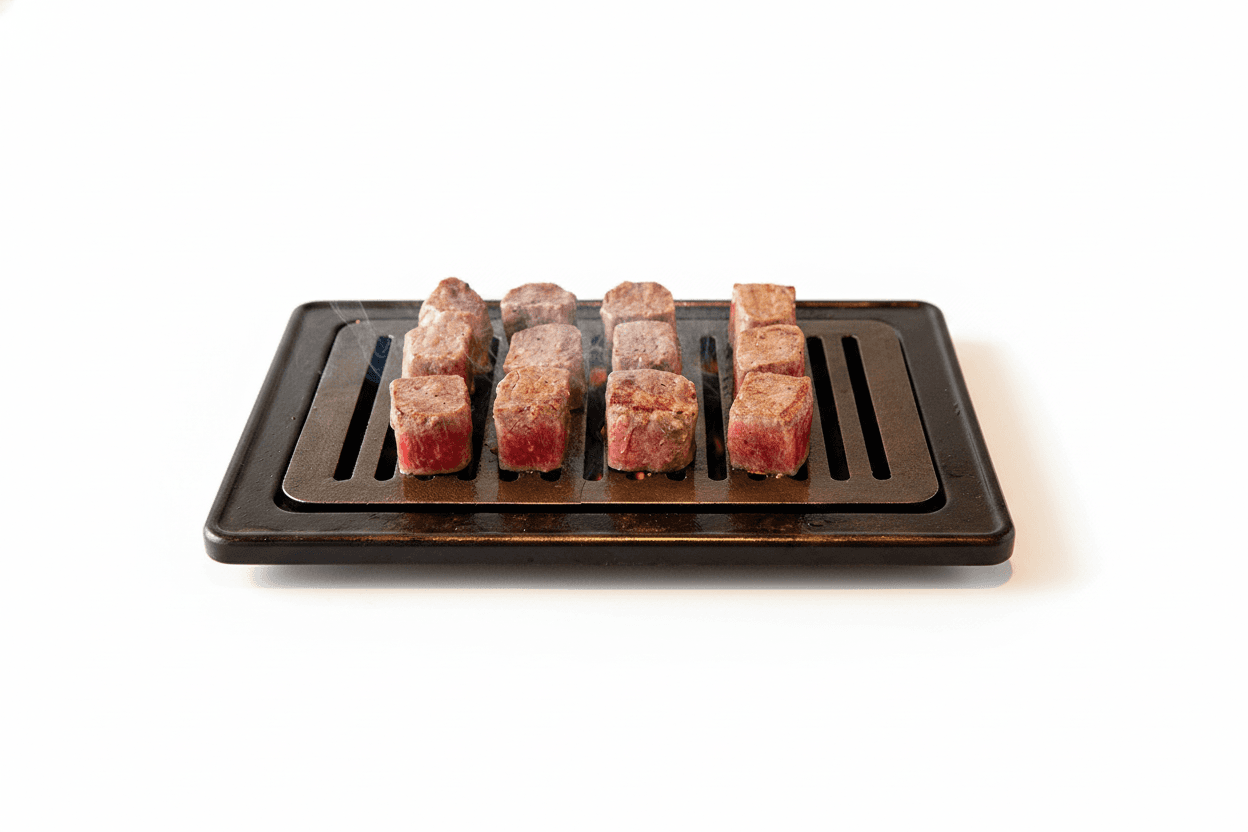
Tabletop Yakiniku
おうち焼肉·(ōchi yakiniku)
Weekend Teppan & Hot Pots
This isn't the neon-lit, sugar-soaked barbecue of Americanized steakhouses. This is what Japanese families actually cook on a weeknight. No smoke-filled kitchens, no over-complicated marinades masking subpar meat. It’s about the primal, communal joy of searing unadorned cuts on a hot plate and plunging them into a bright, savory tare sweetened with grated apple. The secret is the exact temperature—keep the griddle at 400°F to get a flawless crust without smoking out your dining room. Squeeze the life out of your bean sprouts, take your time, and let the raw ingredients speak for themselves.
Before you start
Freeze the meat slightly before slicing.
Mainstream supermarkets rarely slice meat thinly enough for yakiniku. If buying whole cuts, place the meat in the freezer for 45 minutes until firm, then shave it into 1/4-inch slices with your sharpest knife.
Arrange the raw ingredients on platters.
Provide each diner with a pair of cooking tongs or dedicated cooking chopsticks to avoid cross-contamination with the raw meat.
Ingredients
- boneless beef short rib1 lb
- beef skirt steak1/2 lb
- uncured pork belly1/2 lb
- Kabocha squash1 small
- sweet onion1 large
- green bell peppers2 med
- shiitake mushrooms1 pack
- Japanese soy sauce1/2 cup
- mirin1/4 cup
- sake1/4 cup
- brown sugar2 tbsp
- Fuji apple1/4 med
- yellow onion1/4 med
- garlic clove3 1/2 med
- fresh ginger1 tsp
- toasted sesame oil4 tbsp
- toasted white sesame seeds2 tbsp
- scallions1 cup
- granulated chicken bouillon2 tsp
- fine sea salt1/2 tsp
- black pepper1/2 tsp
- fresh lemon juice1/2 tsp
- mung bean sprouts12 oz
- kosher salt1/2 tsp
- steamed short-grain Japanese rice4 cup
Method
- 01
Make the Apple-Soy Tare.
In a small saucepan, combine the soy sauce, mirin, sake, brown sugar, grated apple, grated onion, 2 grated garlic cloves, and fresh ginger. Bring to a gentle boil over medium heat for 2 to 3 minutes to cook off the alcohol and soften the onion's bite. Remove from heat, stir in 1 tablespoon of sesame oil and 1 tablespoon of sesame seeds, and let cool.
- 02
Mix the Negi-Shio Dare.
In a small bowl, vigorously stir together the minced scallions, 2 tablespoons of sesame oil, 1 teaspoon of chicken bouillon, sea salt, black pepper, lemon juice, and a half clove of grated garlic. Let it sit for 15 minutes so the salt draws out the natural juices and softens the scallions into a relish.
- 03
Prepare the Moyashi Namul.
Microwave the bean sprouts in a loosely covered bowl on high for 3 minutes until just tender but still crunchy. Rinse briefly with cold water in a colander, then squeeze them firmly with your hands to extract as much water as possible. Toss the dry sprouts with 1 tablespoon of sesame oil, 1 teaspoon of chicken bouillon, 1 grated garlic clove, kosher salt, and 1 tablespoon of sesame seeds.
- 04
Preheat the griddle to exactly 400°F.
This is the golden rule of indoor yakiniku. It triggers the Maillard reaction for a perfect crust but stays below the point where animal fat vaporizes into thick smoke. Let the empty pan heat up for a full 5 minutes before cooking.
- 05
Grill the meats and vegetables.
Don't overcrowd the pan; stick to a few slices at a time. Sear the beef for 30 to 45 seconds per side, dip straight into the Apple-Soy Tare, and eat over steamed rice. Cook the pork belly until crisp, then top with a spoonful of the Negi-Shio sauce. Let the vegetables roast slowly in the corners to absorb the meat drippings.
Notes
Grate the apple.
This classic grandmother's trick adds a gentle, fruity sweetness that sugar alone cannot replicate, while naturally thickening the tare so it clings to the meat.
Do not skip squeezing the bean sprouts.
If you don't wring the excess water out of the blanched sprouts, your namul will end up a soggy, diluted mess.
Source the right bouillon.
Granulated chicken bouillon, known as torigara soup in Japanese markets, provides a cleaner umami than Western chicken stock cubes. Knorr chicken bouillon powder works well as an alternative.
From Cook Japanese in America.