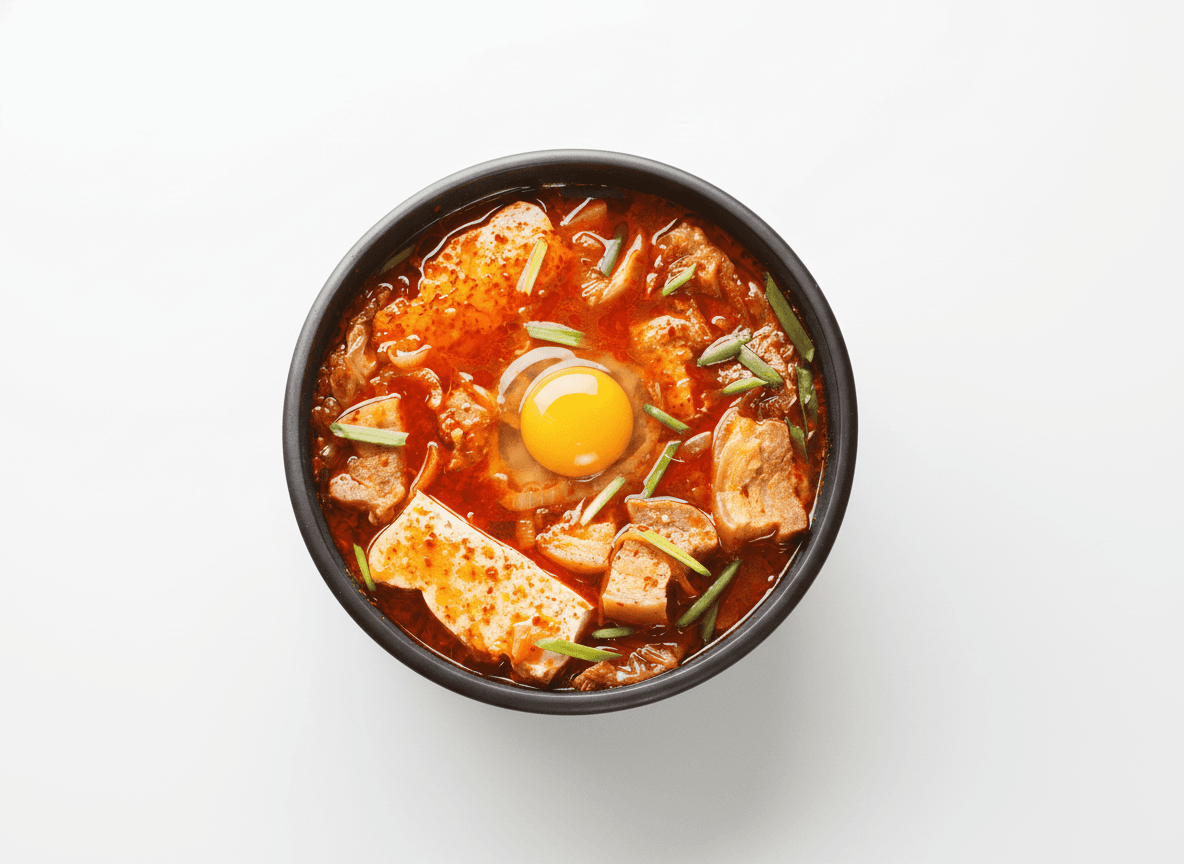
Sundubu-jjigae
순두부찌개·(soon-doo-boo-jee-gae)
The Everyday Babsang
To the first-generation kids of the diaspora, the roaring, violent bubbling of an earthenware pot hitting the table means one thing: comfort. It is the ultimate taste of home—a fiercely red stew yielding trembling clouds of custardy tofu. But to get that profound depth on a weeknight without it tasting like spicy dishwater, you have to respect the old-school mechanisms: drain the excess liquid from your tofu before it hits the broth, and bloom a rich, pork-fat chili oil directly in the bottom of the pot. Unfussy, unapologetic, and strictly canonical.
Before you start
Drain the tofu to preserve the broth.
Slice the plastic tube of tofu perfectly in half through the middle. Gently squeeze the two halves out onto a fine-mesh strainer set over a bowl, sprinkle with a tiny pinch of coarse salt, and let it drain for 10 to 15 minutes. This is the grandmother's secret to preventing the coagulant liquid from watering down your stew.
Steep the mushrooms for a quick stock.
Pour the boiling water over the dried shiitake mushrooms and let them steep while you prepare the rest of the ingredients.
Ingredients
- extra-soft Korean tofu11 oz
- coarse salt1 pinch
- dried shiitake mushrooms2 med
- water1 1/2 cup
- toasted sesame oil1 tbsp
- neutral cooking oil1 tbsp
- scallions1/4 cup
- ground pork3 oz
- garlic3 clove
- gochugaru2 tbsp
- zucchini1/2 med
- yellow onion1/4 med
- guk-ganjang1 tbsp
- saeujeot1 tsp
- manila clams6 large
- jalapeno1 med
- egg1 large
Method
- 01
Build the aromatic foundation.
Place a Korean earthenware pot (ttukbaegi) or a heavy-bottomed small saucepan over medium heat. Add the sesame oil, neutral oil, chopped white scallions, minced garlic, and ground pork, sautéing for 3 to 4 minutes until the pork loses its pink color and the fat begins to render.
- 02
Bloom the chili oil.
Turn the heat down to low, add the gochugaru to the pork and fat, and stir constantly for exactly one minute. The chili flakes will absorb the fat and turn the oil a brilliant, fiery red—do not walk away, as gochugaru burns easily and turns bitter.
- 03
Form the broth and bring to a boil.
Remove and slice the soaked shiitake mushrooms. Pour the soaking water into the pot (leaving any grit behind at the bottom of the bowl), turn the heat to medium-high, and bring to a boil. Add the sliced zucchini, yellow onion, and the sliced mushrooms.
- 04
Season the stew and add the seafood.
Season the broth with the guk-ganjang and saeujeot—it should taste slightly too salty at this stage, which will balance perfectly once the unseasoned tofu is added. Drop in the scrubbed clams and boil for 3 to 4 minutes until the shells pop open.
- 05
Introduce the tofu.
Gently slide the drained soft tofu into the vigorously boiling stew, using your spoon to carefully cleave it into three or four large, jiggly chunks. Let it boil for two more minutes so the tofu absorbs the chili broth without being stirred into a scrambled mess.
- 06
Apply the final flourishes.
Remove the pot from the heat. Immediately top with the sliced jalapeno and reserved green scallion tops, and crack the raw egg directly into the center of the bubbling stew right before serving.
Notes
The tofu paradox.
American supermarkets often sell 'Soft Tofu' in water-filled plastic tubs. This has been curdled and pressed lightly; it will not yield the velvety, melt-in-the-mouth texture required for this dish. If uncurdled tubes of sundubu are unavailable, you must buy aseptic boxes labeled explicitly as 'Silken' (like Mori-Nu brand).
Substituting specialized pantry ingredients.
If you do not have guk-ganjang (Korean soup soy sauce), mimic its sharp salinity and umami by blending 2 teaspoons of fish sauce with 1 teaspoon of regular soy sauce. If saeujeot (salted fermented shrimp) is unavailable, substitute an extra splash of high-quality fish sauce.
Managing heat retention without an earthenware pot.
The traditional ttukbaegi retains heat so efficiently that it coddles the raw egg at the table. If you are using a standard Western stainless steel saucepan, let the egg cook for 30 to 45 seconds on the stove before removing it from the heat.
From Cook Korean in America.