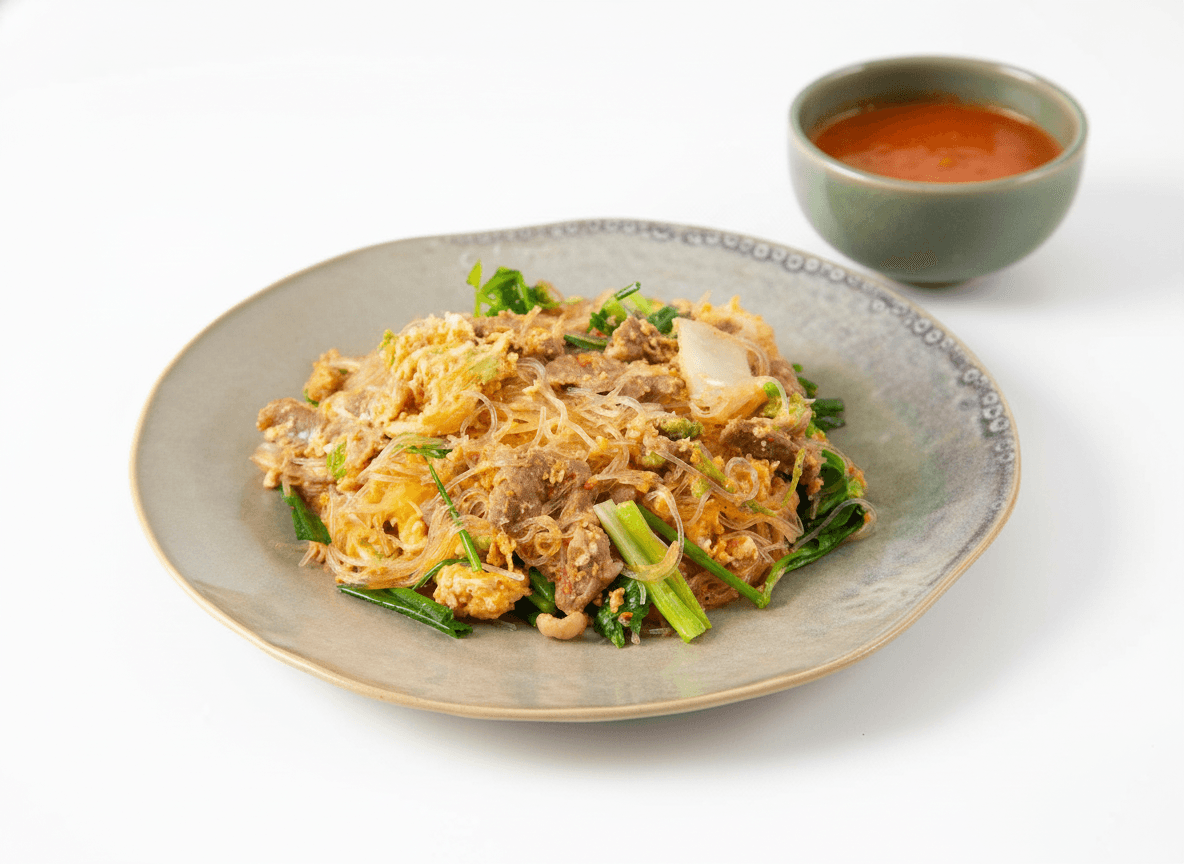
Suki Haeng
สุกี้แห้ง·(su-ki haeng)
Midnight Mama: Thai Dorm Food & 2 AM Nostalgia
Before it was a stir-fry, Suki was a communal hot pot simmering on the chaotic streets of Bangkok. But for tired students and late-night cooks, waiting around a boiling pot doesn't cut it. Enter Suki Haeng—the dry version. This is the ultimate, fridge-clearing dorm food. The secret that bridges the gap between a sad bowl of noodles and a vibrant, street-cart meal is an unapologetic, umami-bomb sauce powered by red fermented bean curd. It lives in a jar in your local Asian market, lasts forever, and takes you straight back to a midnight kitchen in Thailand. Velvet the pork, hit it with a screaming hot wok, and let the glass noodles soak up all that beautiful damage.
Before you start
Blend the Nam Jim Suki sauce.
In a blender or food processor, combine the fermented bean curd and its liquid, peeled garlic cloves, pickled garlic juice, Sriracha, white vinegar, 1 tablespoon sugar, 1 tablespoon sesame oil, and fresh chilies. Blend until completely smooth and vibrant pink, then stir in the sesame seeds.
Velvet the pork.
In a bowl, combine the sliced pork with the oyster sauce, soy sauce, 1 teaspoon sesame oil, 1 teaspoon sugar, cornstarch, egg white, and baking soda. Massage the mixture into the meat with your hands until the liquid is entirely absorbed. Let it rest in the fridge for at least 15 minutes.
Hydrate the glass noodles.
Submerge the dried glass noodles in a large bowl of warm tap water for 10 minutes until pliable. Drain well and snip them once or twice with kitchen shears so they don't turn into an unmanageable tangle in the wok.
Ingredients
- red fermented bean curd3 small
- garlic3 small
- pickled garlic juice2 tbsp
- Thai Sriracha2 tbsp
- white vinegar1 tbsp
- sugar1 tbsp
- sesame oil1 tbsp
- toasted white sesame seeds1 tbsp
- Thai bird's eye chilies2 small
- pork loin or shoulder8 oz
- oyster sauce1 tbsp
- light soy sauce1 tsp
- sesame oil1 tsp
- sugar1 tsp
- cornstarch1 tbsp
- egg white1 large
- baking soda1/8 tsp
- dried glass noodles2 oz
- neutral oil2 tbsp
- garlic2 small
- egg1 large
- napa cabbage1 cup
- baby bok choy or spinach1/2 cup
- celery1 med
Method
- 01
Sear the pork in a screaming hot wok.
Heat a wok or large non-stick skillet over medium-high heat with the neutral oil. Toss in the smashed garlic for 10 seconds, then add the velveted pork. Let it sear undisturbed for 30 seconds, then toss until about 80 percent cooked.
- 02
Scramble the eggs into the mix.
Push the pork to one side of the pan. Crack the whole egg and the reserved yolk into the empty space. Scramble quickly with your spatula until just set, then fold it into the pork.
- 03
Add the crunchy vegetables.
Toss in the napa cabbage and celery. Stir-fry for 30 seconds until the vegetables turn bright and begin to release a little moisture.
- 04
Toss with the noodles and sauce.
Add the drained glass noodles and 3 to 4 tablespoons of your homemade Suki Sauce. Toss vigorously. The noodles will immediately begin absorbing the sauce and vegetable juices.
- 05
Adjust the moisture and wilt the greens.
If the pan looks dry and the noodles are still stiff, splash in a tablespoon of water. Keep tossing until the noodles are soft, glossy, and coated in red. Stir in the bok choy or spinach at the very last second just to wilt, then slide onto a plate immediately.
Notes
Embrace the baking soda.
Do not skip the baking soda in the pork marinade. This chemical tenderization process, known as Moo Nhoom, alters the meat's pH and creates the impossibly velvety texture found on the streets of Bangkok.
Keep extra sauce on hand.
The homemade Nam Jim Suki yields enough for multiple portions and keeps in the fridge for weeks. Serve an extra spoonful on the side for dipping.
From Cook Thai in America.