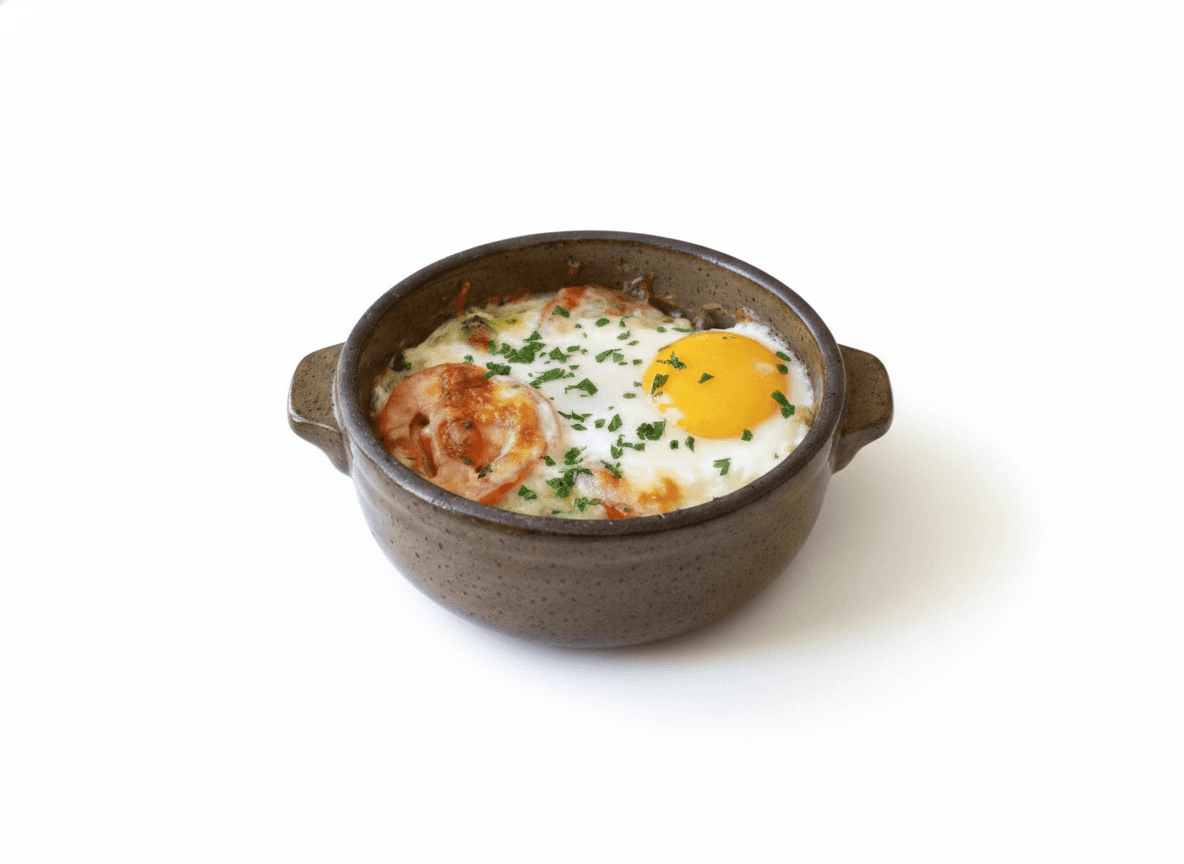
Skillet Sirene po Shopski
Сирене по шопски на тиган·(si-re-ne po shop-ski na ti-gan)
Mish-Mash & The 15-Minute Skillet
If you grew up in a Bulgarian-American household, the smell of melting butter, hot tomatoes, and the piney, earthy scent of chubritsa means only one thing: someone is making dinner the right way, with zero fuss. Back in the homeland, Sirene po Shopski is painstakingly baked in individual earthenware pots called gyuvecheta. But for a busy weeknight in the States, a cast-iron skillet does the exact same magic in a fraction of the time. The secret isn't some complex culinary technique. It's buying a block of real sheep's milk feta in brine, tracking down a jar of summer savory, and knowing when to leave the pan alone. Just build the layers, crack the eggs, drop the lid, and let the steam do the work.
Before you start
Desalt the cheese if necessary.
If your feta tastes aggressively sharp and salty rather than creamy, submerge the slabs in a bowl of cold water for 30 minutes prior to cooking, then pat them thoroughly dry. This perfectly replicates the milder, higher-fat profile of authentic Bulgarian sirene.
Ingredients
- unsalted butter2 tbsp
- yellow onion1/2 med
- beefsteak tomato1 large
- sheep's milk feta in brine10 oz
- sweet bell pepper1 med
- jalapeno1 med
- dried summer savory1 tsp
- sweet paprika1/2 tsp
- eggs2 large
- fresh parsley1/4 cup
Method
- 01
Sauté the aromatics.
Place a medium cast-iron skillet over medium heat and melt the butter until foaming. Add the onions and cook for 2 to 3 minutes until they begin to soften.
- 02
Build the tomato foundation.
Lay the thick tomato slices over the onions in a single layer to form a bed. Let them fry gently for 2 minutes on one side, then flip. Season the tomatoes with half of the savory and all of the paprika. Do not add salt; the cheese brings enough to the party.
- 03
Layer the cheese and peppers.
Arrange the thick slabs of feta directly on top of the tomatoes. Scatter the sweet pepper rings over and around the cheese, nestle the hot pepper into the center, and sprinkle the remaining savory over the top.
- 04
Poach the eggs.
Use a spoon to create slight depressions in the mixture. Crack the eggs directly into these spaces.
- 05
Steam to finish.
Immediately place a tight-fitting lid on the skillet and reduce the heat to medium-low. Let it steam undisturbed for 5 to 7 minutes. The ambient steam trapped by the lid will melt the cheese into the tomato base and cook the egg whites while leaving the yolks gloriously runny.
- 06
Garnish and serve.
Remove the lid. The butter, tomato juices, and whey should be bubbling at the edges. Remove from the heat, garnish generously with fresh parsley and a crack of black pepper, and serve immediately straight from the hot skillet with crusty bread.
Notes
Resist the urge to stir.
The architectural integrity of the layers is critical. The tomatoes sit on the bottom to protect the cheese from burning, the cheese melts in the middle into a custard, and the egg steams on top. Stirring turns this into scrambled eggs.
The chubritsa mandate.
Summer savory (chubritsa) is the olfactory signature of the Shopluk region. If you absolutely cannot find it, substitute a blend of dried oregano and a pinch of thyme, but the real thing is a secret weapon worth keeping in your pantry.
Mountain style variation.
In the Pirin mountain town of Bansko, it is traditional to add cured pork to the pot. Replicate this by layering a few slices of dry-cured salami or smoked sausage over the tomatoes before adding the cheese.