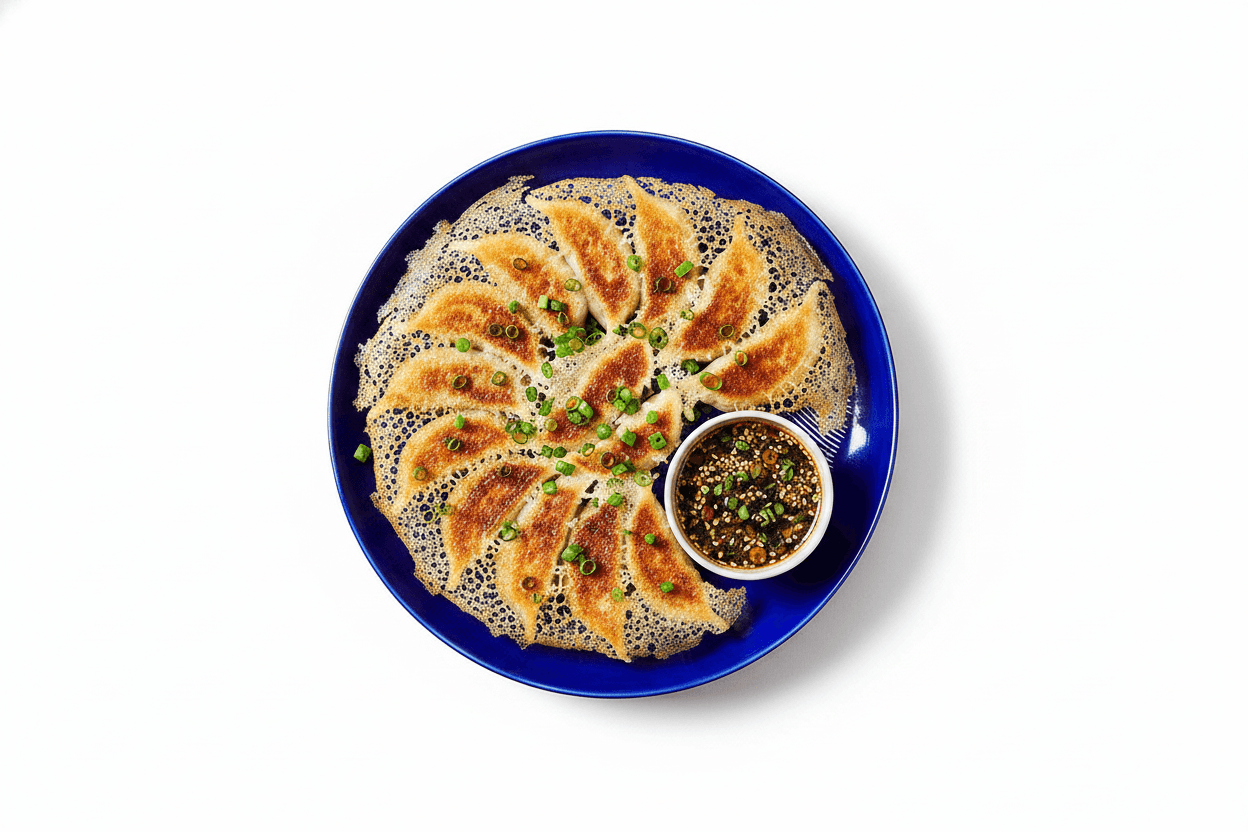
Schmaltz-Seared Hanetsuki Gyoza
羽根つき餃子·(hanetsuki gyōza)
Chapter 4 — Sides: The Ramen-Shop Counter Menu
A ramen shop side dish isn't an afterthought; it's a direct extension of the same obsession that built the broth. This winged gyoza—born in Kamata, bound by a shattering lattice of starch, and enriched with the very same rendered chicken fat that perfumes a proper shoyu ramen—demands that exact respect. We rigorously extract the meat's proteins to trap the fat, we drain the cabbage mercilessly, and we listen closely for the violent, high-pitched crackle of the sear. Don't cut corners here.
Before you start
Render the aromatic chicken fat.
Place the raw chicken skin and fat in a cold, wide skillet over medium-low heat. As it begins to pool, add the scallion greens and ginger slices. Maintain a gentle extraction for 15 to 20 minutes until the skins are deeply browned and the oil is a brilliant, clear gold. Strain through a fine-mesh sieve and let cool. This is your chiyu.
Draw the excess water from the cabbage.
Toss the minced cabbage with 1 teaspoon of kosher salt in a bowl and let sit for 20 minutes. Transfer to a clean kitchen towel and wring it out mercilessly. If you think you have squeezed out enough water, squeeze it again; excess moisture is the enemy of a proper pan sear.
Ingredients
- raw chicken skin and fat1 lb
- green onions2 med
- fresh ginger1 med
- fatty ground pork1 lb
- kosher salt1 1/2 tsp
- concentrated chicken stock3 tbsp
- chiyu2 tbsp
- soy sauce1 tbsp
- oyster sauce1 tbsp
- toasted sesame oil1 tsp
- fresh ginger1 tsp
- garlic clove1 small
- green cabbage3 cup
- kosher salt1 tsp
- nira1 cup
- thick gyoza wrappers40 large
- hot water150 ml
- all-purpose flour1 1/2 tsp
- potato starch1 1/2 tsp
- chiyu1 tbsp
- toasted sesame oil1 tsp
Method
- 01
Extract the proteins to engineer a sticky meat matrix.
In a cold bowl, combine the cold ground pork and 1 1/2 teaspoons of kosher salt. Knead vigorously with your hand for 3 to 5 minutes until the meat turns pale white, becomes incredibly sticky, and pulls away from the bowl in a cohesive, stringy mass. This step is non-negotiable for trapping the fat.
- 02
Emulsify the liquids and fold in the aromatics.
Incrementally beat the cold chicken stock into the meat, 1 tablespoon at a time. Add the 2 tablespoons of liquid chiyu, soy sauce, oyster sauce, 1 teaspoon sesame oil, grated ginger, and garlic, kneading until a glossy emulsion forms. Gently fold in the squeezed-dry cabbage and nira without over-mixing.
- 03
Rest the filling to solidify the fats.
Cover the bowl tightly with plastic wrap and refrigerate for at least 60 minutes. The fats must be solid so the mixture is firm, ensuring it won't bleed out and ruin the wrapper's seal.
- 04
Pleat and seal the gyoza.
Place a scant tablespoon of filling in the center of a wrapper. Wet the top semi-circle, fold in half, and pinch exactly at the top center. Create 3 to 4 pleats down each side, pressing firmly to seal, then press the bottom gently against your cutting board to create a flat seat for the sear.
- 05
Sear the dumplings in schmaltz.
Heat a heavy 10-inch skillet over medium-high heat and coat the bottom with 1 tablespoon of chiyu. Pack the gyoza tightly into the pan in a circular, interlocking sunflower pattern. Sear for 1 to 2 minutes until the bottoms turn pale golden.
- 06
Steam and fry the hanetsuki wing.
Whisk the hot water, flour, and potato starch vigorously, then pour the slurry evenly over the dumplings and immediately cover with a tight lid. Reduce heat to medium and steam for 4 to 5 minutes. Remove the lid, increase heat slightly, and listen closely; when the low boil transitions to an aggressive, high-pitched crackle, drizzle 1 teaspoon of sesame oil around the perimeter. Fry for 1 final minute, then confidently flip the pan over onto a plate to serve.
Notes
Source true potato starch, not cornstarch.
American cornstarch turns gummy or powdery when used for the wing slurry. Japanese katakuriko (potato starch) provides the essential, glass-like snap to the lattice.
Utilize chashu trim if you have it.
Since you are likely making the book's signature cold-sliced chashu, finely mince any end pieces and fold them into the gyoza filling alongside the raw pork for an incredible layer of braised, soy-heavy depth.
Use nira, not standard American chives.
Regular chives are too delicate. Nira (garlic chives) bring the pungent, sulfuric bite necessary to cut through the heavy pork and chicken fat.