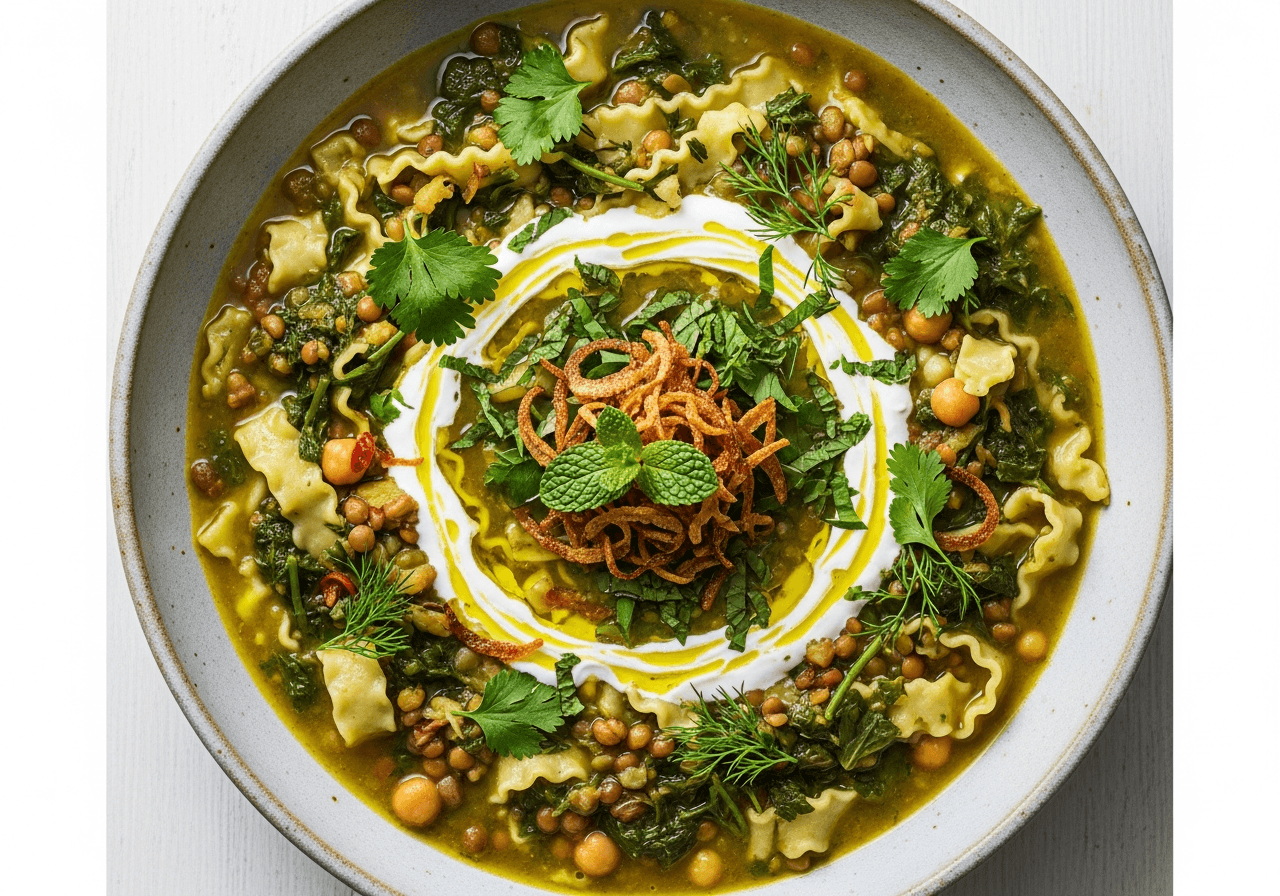
Quick Ash-e Reshteh (Persian Noodle and Herb Soup)
آش رشته·(ash-e resh-teh)
The Iranian-American Pantry & Prep (Setting the Sofreh)
In Iran, cooking Ash-e Reshteh is an event—a dish for fresh starts, New Year's celebrations, and bidding safe travels. But if you grew up in an American suburb, you might think you only get to eat this on holidays. Not true. Modern Iranian home cooks rely on high-quality canned beans and frozen herbs to pull this off on a random Tuesday. The secret to making it taste like a grandmother spent twenty-four hours over a hot stove isn't the beans. It’s the golden, turmeric-stained onions, the pungent hit of mint oil, and knowing to keep the damn lid off the pot so the herbs stay vibrant green.
Before you start
Rinse the canned beans relentlessly.
Do not skip this. The starchy, salty canning liquid will muddy the soup's bright color and ruin its texture.
Dissolve the flour completely.
Mix the tablespoon of flour into the cold water until it's completely smooth before adding it to the soup to avoid finding raw lumps of flour in your bowl.
Ingredients
- vegetable oil3 tbsp
- yellow onion1 large
- ground turmeric1 tsp
- black pepper1/2 tsp
- low-sodium vegetable or chicken broth6 cup
- dried green or brown lentils1/2 cup
- canned chickpeas15 oz
- canned kidney beans15 oz
- frozen chopped spinach1 lb
- fresh cilantro2 large bunch
- fresh flat-leaf parsley1 large bunch
- scallions1 large bunch
- dried dill2 tbsp
- neutral oil1/4 cup
- yellow onions2 large
- turmeric1/2 tsp
- garlic6 clove
- dried mint2 tbsp
- all-purpose flour1 tbsp
- Persian noodles (reshteh)5 oz
- liquid kashk1/2 cup
- saltto taste
Method
- 01
Build the broth's foundation.
Heat 3 tablespoons of vegetable oil in a large heavy-bottomed Dutch oven or soup pot over medium heat, add the diced onion, and sauté until softened and starting to brown. Stir in the 1 teaspoon of turmeric and the black pepper, cooking for 30 seconds until deeply fragrant.
- 02
Simmer the lentils.
Pour in the broth and the rinsed dried lentils. Bring to a boil, then drop the heat down to a steady simmer, cover, and cook for 20 minutes until the lentils are tender but still hold their shape.
- 03
Add the beans and greens.
Stir in the thoroughly rinsed chickpeas, kidney beans, frozen spinach, cilantro, parsley, scallions, and dried dill.
- 04
Apply the open-lid rule.
Bring the soup back to a gentle boil, but do not put the lid back on the pot. This is the grandmother trick: keeping the lid off lets volatile acids escape, ensuring your soup stays a vibrant green instead of turning a muddy, unappetizing brown. Simmer uncovered for 15 minutes.
- 05
Fry the flavor trinity.
While the soup simmers, heat a quarter cup of neutral oil in a large skillet over medium-high heat. Fry the thinly sliced onions, stirring occasionally, until they are deep golden brown and slightly crispy, about 15 minutes. Stir in the remaining half teaspoon of turmeric. Remove half of these onions and set them aside on a paper towel to use later as a garnish.
- 06
Bloom the garlic and mint.
To the remaining onions in the skillet, add the minced garlic and cook for 1 minute until fragrant. Turn the heat completely off. Wait 10 seconds, then stir in the dried mint—if you do this on active heat, the mint will burn instantly and turn bitter. Scrape this entire onion-garlic-mint mixture directly into your simmering soup pot.
- 07
Thicken and add noodles.
Stir the flour-water mixture into the soup, then drop in the broken noodles. Simmer, stirring occasionally to prevent the noodles from sticking to the bottom, for 10 to 12 minutes until al dente. The starch from the noodles and the flour will thicken the broth, creating that signature velvety texture.
- 08
Finish with kashk off the heat.
Turn off the heat entirely. Taste the broth before reaching for the salt shaker, as the noodles and kashk both bring plenty of their own. Ladle the soup into bowls, drizzle generous ribbons of liquid kashk over the top, crown with the reserved crispy onions, and serve.
Notes
Do not boil the kashk.
Kashk is highly susceptible to separating and curdling if exposed to extreme heat. Always add it off the heat or drizzle it directly into individual serving bowls at the table.
Ingredient sourcing.
Liquid kashk and reshteh (Persian noodles) are easily found at local Middle Eastern markets or online. In an absolute emergency, substitute dried linguine or udon for the noodles, and a mix of whole-milk Greek yogurt, sour cream, and a splash of lemon juice for the kashk.
From Saffron in the Suburbs.