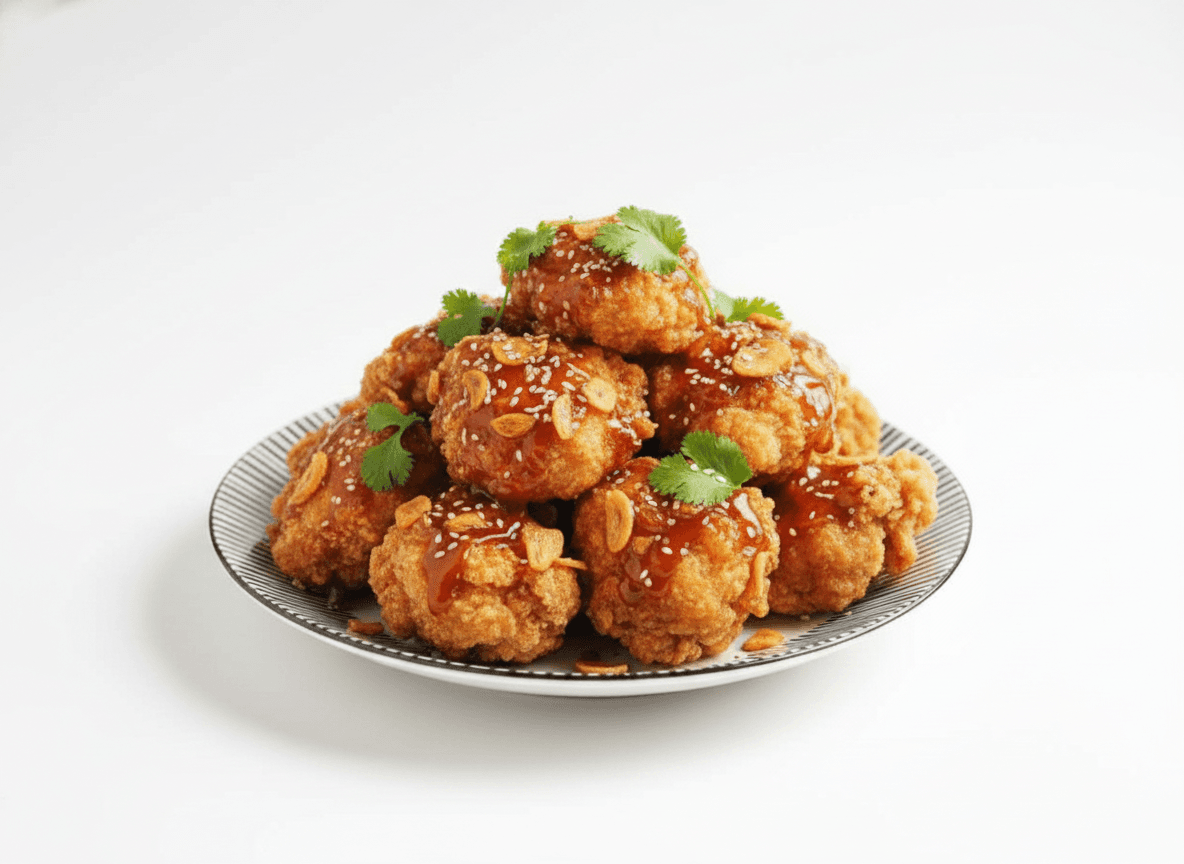
Potato-Starch Karaage with Toasted Garlic Caramel
唐揚げ·(kah-rah-ah-geh)
Chapter 4 — Sides: The Ramen-Shop Counter Menu
In the same way a proper tonkotsu broth demands an 18-hour rolling boil to physically force fat into suspension, a proper ramen-shop karaage is an exercise in physical chemistry. There are no shortcuts here. Do not remove the skin. Do not substitute flour for potato starch, and above all, do not skip the two-stage fry. The starch yields a jagged, glass-like lattice. The mandatory resting period gently cooks the meat without drying it out, while the final 400°F flash-fry obliterates surface moisture. It sets the crust so firmly that it withstands a toss in boiling, sticky toasted garlic caramel without instantly turning to mush.
Ingredients
- boneless skin-on chicken thighs1 1/2 lb
- Japanese soy sauce2 tbsp
- sake1 tbsp
- mirin1 tbsp
- toasted sesame oil1 tsp
- garlic3 med cloves
- fresh ginger1 med piece
- kosher salt1/2 tsp
- black pepper1/4 tsp
- potato starch1 1/2 cup
- neutral oil1 qt
- neutral oil2 tbsp
- garlic8 med cloves
- Japanese soy sauce1/4 cup
- mirin1/4 cup
- sake2 tbsp
- dark brown sugar3 tbsp
- rice vinegar1 tbsp
- Kewpie mayonnaise1/4 cup
- buttermilk1/4 cup
- fresh shiso leaves5 med leaves
- garlic powder1/2 tsp
- onion powder1/2 tsp
- black pepper1/4 tsp
Method
- 01
Massage the marinade into the meat.
In a large mixing bowl, combine the 2 tablespoons of soy sauce, 1 tablespoon sake, 1 tablespoon mirin, sesame oil, grated garlic, grated ginger, kosher salt, and 1/4 teaspoon black pepper. Add the chicken pieces and aggressively massage the liquid into the meat for 2 to 3 minutes until fully absorbed.
- 02
Rest the chicken for exactly 30 minutes at room temperature.
Do not leave it overnight. Prolonged osmotic pressure will draw moisture out of the muscle fibers, resulting in a tough chew.
- 03
Dredge in potato starch and hydrate the crust.
Pour the potato starch into a shallow tray. Scoop the starch over the marinated chicken, pressing firmly so it adheres to every crevice. Shake off the loose excess and place the pieces on a wire rack. Refrigerate for 30 minutes so the chicken's moisture gently hydrates the innermost layer of starch, gluing the crust to the meat.
- 04
Toast the minced garlic for the caramel.
In a small saucepan over medium-low heat, continuously stir the 2 tablespoons of neutral oil and the minced garlic. Toast until it hits a deep, golden-brown hue that smells intensely nutty. Do not let it burn.
- 05
Build and reduce the toasted garlic caramel.
Immediately halt the garlic's frying process by pouring in the 1/4 cup soy sauce, 1/4 cup mirin, 2 tablespoons sake, and dark brown sugar. Bring to a rapid boil over medium-high heat for 4 to 5 minutes until it reduces to a viscous, sticky syrup. Remove from heat and stir in the rice vinegar.
- 06
Execute the low-temperature first fry.
Heat 2 inches of neutral oil in a heavy-bottomed Dutch oven to 350°F. Lower half the chicken in, allowing the oil temperature to drop to 325°F. Fry undisturbed for 3 to 4 minutes. The crust will look pale and blonde—this is correct.
- 07
Remove the chicken and rest for exactly 3 minutes.
This is the secret of ramen-ya karaage. The residual surface heat conducts inward to perfectly cook the center, while internal moisture is driven outward to the crust.
- 08
Flash fry at 400°F to shatter the crust.
While the chicken rests, crank the heat until the oil reaches a violent 400°F. Drop the rested chicken back in for 60 to 90 seconds. The outward-migrating moisture instantly evaporates, leaving a blistered, shatteringly crisp crust.
- 09
Toss the hot karaage in the garlic caramel.
Reheat the caramel if needed. Place the piping-hot, twice-fried chicken into a large steel bowl, pour the hot caramel over it, and toss vigorously. The jagged ridges will catch the sticky molasses without turning soggy. Plate immediately.
- 10
Serve with optional Shiso Ranch.
Whisk the Kewpie mayonnaise, buttermilk, minced shiso, garlic powder, onion powder, and remaining 1/4 teaspoon black pepper. Serve alongside the chicken as the ultimate counterpoint to a bowl of tonkotsu.