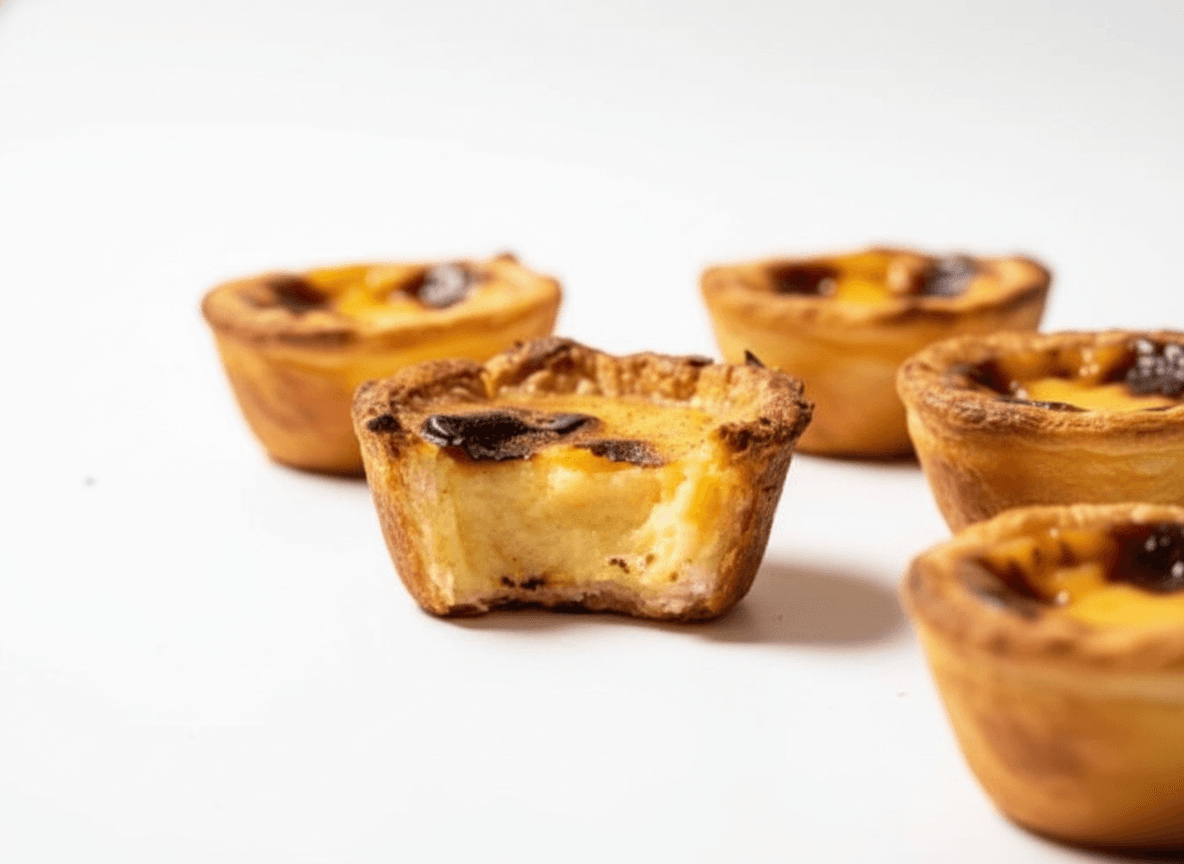
Pastéis de Nata
Pastéis de Nata·(pah-SHTEYZH de NAH-tah)
Despensa Luso-Americana
The monks at Lisbon’s Jerónimos Monastery were pragmatists. After using vats of egg whites to starch their habits, they took the leftover yolks and engineered a culinary masterpiece: a rich, scorch-topped custard sitting in a shattering, laminated crust. Making that dough from scratch is a beautiful weekend project, but a tired first-generation cook on a Tuesday night knows that a high-quality, all-butter puff pastry is a totally respectable shortcut. The true soul of the dish lies in the non-negotiable custard chemistry. By cooking a flour paste and hitting it with a screaming-hot cinnamon syrup, the eggs are armored against the blazing heat of the oven. Slam these into a maxed-out oven on a preheated pizza stone, and they'll emerge blistered, blackened, and tasting exactly like the cobbled streets of Belém.
Before you start
Prepare the dough log.
Unfold the cold puff pastry onto a lightly floured surface, roll it away from you into a very tight, compact cylinder, wrap it tightly in plastic wrap, and chill in the refrigerator for at least 30 minutes to harden the butter.
Preheat your oven and baking stone.
Place a baking steel or pizza stone on the upper-middle rack of your oven and preheat to its absolute maximum temperature (ideally 500°F to 550°F) with the convection fan on. Let it heat for at least 45 minutes.
Ingredients
- all-butter puff pastry14 oz
- cold water1 cup
- granulated sugar1 1/4 cup
- water150 ml
- cinnamon stick1 large
- lemon peel3 large
- all-purpose flour1/3 cup
- whole milk500 ml
- egg yolks6 large
- ground cinnamon1 tbsp
- powdered sugar1 tbsp
Method
- 01
Whisk the flour with a quarter cup of the cold milk until a completely smooth, lump-free slurry forms.
This is the crucial foundation that prevents the custard from splitting at extreme temperatures.
- 02
Bring the remaining milk to a gentle boil, then slowly whisk it into the flour slurry in a steady stream.
Pour this entire mixture back into the saucepan over medium-low heat. Whisk continuously for 3 to 5 minutes until it thickens into a heavy paste, cooking out the raw flour taste, then remove from heat.
- 03
Combine the sugar, water, cinnamon stick, and lemon peels in a small saucepan over medium-high heat.
Do not stir. Let it boil until it reaches 220°F (105°C) on a candy thermometer. If you lack a thermometer, let it boil for exactly 3 minutes after reaching a rolling boil.
- 04
Carefully remove the aromatics with tongs, then pour the boiling syrup into the thickened milk-flour mixture.
Pour in a slow, steady stream while whisking vigorously. The mixture will loosen up and become completely smooth. Let it cool for 10 minutes.
- 05
Whisk the beaten egg yolks into the slightly cooled custard until fully incorporated.
Strain the completed custard through a fine-mesh sieve into a jug with a spout to remove any stray lumps or scrambled egg bits.
- 06
Slice the chilled pastry log into 12 equal discs, about three-quarters of an inch thick.
Trim the uneven ends first to ensure perfectly even tarts.
- 07
Place one disc, cut-side down, into each well of an ungreased muffin tin and press into shape using wet thumbs.
Dip your thumbs into a bowl of cold water, press directly into the center of the spiral, and push the dough flat against the bottom. Gently massage it up the sides, creating a slight lip above the rim of the well.
- 08
Pour the strained custard into the pastry shells, filling them about three-quarters of the way to the top.
Do not overfill, or the custard will boil over and ruin the crispness of the pastry.
- 09
Place the muffin tin directly onto the preheated baking steel or stone and bake for 10 to 15 minutes.
Watch them closely. You are looking for a deeply puffed, golden-brown crust and fiercely bubbling custard that has developed dark, blistered spots.
- 10
Cool the tarts in the pan for 5 minutes before transferring them to a wire rack.
The domed custard will sink and settle as it cools. Serve warm with an espresso, offering guests ground cinnamon and powdered sugar to dust over the top.
Notes
Do not skip the baking stone or steel.
Standard American ovens don't reach the blistering temperatures of commercial Portuguese ovens. The preheated stone provides a massive blast of conductive heat necessary to shatteringly crisp the pastry bottoms before the custard overcooks.