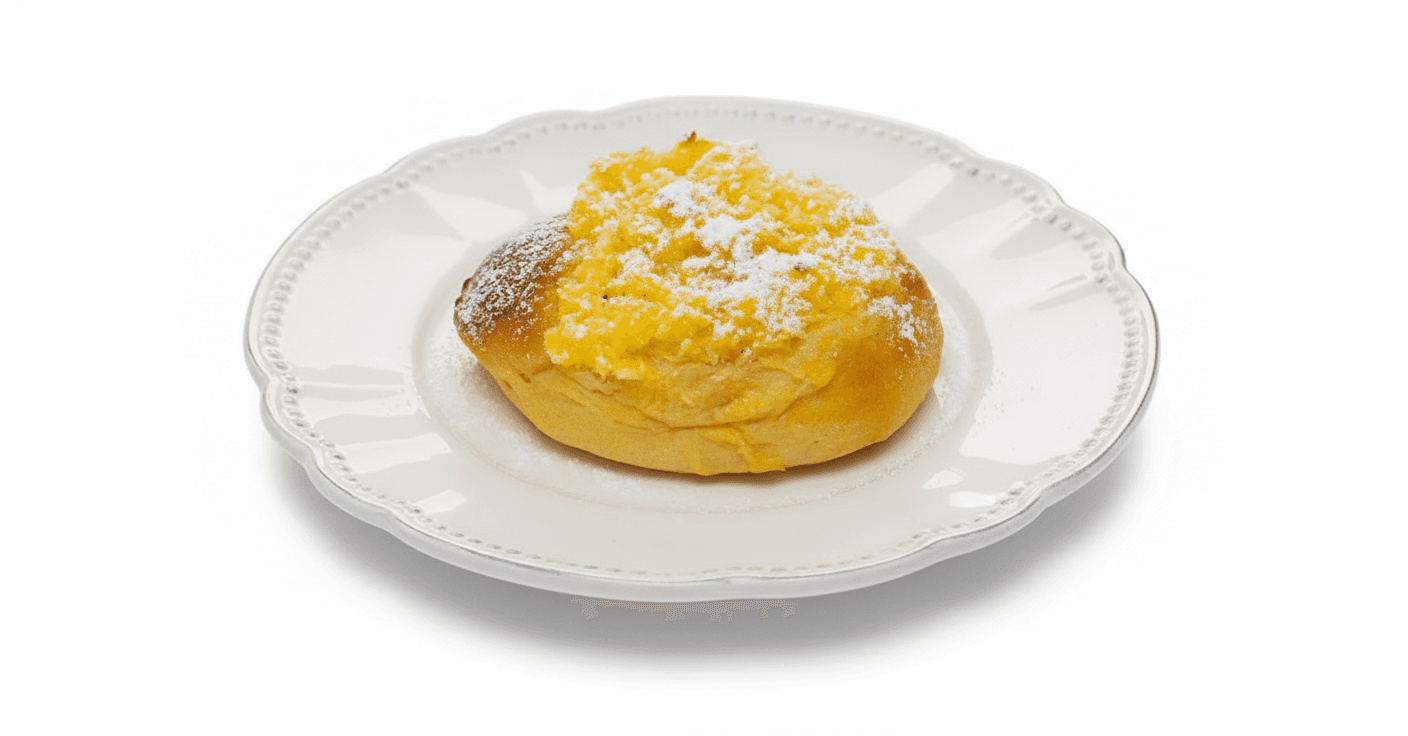
Pão de Deus
(pow de de-oosh)
A Pastelaria na Cozinha
If you grew up in a Portuguese-American home, the scent of toasted coconut and enriched dough baking is essentially a time machine. Born from the rubble of the 1755 Lisbon earthquake as a humble offering, the 'Bread of God' has evolved into the undisputed king of the corner pastelaria. Commercial bakeries now use a complex custard for the topping, but the old-world secret is a rustic, macaroon-like paste that cracks and toasts perfectly in the oven. You make the dough the night before to save your sanity on a weeknight. And if you want to eat it like a local, don't just eat it plain. Slice it open, add a slick of butter, and layer in savory ham and mild cheese to make a misto. The sweet-and-salty contrast will ruin you for anything else.
Ingredients
- unbleached all-purpose flour3 3/4 cup
- instant dry yeast2 1/4 tsp
- granulated sugar1/4 cup
- fine sea salt1 tsp
- lemon1/2 med
- whole milk1 cup
- egg1 large
- unsalted butter6 tbsp
- unsweetened desiccated coconut1 1/2 cup
- granulated sugar1/2 cup
- eggs2 large
- whole milk1 tbsp
- egg1 large
- whole milk1 tbsp
- powdered sugar2 tbsp
Method
- 01
Mix the shaggy dough.
In the bowl of a stand mixer fitted with the dough hook, combine the flour, instant yeast, 1/4 cup of sugar, salt, and lemon zest. Pour in the 1 cup of lukewarm milk and 1 room-temperature egg. Mix on low speed for 3 to 4 minutes until a rough dough forms and no dry spots of flour remain.
- 02
Develop the gluten and incorporate the fat.
Increase the mixer speed to medium-low and knead for 5 minutes. With the mixer still running, add the softened butter one cube at a time, waiting until each piece is incorporated before adding the next. Continue kneading for another 8 to 10 minutes until the dough pulls away from the sides, looks glossy, and can stretch thin without tearing.
- 03
Retard the dough overnight.
Transfer the dough to a lightly oiled bowl, cover it tightly, and place it in the refrigerator for at least 8 hours, and up to 24. This cold fermentation develops profound, old-world flavor while simultaneously chilling the butter so the sticky dough becomes effortlessly easy to shape.
- 04
Shape the cold buns.
Line a large baking sheet with parchment paper. Turn the cold dough out onto a clean work surface and divide it into 10 to 12 equal pieces. Roll each piece into a tight, smooth ball by cupping your hand over the dough and moving it in rapid circles against the counter. Space them 2 inches apart on the baking sheet.
- 05
Proof the dough.
Cover the buns loosely with a damp kitchen towel and let them rise in a warm spot until doubled in size and very puffy, about 1 1/2 to 2 hours.
- 06
Mix the traditional coconut paste.
Preheat your oven to 350°F. In a medium bowl, stir together the desiccated coconut, 1/2 cup of sugar, and 2 whole eggs. Mix until it forms a cohesive, moist paste. If it seems too dry or crumbly, stir in 1 tablespoon of milk.
- 07
Crown the buns and bake.
Whisk the final beaten egg with 1 tablespoon of milk and gently brush the mixture over the risen buns. Spoon a generous mound of the coconut paste onto the center of each bun, patting it down slightly so it stays put without deflating the dough. Bake for 18 to 22 minutes, until the buns are a rich golden brown and the coconut topping is beautifully toasted.
- 08
Cool and garnish.
Transfer the buns to a wire rack. Dust generously with powdered sugar while they are still slightly warm.
Notes
The Misto Secret
To eat this exactly like a local in Lisbon, slice the freshly baked bun in half, spread a thin layer of salted butter, and fill it with slices of savory ham and mild cheese like Edam. The sweet-salty contrast is the real point of this bread.
Sourcing the Coconut
Ensure you are using unsweetened, finely desiccated coconut from the baking aisle. The thick, heavily sweetened shreds used for American macaroons will burn and ruin the texture.