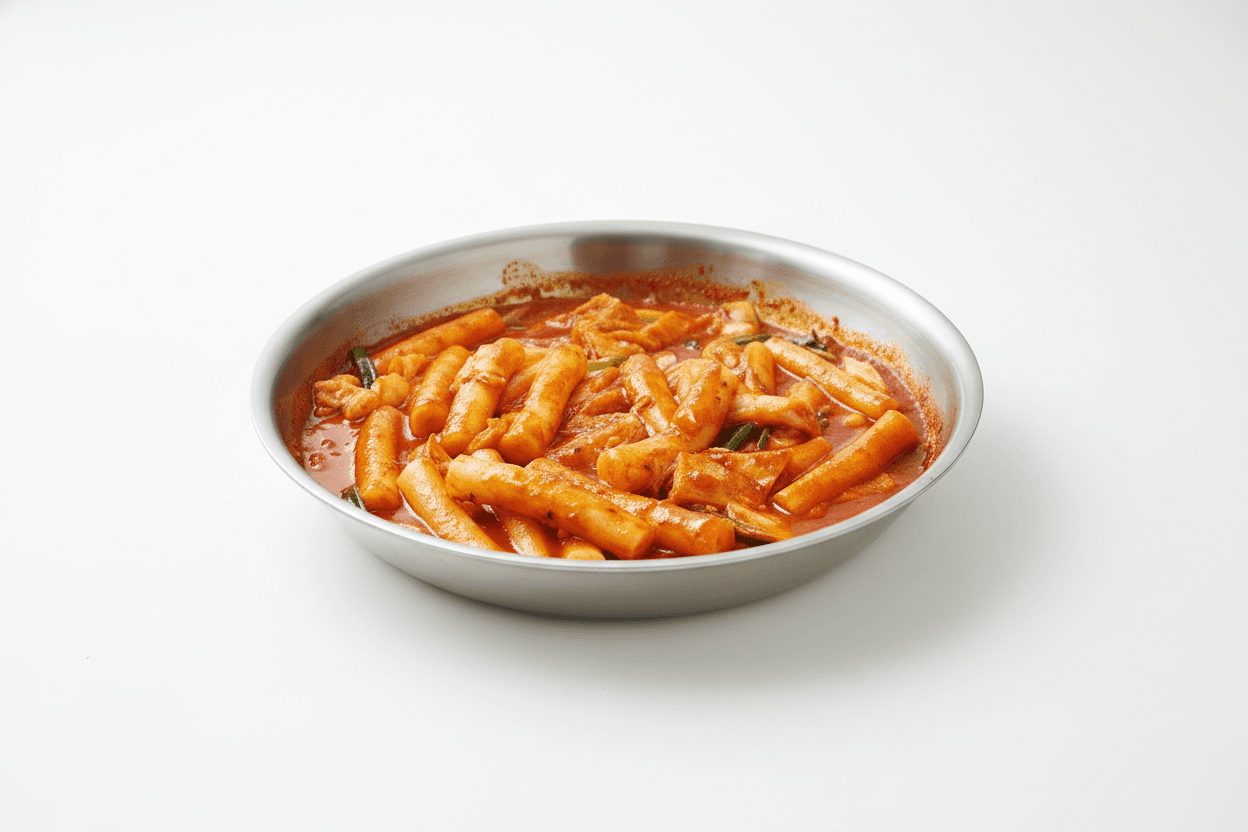
Old-School Pojangmacha Ssal-Tteokbokki
옛날 포장마차 쌀떡볶이·(yennal pojangmacha ssal-tteokbokki)
After-School Bunsikjib
Real street stall tteokbokki isn’t a delicate, brothy soup. It’s a fiery, deeply sweet, unapologetically sticky glaze that clings to dense, chewy rice cakes like wet concrete. The secret to that glossy, fiercely red texture—what locals call kkudeok-kkudeok—is a heavy hand with corn syrup and fine chili powder. But the real grandmother-meets-street-vendor trick? Beef Dashida. While a thirty-minute homemade anchovy broth is traditional for purists, every legendary snack stall in the nineties relied on that magical golden bouillon powder for instant, addictive umami. It delivers the exact taste of an after-school snack joint on a Tuesday night, no apologies necessary.
Before you start
Grind the chili flakes.
If your pantry only has standard coarse Gochugaru, run it through a spice grinder until fine. Coarse flakes will make the sauce gritty; fine powder makes it velvety.
Soak the rice cakes.
Submerge the hardened, refrigerated rice cakes in warm water for ten minutes to prevent cracking and ensure an even, chewy cook.
Ingredients
- Ssal-tteok (thick cylinder rice cakes)1 lb
- Eomuk (thin fish cakes)3 med
- Daepa or standard scallions3 large
- water3 cup
- Gochujang (Korean chili paste)3 tbsp
- Goun Gochugaru (FINE Korean chili powder)2 tbsp
- Mulyeot (Korean corn syrup)3 tbsp
- white sugar2 tbsp
- Jin-ganjang (Korean soy sauce)1 1/2 tbsp
- Dasida (Korean beef soup stock powder)1 tsp
- garlic1/2 tsp
Method
- 01
Build the base in cold water.
In a wide, shallow skillet, whisk the Gochujang, fine Gochugaru, Mulyeot, sugar, soy sauce, Dasida, and minced garlic into the cold water until completely dissolved.
- 02
Bring the rice cakes to a vigorous boil.
Add the drained rice cakes to the cold, seasoned liquid, turn the heat to medium-high, and boil for 5 to 7 minutes to draw out the starches.
- 03
Add the fish cakes and scallions.
Once the liquid reduces by about a third and begins to look slightly syrupy, drop the heat to medium-low and fold in the Eomuk and scallions.
- 04
Simmer to achieve the legendary kkudeok texture.
Simmer gently for another 5 to 8 minutes, stirring constantly and scraping the bottom of the pan to prevent the dense rice cakes from scorching, until the sauce is thick, shiny, and sticks stubbornly to the back of a spoon.
- 05
Serve immediately.
Remove from heat to preserve the chewiness of the rice cakes, optionally topping with toasted sesame seeds and hard-boiled eggs mashed straight into the red glaze.
Notes
The Gochugaru Warning.
Use Goun (fine) Gochugaru. This is the single biggest reason American-made tteokbokki tastes dusty or looks wrong compared to the homeland.
The Mulyeot Mandate.
Do not substitute raw sugar, honey, or agave. The corn or rice syrup isn't just for sweetness; it's structural, binding the sauce to the rice cake for that iconic glassy sheen.
Demystifying Dashida.
This beef stock powder is the mother flavor of late twentieth-century Korean snack food, delivering an accurate street-food profile while saving thirty minutes of boiling anchovies.
From Cook Korean in America.