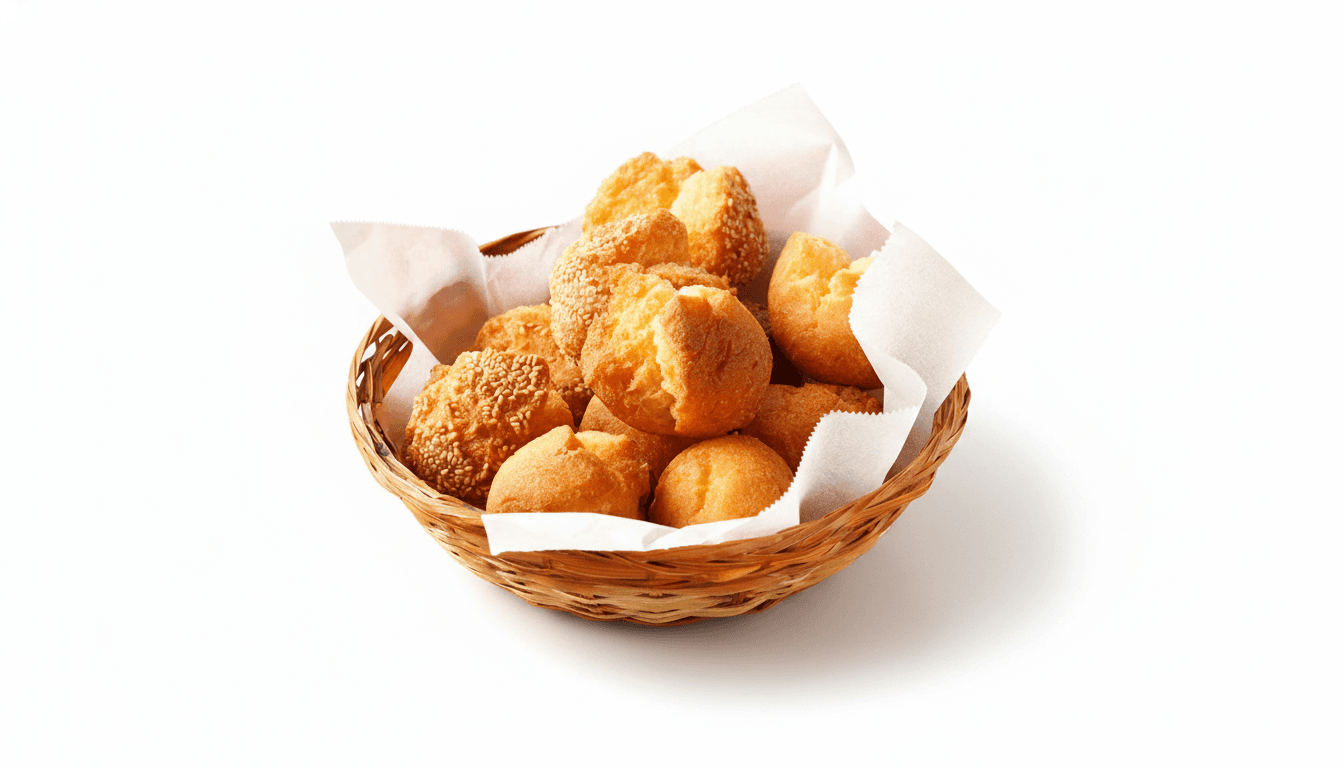
Okinawan Andagi
サーターアンダギー·(sātā andagī)
Plantation Sweets: The Sugar Legacy
Andagi are not donuts. If you bite into one expecting a light, airy pastry, you are in for a shock. These are dense, hearty, cake-like orbs engineered to survive a brutal shift in a Hawaiian sugar plantation worker's lunch pail. The diaspora adapted the fierce Okinawan original with a splash of evaporated milk and vanilla, softening the crumb just enough for modern tastes while preserving the armor-like crust. The secret to achieving that iconic, cracked smile on the exterior is uncompromising: treat the dough like drywall spackle, never overmix it, force it to rest, and fry it slow and low.
Before you start
Bring the eggs to room temperature.
Cold eggs straight from the fridge will cause the melted butter to seize on contact, creating unpleasant lumps of fat in your wet mix.
Ingredients
- cake flour3 cup
- granulated sugar1 cup
- dark brown sugar1/2 cup
- baking powder1 tbsp
- kosher salt1/2 tsp
- eggs3 large
- evaporated milk1/2 cup
- unsalted butter2 tbsp
- vanilla extract1 tsp
- neutral oil2 qt
Method
- 01
Sift the dry ingredients together to prevent clumping.
In a large mixing bowl, vigorously whisk the cake flour, granulated sugar, dark brown sugar, baking powder, and salt. Cake flour clumps easily, and perfectly distributed baking powder is essential for the andagi to bloom uniformly in the oil.
- 02
Whisk the wet ingredients gently in a separate bowl.
Crack the eggs and break them up without beating them into a massive froth. Stir in the evaporated milk, melted butter, and vanilla extract.
- 03
Fold the wet and dry ingredients together without overmixing.
Make a well in the dry ingredients, pour in the wet mixture, and fold gently with a spatula. Stop the absolute second the dry streaks of flour disappear. The batter should look thick, lumpy, and sticky; overmixing develops gluten, locking the dough tightly and preventing it from cracking in the fryer.
- 04
Rest the dough in the refrigerator for at least 30 minutes.
Cover the bowl tightly with plastic wrap. This mandatory resting period hydrates the flour evenly, relaxes the gluten you inevitably formed, and firms up the sticky dough so it holds its shape and repels excess frying oil.
- 05
Heat three inches of neutral oil to exactly 320°F.
Use a heavy-bottomed Dutch oven or wok equipped with a deep-fry thermometer over medium-low heat. Temperature control is non-negotiable; because of the high sugar content, standard high-heat frying will scorch the exterior to a bitter black before the inside is cooked.
- 06
Drop ping-pong-sized balls of dough into the hot oil.
Wet your hands slightly to keep them slick. Squeeze a handful of dough into a fist, forcing it up through the circle made by your thumb and index finger. Pinch off the ball with a flick of the wrist to create a tiny tail that will fry up into the ultimate crunchy bite.
- 07
Fry slowly until the dough blooms and turns deep golden-brown.
Fry four to five balls at a time so you don't crowd the pot. They will sink, float, expand, and eventually crack open like a blooming flower, often flipping themselves in the oil. Let them fry for 6 to 8 minutes, turning gently, until a wooden skewer inserted into the cracked center comes out clean.
- 08
Drain the andagi and serve them immediately.
Remove with a spider or slotted spoon and drain on a wire rack lined with paper towels. They are at their absolute best eaten within minutes of leaving the oil.
Notes
Revive leftovers in the toaster oven.
Thanks to their robust plantation history, these hold up wonderfully at room temperature for a couple of days. A quick 2 to 3 minutes in a toaster oven will perfectly restore their signature exterior crunch.
Troubleshoot smooth spheres.
If your andagi refuse to crack and remain perfectly smooth, your oil was likely too hot, sealing the crust instantly, or you simply overworked the dough. Stick to gentle folding and strict low-temperature frying.
From Cook Hawaiian in America.