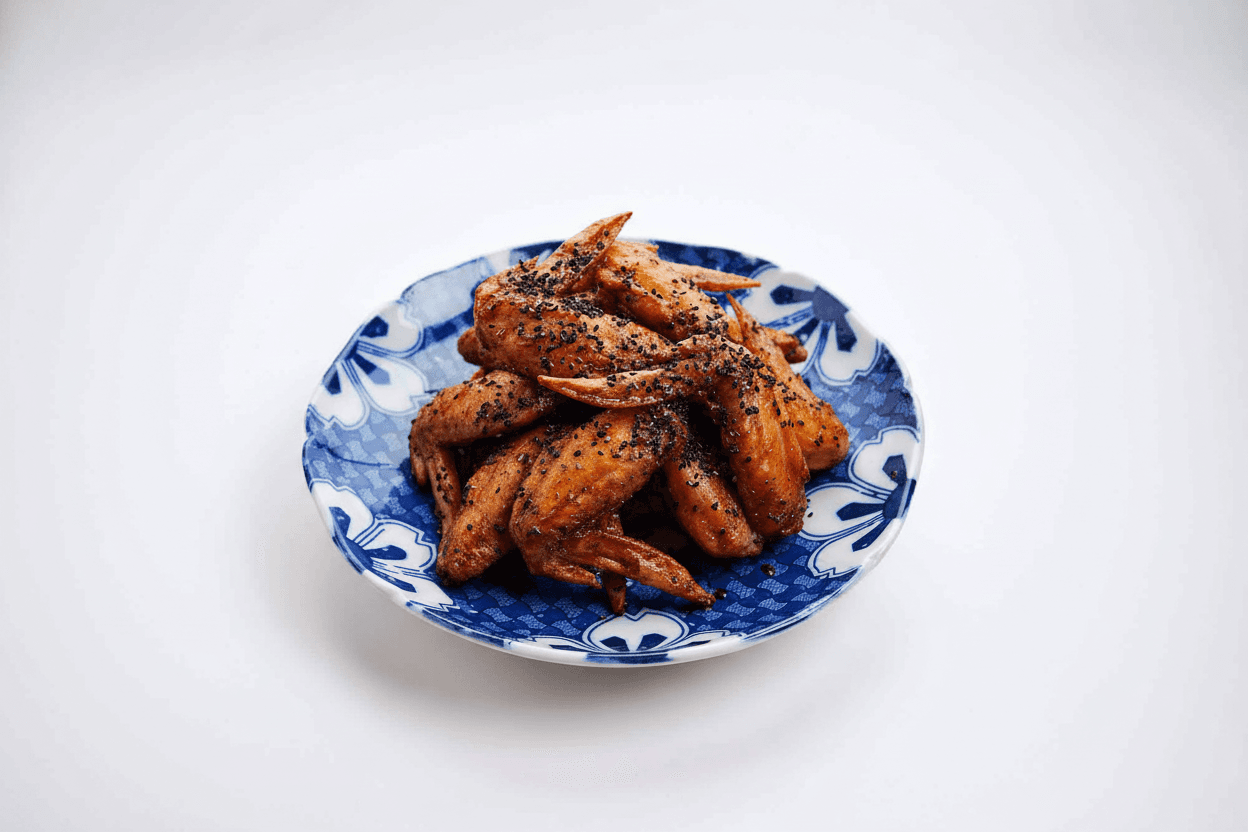
'Octo-Vin' Chicken Wings
手羽先の唐揚げ·(tebasaki karaage)
Chapter 4 — Sides: The Ramen-Shop Counter Menu
A proper bowl of ramen is a heavy, lipid-rich anchor that demands a sharp, necessary counterweight. You do not survive a late-night counter meal at Daikokuya without a cold beer and the biting acid of a side dish to cut the fat and reset the palate. These wings, tossed in a legendary, hyper-aggressive vinaigrette born from repurposed konbu and Momofuku ingenuity, serve exactly that architectural purpose. But there are no shortcuts here: you will brine, you will steam, you will air-dry overnight, and only then will you fry. The result is a skin that shatters like glass, yielding a blast of hand-chopped garlic, ginger, and unapologetic acid that wakes up every deadened nerve ending in your mouth.
Before you start
Mince aromatics by hand.
Do not use a garlic press or a microplane for the ginger. Crushing the cell walls too violently releases an acrid blast of allicin that will ruin the balance of the sauce. Utilize knife skills to create a fine, even brunoise.
Ingredients
- whole chicken wings3 lb
- lukewarm water4 cup
- granulated sugar1/2 cup
- kosher salt1/2 cup
- neutral oil4 cup
- rice wine vinegar1/4 cup
- usukuchi shoyu1/4 cup
- neutral oil2 tbsp
- granulated sugar1 1/2 tbsp
- fresh garlic2 tbsp
- fresh ginger2 tbsp
- fresh Thai bird's eye chili1 med
- Asian toasted sesame oil1/4 tsp
- black pepper1/4 tsp
Method
- 01
Dissolve the brine.
In a large stockpot or commercial food-safe container, whisk the lukewarm water, sugar, and kosher salt together until the crystals are completely dissolved.
- 02
Submerge and chill.
Submerge the chicken wings entirely in the liquid, cover the container, and refrigerate for a minimum of 1 hour, but absolutely no longer than 6 hours to prevent the texture from becoming hammy and cured.
- 03
Rinse the wings.
Remove the wings from the brine, discard the liquid, and rinse the wings thoroughly under cold water to remove the excess surface salt.
- 04
Steam the fat away.
Set up a steamer basket over a pot of simmering water. Arrange the wings in a single layer and cover, leaving the lid ever so slightly ajar to prevent the heat from becoming too violent. Steam for 40 to 45 minutes to fully cook the meat and render the problematic subcutaneous fat.
- 05
Air-dry the skin overnight.
Carefully transfer the hot wings to a wire cooling rack set over a baking sheet. Place them completely uncovered in the refrigerator for at least 2 hours, but ideally 12 to 14 hours, allowing the dry cold air to tighten the skin into a leathery pellicle.
- 06
Temper the meat.
Remove the wings from the refrigerator 30 minutes before frying to take the chill off.
- 07
Build the Octo-Vin.
In a lidded jar, combine the chopped garlic, ginger, chili, rice wine vinegar, usukuchi, the 2 tablespoons of neutral oil, sesame oil, sugar, and black pepper. Shake violently until the sugar is dissolved and the liquids emulsify.
- 08
Heat the oil.
In a heavy-bottomed Dutch oven or deep-fryer, heat the 4 cups of neutral oil to 350°F to 375°F. Use a thermometer; guessing will ruin your weekend's work.
- 09
Fry to a shatter.
Working in batches so the temperature doesn't drop, carefully lower the dry wings into the hot oil. Fry for 6 to 8 minutes until the skin is a deep, lacquered mahogany brown and distinctly crisp.
- 10
Drain briefly.
Transfer the fried wings to a plate lined with paper towels for exactly one minute to drain excess grease.
- 11
Dress and serve.
While still blazing hot, transfer the wings to a large stainless steel bowl. Pour half the Octo-Vin over the top and toss vigorously until the garlic and ginger are evenly distributed and clinging to the crisp skin. Add more dressing as desired, and serve immediately alongside an ice-cold Japanese lager.
Notes
Do not bake these wings.
Baking raw wings traps rendering fat against the pan, resulting in a flabby underbelly. The steaming and chilling phases are non-negotiable for achieving a restaurant-quality skin that shatters like glass.
Sourcing usukuchi.
Japanese light soy sauce (usukuchi) is saltier and lighter in color than standard dark soy sauce. Do not substitute thick dark soy sauces as a 1:1 replacement, or the salt density will be wrong and the chicken will stain an unappetizing black.