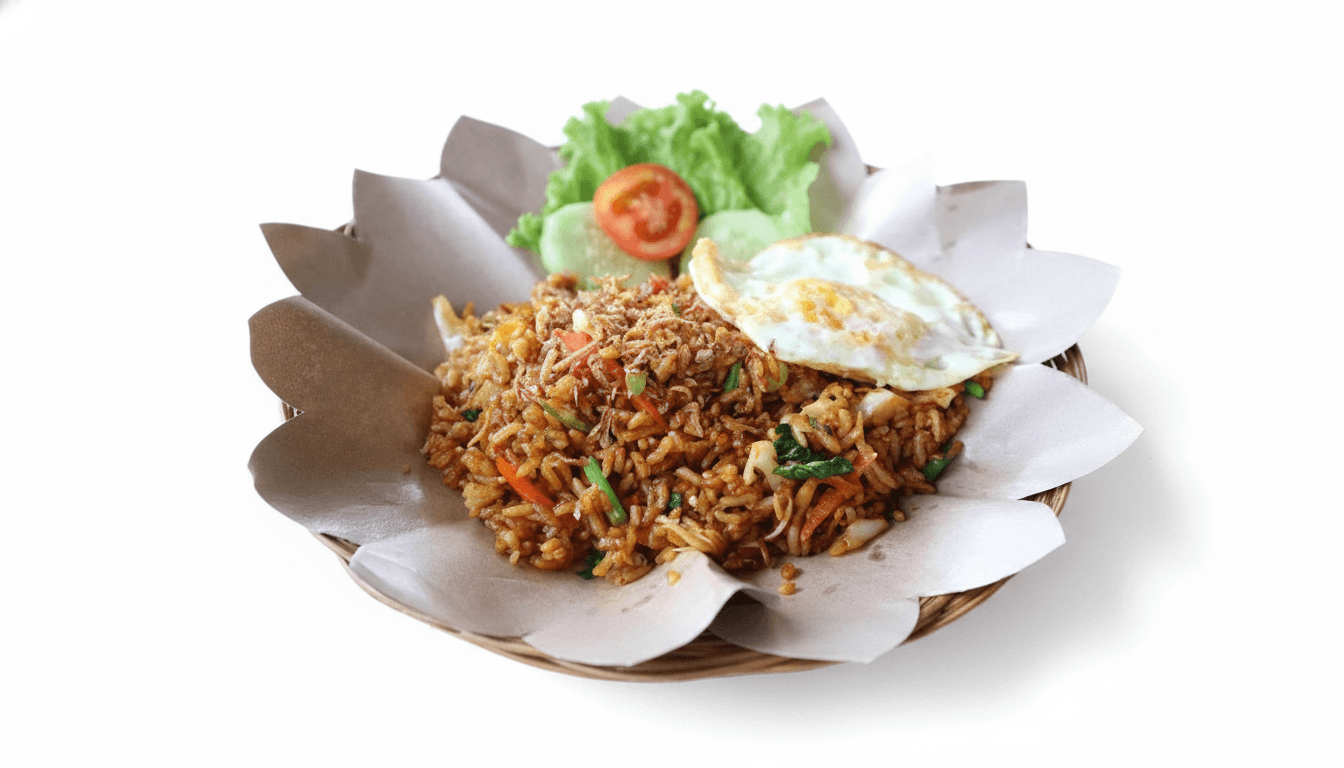
Nasi Goreng Tek-Tek
Makan Tengah: The Weeknight Communal Table
If you grew up in an Indonesian household, the rhythmic, metallic tek-tek of the street vendor's spatula at ten o'clock at night meant one thing: salvation in a wok. This isn't the tired, soy-drenched takeout fried rice of American strip malls; it is a masterclass in aggressive caramelization and deep, fermented funk. The secret is the bumbu halus—a freshly blended wet spice paste—and swapping out mildly toxic candlenuts for their biological cousin, the macadamia, to achieve that essential creamy emulsion. Batch the paste on a Sunday, and you'll possess the ultimate weeknight weapon to effortlessly replicate that dark, smoky street-cart magic in your own kitchen.
Before you start
Blitz the aromatics into a smooth bumbu halus.
Combine the shallots, garlic, macadamia nuts, soaked chilies, shrimp paste, 3 tablespoons of canola oil, and water in a small blender or food processor, pulsing until it forms a creamy paste.
Ingredients
- shallots5 med
- garlic clove4 med
- macadamia nuts3 med
- dried red chilies2 med
- fermented shrimp paste1 tsp
- canola oil3 tbsp
- water1 tbsp
- jasmine rice4 cup
- canola oil2 tbsp
- eggs2 large
- cooked chicken1/2 cup
- kecap manis3 tbsp
- oyster sauce1/2 tbsp
- salt1/2 tsp
- chicken bouillon powder1/2 tsp
- white pepper1/4 tsp
- green cabbage1 cup
- mustard greens1 cup
- scallion1 med
- fried shallots2 tbsp
- cucumber1/2 med
- tomato1 med
- prawn crackers1 cup
Method
- 01
Crack the oil to neutralize the raw aromatics.
Heat a wok or your largest skillet over medium heat, pour in the spice paste, and sauté for 5 to 7 minutes until the water evaporates, the paste darkens, and the oil visibly bubbles and separates around the edges—a non-negotiable step called pecah minyak.
- 02
Secure your weeknight stash.
Scoop exactly half of the cooked paste out of the wok and save it in a jar in the fridge; this recipe yields enough bumbu for four portions, giving you a serious head start on tomorrow's dinner.
- 03
Scramble the eggs and build the savory foundation.
Push the remaining paste to one side of the wok, turn the heat to medium-high, add the remaining 2 tablespoons of oil to the empty side, and vigorously scramble the eggs until just set before tossing in the shredded chicken to coat it in the fragrant red-gold oils.
- 04
Summon the breath of the wok.
Crank your burner to its absolute maximum, add the cold, crumbled rice, and toss aggressively, pressing the back of your spatula into the grains to break up any lingering clumps.
- 05
Caramelize the sauces for smoky, street-cart depth.
Drizzle the kecap manis and oyster sauce directly around the hot edges of the wok rather than on the rice itself, allowing the sugars to instantly bubble and smoke before rapidly tossing them through the grains along with the salt, bouillon, and white pepper.
- 06
Fold in the greens strictly off the heat.
Turn off the burner entirely and immediately fold in the chopped cabbage, mustard greens, and scallions so the residual heat wilts them perfectly while preserving their essential crunch.
Notes
Respect the garnish.
In Indonesian cuisine, garnishes aren't optional window dressing; the cooling cucumber, sweet-bitter fried shallots, and crispy prawn crackers are architectural necessities to cut through the intense, oily weight of the rice.
The macadamia hack.
Candlenuts (kemiri) provide the signature creamy emulsion of Indonesian spice pastes but are highly toxic if eaten raw and nearly impossible to find fresh in America. The macadamia nut is biologically related, entirely safe, and provides the exact same high-fat botanical structure.