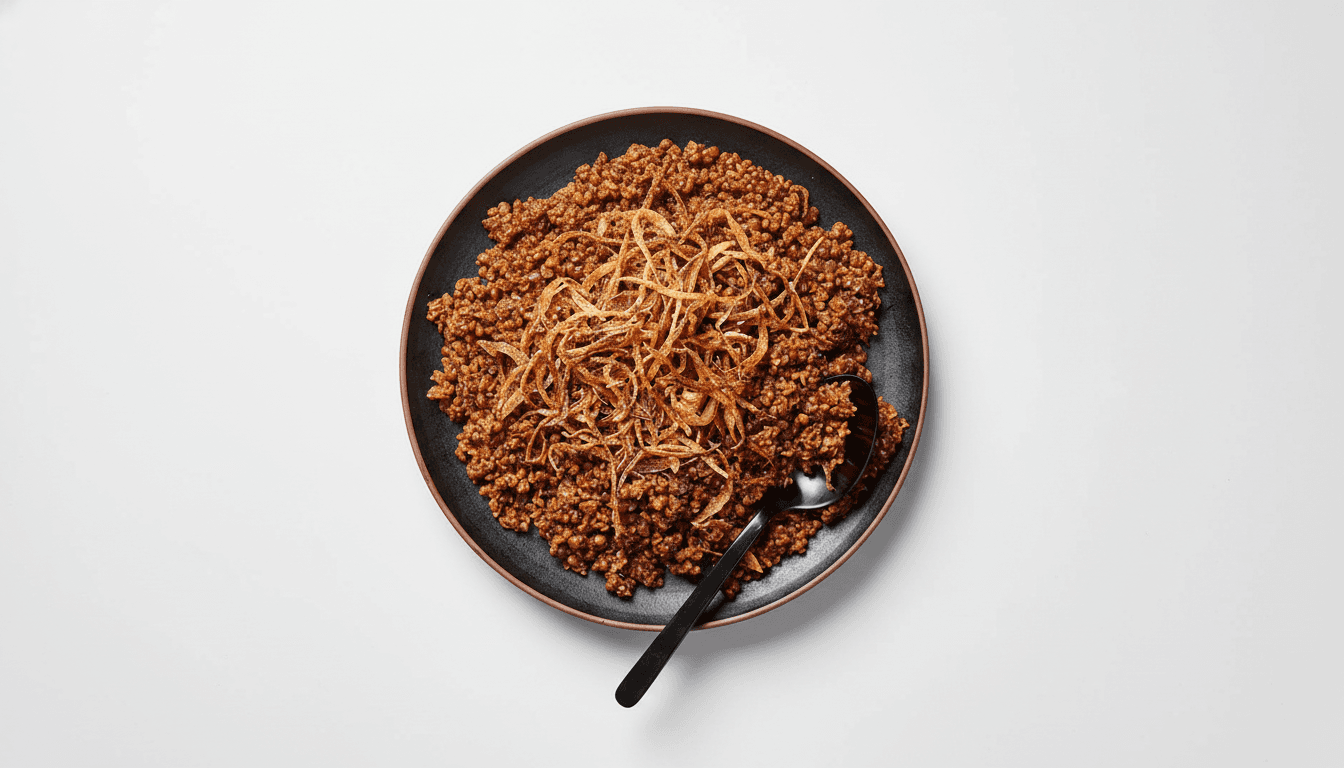
Mujadarat Bulgur
مجدرة برغل·(moo-jah-dah-rat bool-goor)
The American Dukkan: Pantry Suppers & Market Hacks
If you want to know what a Lebanese home actually smells like on a Tuesday night, it’s not roasting lamb or complex spice bazaars. It’s the intoxicating, deeply savory aroma of onions slowly turning to dark mahogany in a pool of olive oil. Mujadara is the ultimate peasant food—a masterpiece born out of necessity, using cheap, shelf-stable ingredients from the pantry to build something transcendent. The secret to making it taste exactly like the homeland isn't a magical spice mix, but absolute patience. You have to take the onions right to the brink of ruin, turning the infused olive oil into liquid gold that flavors the hearty grains. No stock cubes, no turmeric, no nonsense. Just the pure magic of the humble onion, done right.
Before you start
Prep the onions for dual duty.
Take exactly half of your sliced onions and toss them in a bowl with the flour until lightly coated to ensure they fry up crispy for the garnish. Keep the other half plain for caramelizing into the base.
Ingredients
- brown lentils1 cup
- coarse bulgur wheat1 1/2 cup
- yellow onions4 large
- extra virgin olive oil1/2 cup
- all-purpose flour1 tbsp
- kosher salt1 1/2 tsp
- ground cumin1 tsp
- water4 1/2 cup
Method
- 01
Fry the floured onions into a crispy garnish.
In a large, heavy-bottomed pot or Dutch oven, heat the olive oil over medium-high heat. Add the flour-coated onions and fry, stirring frequently, until they turn a deep, dark golden brown and become crispy, about 15 to 20 minutes. Remove with a slotted spoon to a paper towel-lined plate, salt lightly, and set aside.
- 02
Build the deep, dark base.
Lower the heat to medium and add the plain sliced onions to the exact same pot, utilizing that deeply flavored, onion-infused oil. Cook until they are heavily caramelized and dark brown, almost jammy and verging on burnt, which will give the dish its authentic color and depth.
- 03
Parboil the lentils to soften their bite.
While the onions are caramelizing, place the brown lentils in a small saucepan, cover with 2 cups of the water, and bring to a boil. Lower the heat and simmer for 10 to 12 minutes until just starting to soften. Do not drain them; that dark, iron-rich cooking water is essential for the final dish.
- 04
Marry the grains in the main pot.
Add the rinsed bulgur, the parboiled lentils along with their cooking water, the remaining 2 1/2 cups of water, the salt, and the cumin directly into the large pot with the jammy onions and oil. Stir well to combine.
- 05
Simmer, then steam off the heat.
Bring the pot to a gentle boil, then reduce the heat to the lowest possible setting. Cover with a tight-fitting lid and simmer for 20 minutes. Turn off the heat completely and let the pot sit, unopened, for another 10 minutes to allow the bulgur to absorb every last drop of moisture without turning to mush.
- 06
Fluff and crown with crispy onions.
Remove the lid and fluff the pilaf gently with a fork. Transfer to a large serving platter and top generously with the reserved crispy onions.
Notes
Bulgur size matters.
You must use coarse bulgur (look for size #3 or #4 at a Middle Eastern market, or Bob’s Red Mill 'Coarse'). Fine bulgur, typically used for tabbouleh, will turn into an unappetizing paste when simmered like this.
Serve it like a local.
Eat this warm or at room temperature alongside a generous dollop of cold plain yogurt or labneh. The sharp contrast of the hot, earthy grains with the cold, acidic yogurt is the defining bite.
From Cook Lebanese in America.