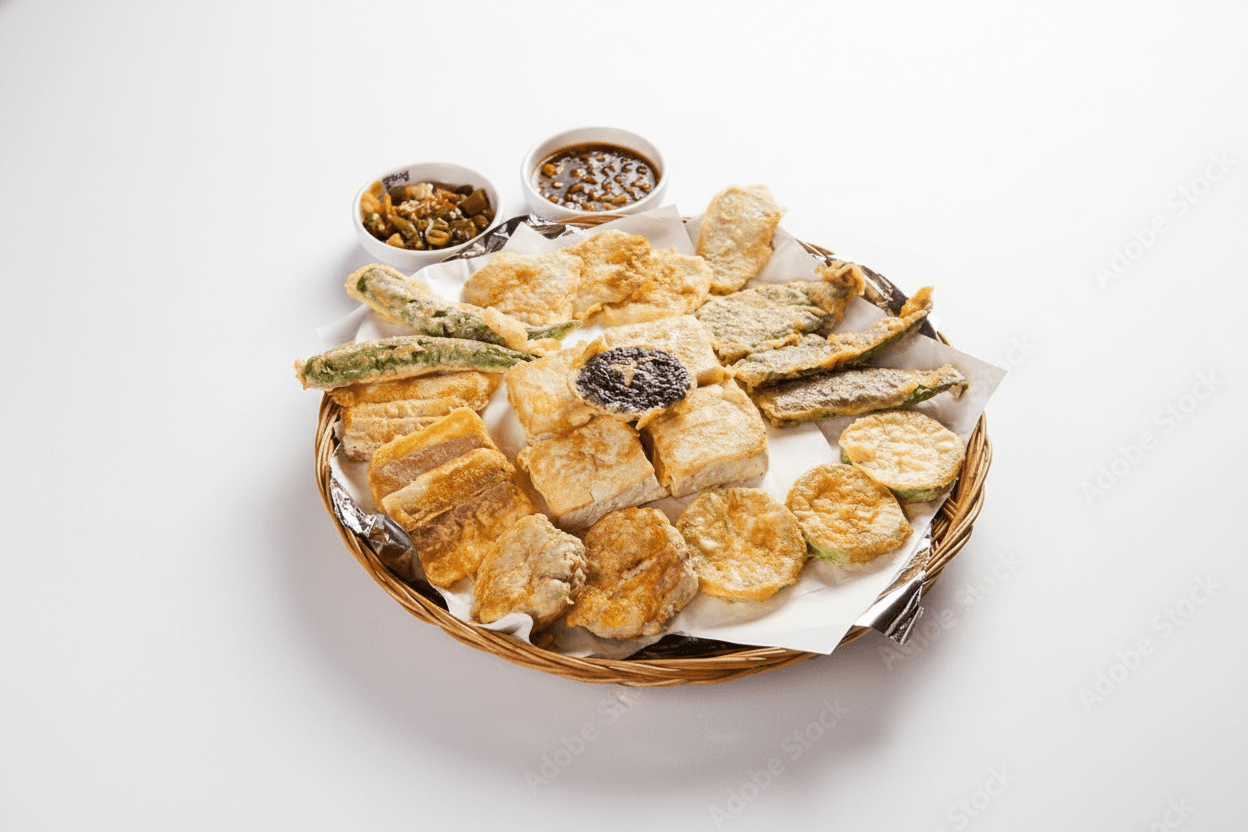
Modum Jeon
모둠전·(mo-dum jeon)
The Sunday Church Potluck
If you grew up hitting the fellowship hall of a Korean immigrant church in the Midwest, you know the smell—that rich, toasted-sesame scent of hot oil and frying eggs that meant a feast was about to go down. This platter looks like it took a village of grandmothers three days to make, but the pragmatic secret is a single, heavily seasoned, umami-laced pork and tofu mixture stuffed into whatever vegetables you have on hand. Squeeze your tofu bone-dry, use fermented salted shrimp instead of just soy sauce, and never stack them while hot; follow those rules, and you'll nail that uncompromised, nostalgic taste of the homeland on a Tuesday night.
Before you start
Whisk together the dipping sauce ingredients.
In a small bowl, combine the two tablespoons of soy sauce, rice vinegar, one teaspoon of sugar, and the rough onion chunks, setting it aside to meld while you cook.
Ingredients
- ground pork1 lb
- firm tofu7 oz
- white onion1/2 cup
- carrot1/3 cup
- scallions2 med
- Korean salted shrimp1 tbsp
- soy sauce1 tbsp
- toasted sesame oil1 tbsp
- garlic1 tbsp
- sugar1 tsp
- kosher salt1/2 tsp
- black pepper1/2 tsp
- perilla leaves12 large
- Korean zucchini1 med
- shiitake mushrooms8 med
- mild green chili peppers4 med
- Korean pancake mix1/2 cup
- eggs3 large
- egg yolks2 large
- neutral oil4 tbsp
- soy sauce2 tbsp
- rice vinegar1 tbsp
- sugar1 tsp
- white onion1/2 small
Method
- 01
Press the blood and moisture out of your ground pork so the meat fries up clean.
Place the meat between several layers of paper towels and press down firmly to extract as much moisture and myoglobin as possible; this prevents gross black scum from leaking out and ruining your pristine frying oil.
- 02
Vigorously knead the universal meat filling until it becomes cohesive and slightly sticky.
In a large bowl, combine the pressed pork, squeezed dry tofu, minced onion, carrot, scallions, salted shrimp, one tablespoon soy sauce, sesame oil, garlic, one teaspoon sugar, salt, and black pepper, using your hands to mix it thoroughly for about two minutes.
- 03
Stuff the prepared vegetables using the pancake mix as an edible adhesive.
Dust the shiny underside of the perilla leaves, the hollowed-out centers of the zucchini rounds, and the insides of the mushrooms and peppers with pancake mix before pressing the meat mixture firmly flush into each vessel.
- 04
Roll any leftover meat filling into small, flat patties.
These little meatballs are called donggeurang-ttaeng and are always a welcome, savory bonus on the final platter.
- 05
Prepare a vibrant golden egg wash by beating the whole eggs and extra yolks with a pinch of salt.
For a truly flawless finish, pour the beaten eggs through a fine-mesh sieve to remove the white chalaza cords, guaranteeing a perfectly smooth, un-clumped coating.
- 06
Dredge and coat each stuffed vegetable before frying in a skillet over medium-low heat.
Heat a large non-stick skillet with the neutral oil; lightly dust the entire outside of each piece in the pancake mix, dip it completely into the egg wash, and lay it carefully into the pan.
- 07
Fry slowly until both sides are a rich golden brown, about two to three minutes per side.
The heat must remain medium-low to safely cook the raw pork all the way through without burning the delicate egg crust; firmly wipe the skillet clean with paper towels and add fresh oil between batches.
- 08
Transfer the finished pieces to a wire cooling rack in a single, un-stacked layer.
This rule is non-negotiable; if you stack them while hot, trapped steam will instantly turn your beautifully crispy coating into a soggy mess.
Notes
The fermented salted shrimp is your grandmother's secret weapon.
Known as saeujeot, this ingredient provides deep umami and contains natural enzymes that break down pork proteins, neutralizing any gaminess and making the filling incredibly tender. Don't skip it.
Sourcing the right ingredients at your local Asian market is straightforward.
Grab Korean pancake mix (buchimgaru) because it comes perfectly pre-seasoned. If you can't find Korean zucchini (aehobak), a standard green zucchini will work just fine.
From Cook Korean in America.