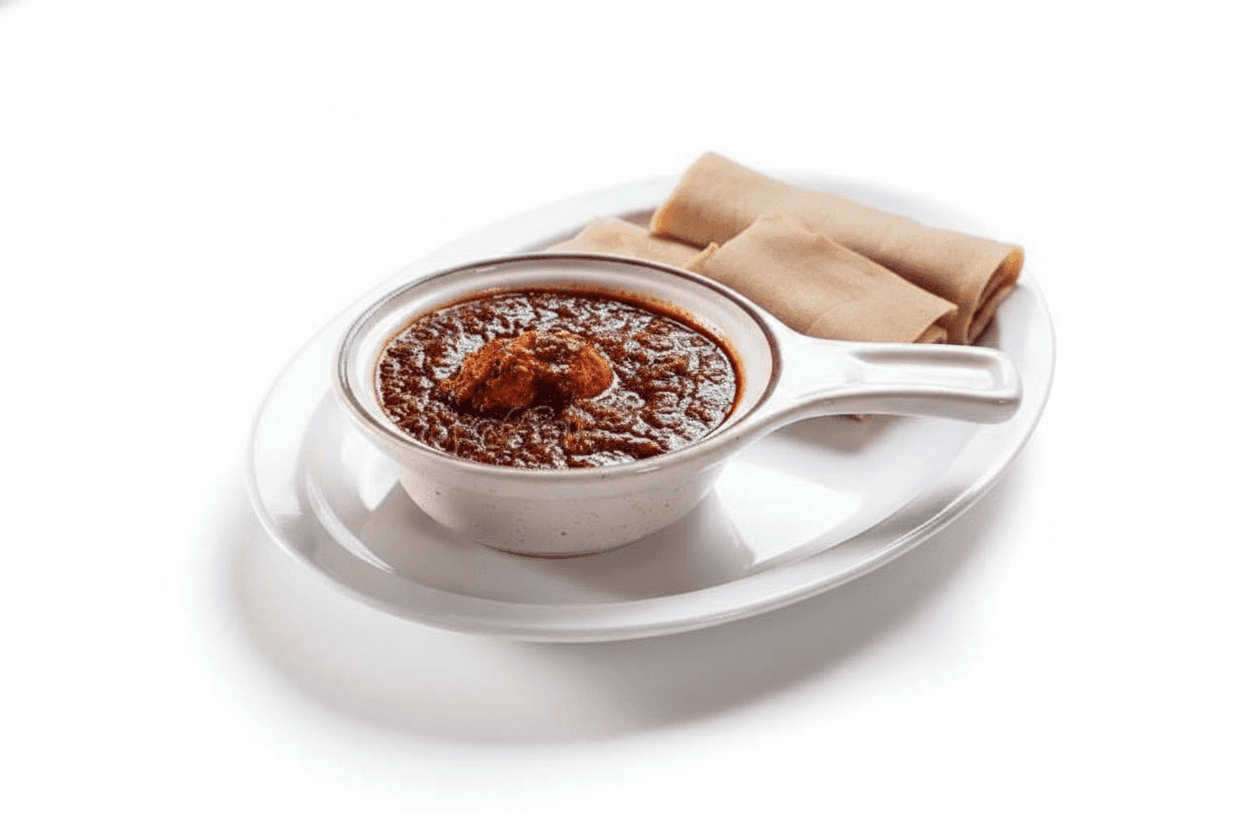
Minchet Abish
ምንቸት አብሽ·(min-chet ah-bish)
The Grandmother's Fridge: Batch-Cooked Foundations
If you want to know why a proper Ethiopian stew tastes like an absolute revelation, don’t look at the meat. Look at the onions. The secret isn't what goes into the pot, but the slow, stubborn process of dry-roasting minced red onions into a dark, caramelized jam before a single drop of fat hits the pan. It demands patience, but master this foundational kulet and your kitchen will instantly smell like the real thing—a deeply spiced, complex bowl of comfort that tastes even better on day three.
Before you start
Mince the onions in a food processor.
To save serious prep time on a weeknight and ensure the onions break down properly for the kulet, pulse your red onions in a food processor until extremely fine, stopping just short of a purée.
Ingredients
- red onions4 med
- garlic1 tbsp
- ginger1 tsp
- neutral cooking oil1/4 cup
- Berbere spice blend4 tbsp
- ground fenugreek1/2 tsp
- crushed tomatoes1/2 cup
- ground beef1 1/2 lb
- Nitir Kibbeh3 tbsp
- hot water1 1/2 cup
- kosher salt1 pinch
- Mekelesha1 tsp
- hard-boiled eggs6 large
Method
- 01
Dry-roast the onions to build the foundational kulet.
Place a large Dutch oven over medium heat with no oil. Add the minced onions and a pinch of salt, stirring frequently until they release their moisture and begin to stick. Deglaze with a tablespoon of hot water whenever they catch, repeating this process for 15 to 20 minutes until the onions collapse into a dark, sweet paste.
- 02
Bloom the aromatics in oil.
Pour the neutral oil into the onion paste, then stir in the garlic and ginger. Sauté for three minutes until the raw edge cooks off and the mixture is deeply fragrant.
- 03
Cook the raw heat out of the spices.
Stir in the Berbere and fenugreek powder. The paste will become very thick and dry; cook it constantly for 5 to 7 minutes to bloom the oils, adding a splash of water if it threatens to scorch.
- 04
Introduce acidity and spiced fat.
Stir in the crushed tomatoes and 2 tablespoons of the Nitir Kibbeh. Let it bubble for five minutes so the acidic tomatoes can meld with the rich, herby butter.
- 05
Brown the beef aggressively.
Add the ground beef and attack it with a wooden spoon, breaking it apart until absolutely no lumps remain. Stir constantly until the meat is fully browned and takes on the deep crimson hue of the sauce.
- 06
Simmer to develop the stew.
Pour in 1 cup of the hot water, bring the pot to a gentle boil, then drop the heat to medium-low. Simmer uncovered for 20 to 30 minutes, adding a splash more water if needed, until you reach a rich, spoonable consistency.
- 07
Apply the grandmother's finish off the heat.
Turn off the stove and stir in the remaining 1 tablespoon of Nitir Kibbeh and the Mekelesha. The residual heat will warm the delicate, volatile spices without destroying their sweet aromas. Gently fold in the scored hard-boiled eggs to warm through and serve.
Notes
Exploit the magic of batch cooking.
This stew is structurally designed for the fridge. Make a double batch on Sunday; the fats solidify overnight, trapping the volatile aromatics and mellowing the chili heat into a profound, warming glow by day two.
Make your own Mekelesha pantry blend.
If you cannot find pre-mixed Mekelesha, raid your baking cabinet. Mix together 1/2 tsp ground cardamom, 1/2 tsp black pepper, 1/4 tsp ground cinnamon, 1/4 tsp ground cumin, 1/4 tsp ground cloves, and a pinch of nutmeg. Keep it in a tiny jar for finishing all your stews.
Substitute for Nitir Kibbeh.
If you cannot source traditional Ethiopian spiced butter, high-quality Indian ghee mixed with a tiny pinch of ground cardamom serves as an acceptable baseline.