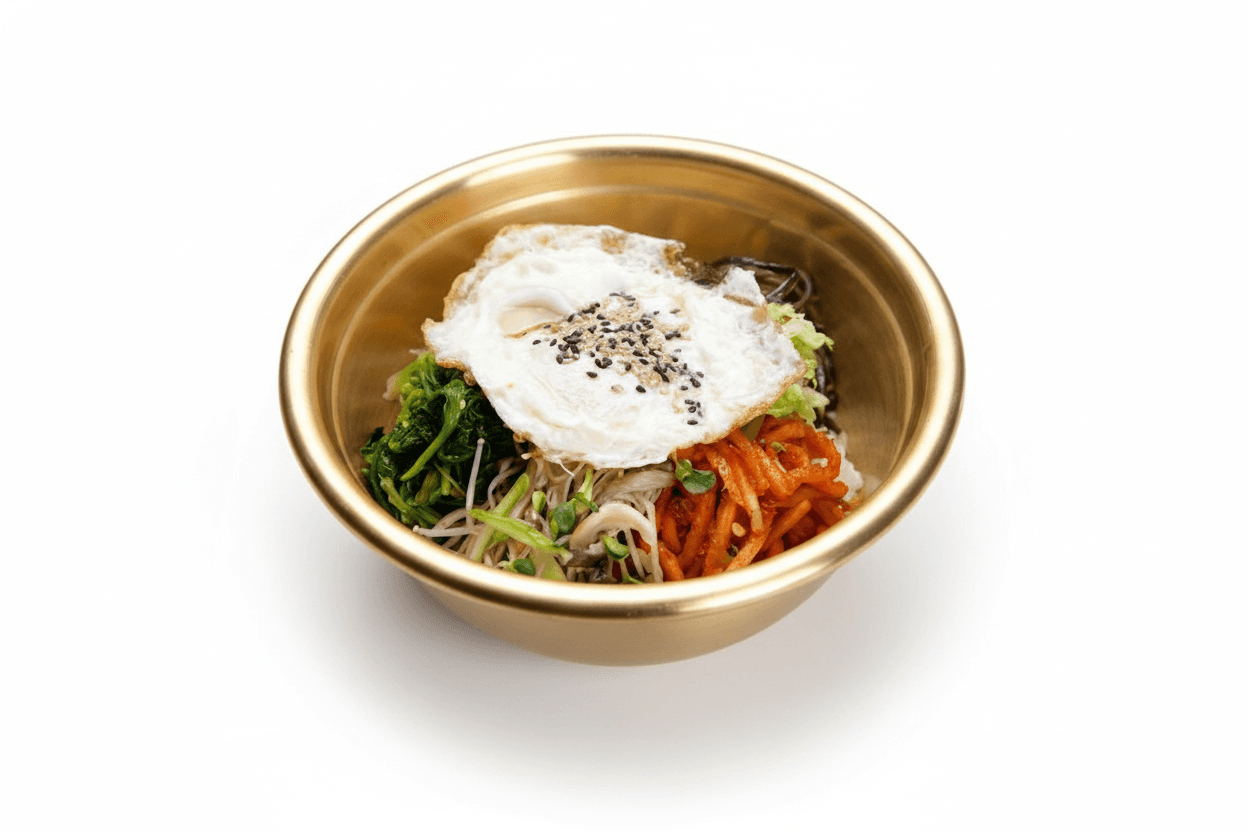
Midnight Yangpun Bibimbap
야식 양푼비빔밥·(yashik yangpun bibimbap)
Gyeran Bap & Quiet Comforts
Forget the sizzling stone bowls and meticulously arranged vegetables of restaurant bibimbap. Real Korean comfort food happens at midnight in a dented stainless steel mixing bowl. It is an unapologetic, deeply practical fridge raid of cold leftover banchan, slightly cooled rice, a couple of runny fried eggs, and whatever drained canned tuna you have on hand. It is aggressive, messy, and bound together by a secret spoonful of leftover kimchi juice that makes the whole bowl taste brilliantly, undeniably like home.
Before you start
Mix the golden bibim sauce.
In a small ramekin, vigorously stir the gochujang, toasted sesame oil, sugar, and water until it transforms from a thick paste into a glossy, pourable drizzle.
Ingredients
- short-grain white rice1 1/2 cup
- eggs2 large
- neutral oil1 tsp
- leftover banchan1/2 cup
- well-fermented kimchi1/3 cup
- fresh greens1 cup
- canned tuna2 1/2 oz
- sheet roasted seaweed1 large
- gochujang2 tbsp
- toasted sesame oil1 tbsp
- sugar1 tsp
- water1 tsp
- kimchi juice2 tbsp
Method
- 01
Spread the rice in a large mixing bowl.
Use the largest, widest mixing bowl you own—a metal yangpun if you have one—and spread the rice across the bottom so it stops steaming and does not wilt the cold ingredients prematurely.
- 02
Fry the eggs.
Heat the neutral oil in a skillet over medium heat and fry both eggs sunny-side up until the whites are set with crispy edges but the yolks remain completely runny.
- 03
Assemble the bowl.
Arrange the banchan, chopped kimchi, fresh greens, and drained tuna in a circle over the slightly cooled rice.
- 04
Add the secret splash.
Spoon the kimchi juice directly over the rice and vegetables to hydrate the bowl and infuse it with deep, sour umami.
- 05
Top and aggressively mix.
Slide the fried eggs into the center, drizzle the gochujang sauce over the top, and crush the seaweed over everything. Take a long-handled spoon, break the yolks, and smash it all together until every grain of rice is stained a glossy reddish-orange.
Notes
Do not skimp on the eggs.
Using two eggs rather than one provides the essential liquid fat needed to properly coat the rice and mellow the sharp heat of the gochujang.
Never waste your kimchi juice.
Spooning the acidic, savory brine from the bottom of a well-fermented kimchi jar directly into the rice is the undisputed grandmother's secret to a bowl that tastes alive rather than dry and starchy. Leftover doenjang jjigae broth works wonders here, too.
From Cook Korean in America.