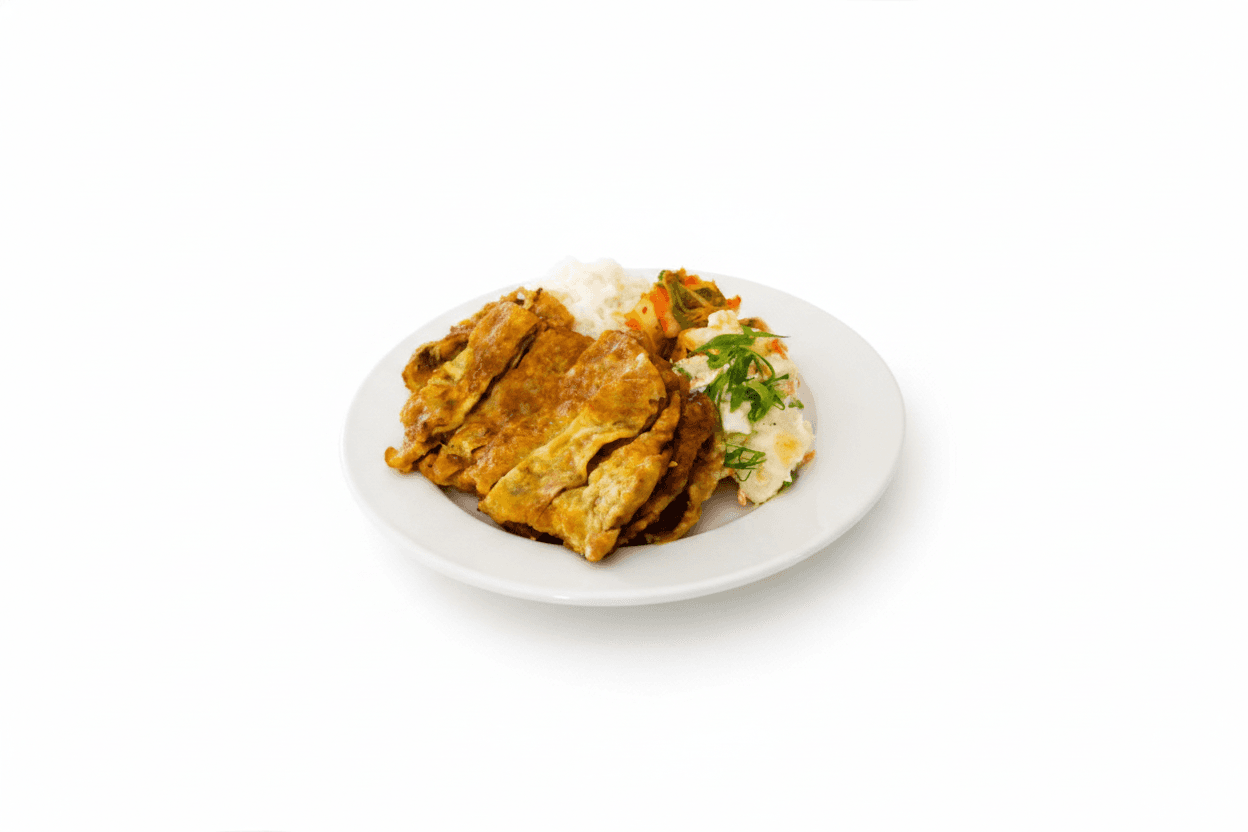
Meat Jun
육전·(yuk-jeon)
Two Scoop Rice: The Daily Plate Lunch Rhythms
Meat Jun is a masterclass in immigrant ingenuity. When early Korean plantation workers in Hawaii couldn't find the resources for traditional ceremonial yukjeon, they adapted. They took cheap, paper-thin beef, soaked it in a sweet, garlicky shoyu marinade born of the local teriyaki culture, and fried it in a traditional egg batter to stretch the protein and feed a hungry family. The result is a profoundly nostalgic, savory-sweet envelope of pure plate-lunch comfort. The secret isn't some mythical island ingredient; it's the technique. Shaking off the excess flour ensures the egg clings like a second skin, trapping the juices inside.
Before you start
Freeze and shave the beef if you can't buy it pre-sliced.
Sourcing 1/8-inch thick beef is the only real barrier to entry here. Asian markets sell perfect 'shabu shabu' cuts, or you can ask a local butcher to run a sirloin through their deli slicer. Otherwise, freeze the steak for 45 minutes until firm and shave it yourself with a sharp chef's knife.
Ingredients
- beef (ribeye, top sirloin, or bulgogi cut)1 lb
- soy sauce1/2 cup
- water1/3 cup
- granulated or light brown sugar1/3 cup
- toasted sesame oil1 tbsp
- garlic cloves3 med
- scallions2 med
- all-purpose flour1/2 cup
- eggs4 large
- neutral cooking oil3 tbsp
- soy sauce1/4 cup
- rice vinegar2 tbsp
- sugar1 tbsp
- toasted sesame oil1 tsp
- gochugaru (Korean chili flakes)1 tsp
- scallion1 med
Method
- 01
Whisk together the soy sauce, water, sugar, sesame oil, garlic, and scallions, then submerge the beef.
Let it sit in the fridge for at least an hour. The addition of water is a crucial grandma secret—it prevents the thin beef from curing and becoming overwhelmingly salty if you leave it overnight.
- 02
Combine the dipping sauce ingredients and set aside.
Mixing the second measure of soy sauce, rice vinegar, sugar, sesame oil, gochugaru, and scallion now lets the flavors meld at room temperature while the meat marinates.
- 03
Set up a breading station next to your stove with three shallow dishes: the beef, the flour, and the beaten eggs.
- 04
Lift a piece of beef, let the excess marinade drip off, and coat it completely in flour, shaking off the excess vigorously.
The meat should look dusty, not caked in paste. If there are wet, bald spots, the egg won't stick, and if it's clumpy, the coating turns gummy.
- 05
Heat the oil in a large skillet over medium-high heat, dip the floured beef into the egg, and fry for one to two minutes per side.
You're looking for a bright, golden-yellow egg casing with slightly caramelized brown edges. Don't overcrowd the pan, and wipe it out with a paper towel if the sugar starts to burn between batches.
- 06
Drain on paper towels, snip into strips with kitchen shears, and serve immediately.
This demands a massive mound of hot white rice and a side of mac salad, exactly how they plate it on the islands.
Notes
Upgrade the flour for a traditional chew.
While all-purpose flour is the Hawaiian standard, traditional Korean cooks use sweet rice flour (chapssalgaru) for a subtle, elastic chew. Potato starch also works brilliantly for a slightly crispier edge.
From Cook Hawaiian in America.