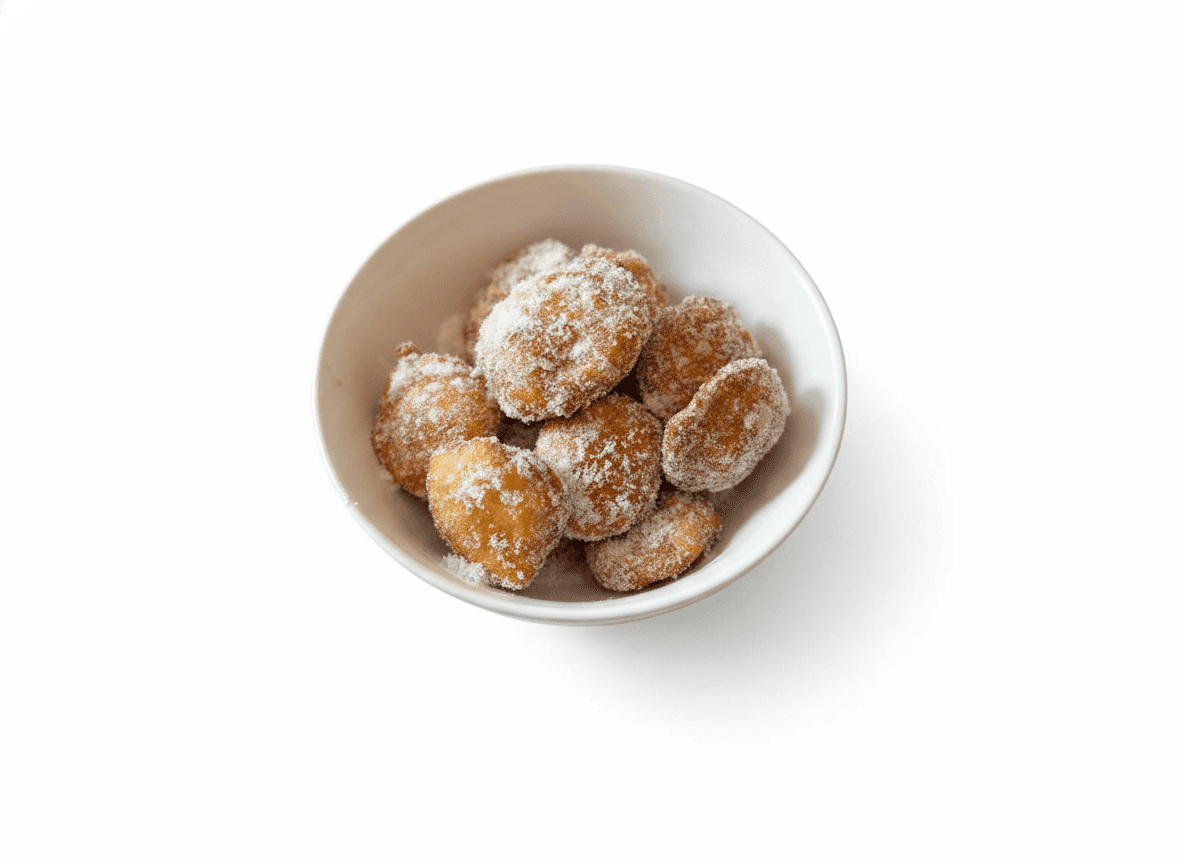
Malassadas Rápidas
Malassadas Rápidas·(mah-lah-SAH-dahsh RAH-pee-dahsh)
Dias de Festa
In Hawaii, they're perfectly round, cream-filled doughnuts, but if you grew up in a Portuguese household in New England or Ohio, you know the truth. A real Azorean malassada is flat, wildly uneven, hand-stretched, and tastes distinctively of yeast, bright citrus, and pure nostalgia. Traditionally, grandmas wrapped the dough in heavy blankets, waiting hours for it to rise. This version relies on an old-world secret to speed things up without losing that fermented funk: the 'bolinha' trick. By floating a tiny ball of dough in a glass of water, you’ll know the exact minute it's ready to fry, turning a weekend marathon into a weeknight triumph.
Before you start
Prepare the citrus zest
Zest the lemon and orange before juicing or using them for other recipes, being careful to only take the fragrant colorful skin and leaving the bitter white pith behind.
Melt and cool the butter
Melt the butter in advance so it has time to cool slightly. If you add scorching hot butter to the wet ingredients, you run the risk of scrambling the eggs or killing the yeast.
Ingredients
- whole milk1/2 cup
- granulated sugar1 tbsp
- instant dry yeast2 1/4 tsp
- all-purpose flour1/4 cup
- all-purpose flour4 cup
- granulated sugar1/2 cup
- fine sea salt1/2 tsp
- eggs4 large
- unsalted butter1/2 cup
- white rum or vodka2 tbsp
- lemon1 large
- orange1 large
- whole milk1/4 cup
- neutral oil6 cup
- granulated sugar1 cup
- ground cinnamon1 tsp
- neutral oil2 tbsp
Method
- 01
Awaken the yeast sponge
In a small bowl, whisk together the half cup of warm milk, one tablespoon of sugar, yeast, and quarter cup of flour. Cover with a towel and let sit in a warm place for 10 minutes until it becomes highly frothy and bubbly.
- 02
Mix the wet and dry ingredients
In a large mixing bowl or a stand mixer, whisk the 4 cups of flour, half cup of sugar, and salt, then make a deep well in the center. In a separate bowl, whisk the eggs, melted butter, rum or vodka, and citrus zest. Pour this wet mixture, along with your frothy yeast sponge, directly into the flour well.
- 03
Knead the sticky dough
Mix using a wooden spoon or dough hook on medium-low speed for about 5 minutes. The dough must be very sticky and soft; if it looks dry and shaggy, add the remaining quarter cup of warm milk. It should end up cohesive but still tacky to the touch.
- 04
Deploy the bolinha trick for the rise
Pinch off a marble-sized piece of dough and drop it into a clear glass of room-temperature water, where it will sink to the bottom. Cover your main mixing bowl with a damp towel and place it in a warm spot. Watch the glass; the exact moment the tiny dough ball floats to the top of the water (usually 40 to 60 minutes), your main batch is perfectly proofed.
- 05
Heat the frying oil
While the dough finishes rising, pour 6 cups of neutral oil into a heavy-bottomed Dutch oven or deep skillet. Attach a deep-fry thermometer and bring the oil to a steady 325°F to 350°F over medium heat. Line a baking sheet with paper towels and mix your coating sugar and cinnamon in a wide, shallow dish.
- 06
Stretch the dough with oiled hands
Pour a little neutral oil into a small bowl and rub it all over your palms and fingers so the dough won't stick to you. Tear off a piece of dough the size of a small tangerine and gently stretch it outward from the center into an uneven, 4 to 5-inch disc, leaving the edges slightly thicker than the middle.
- 07
Fry to a deep golden brown
Carefully lower the stretched dough into the hot oil, frying two to three at a time to maintain the oil temperature. Fry for about 2 minutes on the first side until deep golden brown, then flip with tongs and fry for 1 to 2 minutes on the other side.
- 08
Toss in sugar while hot
Remove the malassadas from the oil, allowing excess fat to drip off for a few seconds onto the paper towels. While they are still hot, drop them into the bowl of sugar and toss to coat heavily on both sides. Serve immediately.
Notes
Resist the urge to over-flour
The dough is supposed to be frustratingly sticky. If you add enough flour to make it smooth and satiny like sandwich bread, your malassadas will become heavy bricks. Use the oiled-hands trick instead.
Trust the alcohol
The splash of rum or vodka serves a crucial scientific purpose. It inhibits gluten formation for a tender bite, and the alcohol evaporates violently during frying, creating internal steam that repels the hot oil so the dough doesn't get greasy.
Embrace the ugly shapes
A perfectly round malassada belongs in a bakery display. The true beauty of this Azorean classic lies in its organic, amoeba-like shape. The thin, crispy craters contrast perfectly with the thicker, pillowy edges.