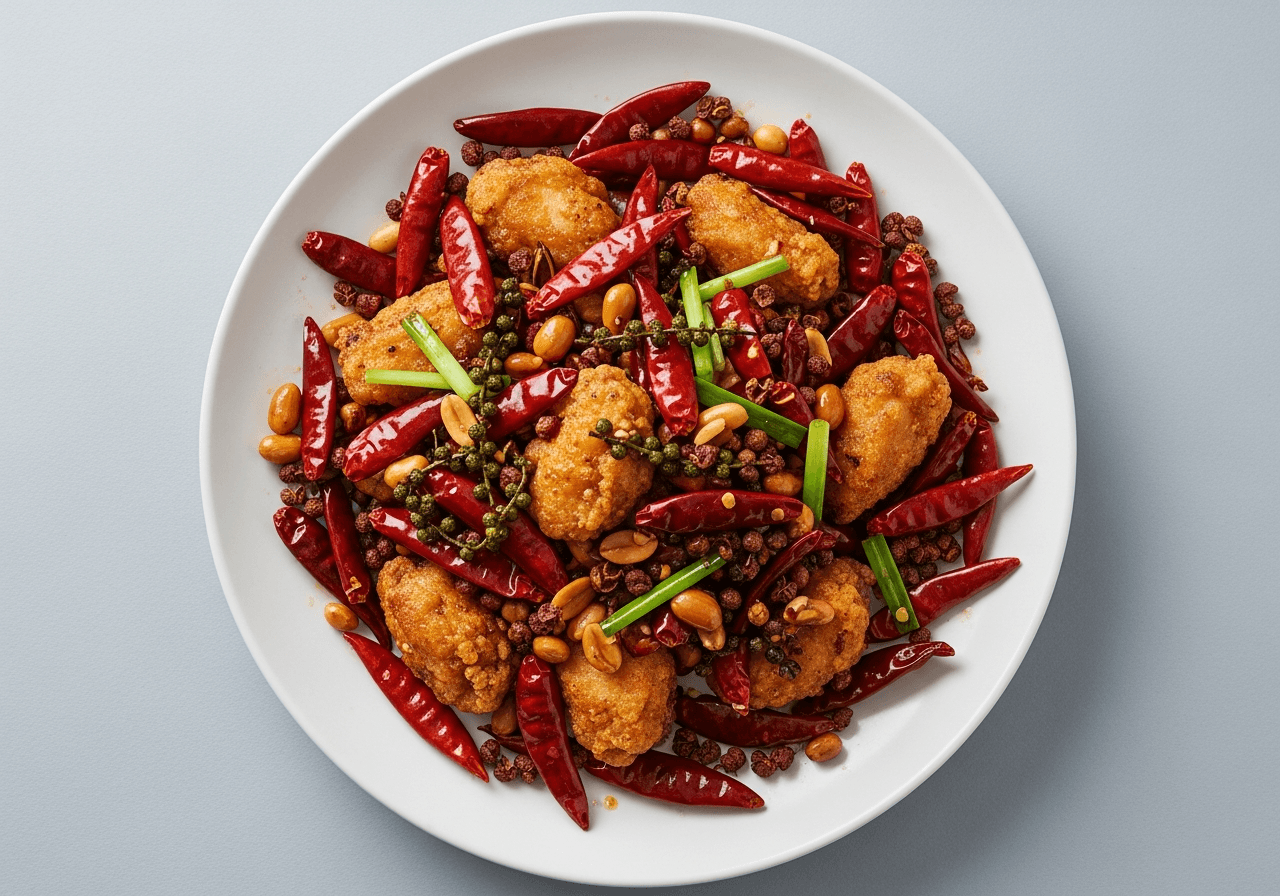
La Zi Ji (Chongqing-Style Firecracker Chicken)
辣子鸡·(là-zǐ-jī)
Cangying Guanzi: The Weekend Fly Restaurant
In Chongqing's roadside fly restaurants, this dish hits the table looking like a terrifying, glowing red mountain of fire. The locals playfully call it "hide and seek chicken." You don't eat the chilies; they exist solely to perfume the oil with a rich, smoky, and floral aroma while you use your chopsticks to hunt through the rubble for the real prize. The secret to recreating this unapologetic street food on an American weeknight is twofold: cross-cutting standard chicken wings to get that crucial bone-in flavor without the burden of a deep-fryer, and aggressively salting the meat before it ever touches the heat. Once that golden crust forms, the flavor is locked out.
Ingredients
- chicken wings1 1/2 lb
- kosher salt1 tsp
- light soy sauce1 tbsp
- Shaoxing cooking wine1 tbsp
- ground white pepper1/2 tsp
- fresh ginger1/2 inch
- scallion1 med
- cornstarch2 tbsp
- neutral oil1 tbsp
- dried mild chilies1 cup
- dried hot chilies1/2 cup
- whole Sichuan peppercorns2 tbsp
- neutral oil1/4 cup
- garlic4 clove
- fresh ginger1 inch
- scallion2 med
- granulated sugar1 tsp
- MSG1/2 tsp
- white sesame seeds1 tbsp
- roasted unsalted peanuts1/4 cup
Method
- 01
Aggressively massage the chicken with the salt, soy sauce, wine, white pepper, smashed ginger, and smashed scallion in a mixing bowl.
Do not skimp on the salt here. Once the chicken hits the hot oil and forms its signature crust, the interior meat becomes completely sealed off from any further seasoning.
- 02
Discard the smashed aromatics, sprinkle the cornstarch over the chicken, and mix until coated in a tacky paste.
Stir in the one tablespoon of neutral oil to help separate the pieces when they hit the pan, then let sit at room temperature for at least 20 minutes.
- 03
Place your snipped chilies and Sichuan peppercorns in a fine-mesh strainer and quickly run them under warm water for five seconds.
Shake them dry immediately. This microscopic layer of moisture acts as a crucial buffer, preventing the delicate spices from instantly turning to bitter ash in the hot wok.
- 04
Heat the quarter cup of oil in a wide cast-iron skillet or flat-bottomed wok over medium-high heat until it shimmers.
Carefully add the chicken in a single, uncrowded layer and leave it entirely undisturbed for 4 to 5 minutes to develop a thick, craggy crust. Flip and fry for another 3 to 4 minutes until the meat is dehydrated and exceptionally crispy, then remove to a paper towel-lined plate.
- 05
Pour off all but two tablespoons of the hot oil, reduce the heat to medium-low, and fry the garlic and ginger matchsticks until fragrant.
Add the slightly dampened chilies and peppercorns, stirring continuously for a minute or two. Watch carefully until the oil turns slightly orange and emits a spicy, nose-tingling vapor, but do not let the chilies turn black.
- 06
Immediately return the crispy chicken to the skillet along with the chopped scallions and peanuts.
Toss everything vigorously to coat the craggy exterior of the chicken in the fragrant, numbing chili oil.
- 07
Sprinkle the sugar, MSG, and toasted sesame seeds over the top and give it three more tosses.
The small pinch of sugar is essential here; it magically rounds out the sharp, aggressive heat of the chilies. Transfer the entire mountain to a large platter and serve immediately with cold beer and steamed white rice.
Notes
The Chili Substitution Secret.
To replicate the authentic visual volume of the homeland without the heat becoming completely inedible, use a three-to-one ratio of mild, fragrant chilies (like Guajillo or Japones) to sharp, hot chilies (like Chile de Árbol).
Warn your guests about the rules of Hide and Seek.
Make sure diners know that the mountain of chilies is strictly structural. They are there to perfume the dish, not to be eaten as vegetables.
From The Sichuan Home Kitchen.