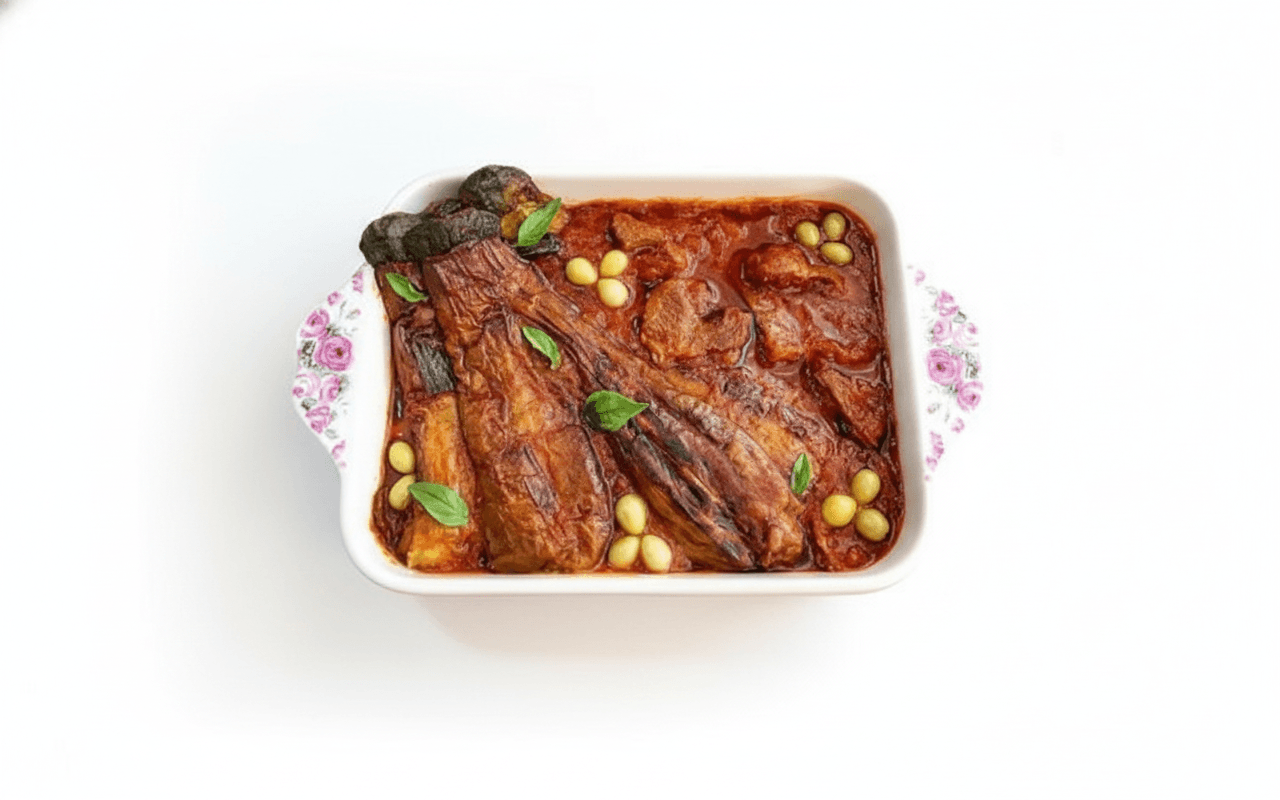
Khoresh Bademjan
خورش بادمجان·(kho-resh bah-dem-jahn)
The Weeknight Khoresh (Stovetop Magic for Busy Parents)
If eggplant is the potato of Iran, Khoresh Bademjan is its highest calling. In the old country, cooks stand over spitting pans of oil for hours, frying eggplants into buttery submission. We don’t have that kind of time on a Tuesday. We bypass the mess by roasting Japanese eggplants and swapping traditional lamb for quick-braising chicken thighs. The grandmother-approved secret that makes it sing is the chashni—a handful of unripe sour grapes that slice right through the rich, savory fat, pulling you straight back to a kitchen in Tehran.
Before you start
Bloom the saffron.
Combine the ground saffron with 2 tablespoons of hot water in a small glass and let it sit to release its aroma and color while you cook the stew.
Ingredients
- Japanese or Chinese eggplants6 small
- kosher salt1 tbsp
- neutral cooking oil6 tbsp
- yellow onion1 large
- bone in skinless chicken thighs1 1/2 lb
- ground turmeric1 tsp
- ground black pepper1/2 tsp
- ground cinnamon1/4 tsp
- double concentrated tomato paste3 tbsp
- ripe tomatoes2 med
- hot water or low sodium chicken broth2 cup
- frozen sour grapes1/3 cup
- ground saffron1/4 tsp
Method
- 01
Extract the bitterness from the eggplants with a heavy dose of kosher salt.
Preheat the oven to 400°F. Toss the sliced eggplants in a colander with the salt and let them sit for 20 minutes to draw out the bitter alkaloids and collapse their spongy texture.
- 02
Rinse the eggplants and roast them into buttery submission.
Rinse the eggplants under cold water, pat them aggressively dry with paper towels, and toss them on a parchment-lined baking sheet with 3 tablespoons of the oil. Roast for 25 to 30 minutes until blistered and soft.
- 03
Build the flavor foundation with golden onions and seared chicken.
Heat the remaining 3 tablespoons of oil in a large Dutch oven over medium-high heat. Sauté the diced onion for 8 to 10 minutes until translucent, then push them aside, drop in the chicken, and dust heavily with the turmeric, black pepper, and cinnamon. Sear for 4 to 5 minutes per side.
- 04
Fry the tomato paste to kill the raw flavor.
Make a well in the center of the pot, drop in the tomato paste, and let it fry in the hot oil for a minute or two until it turns a deep brick red. Dump in the chopped tomatoes, pour in the hot water, and scrape up the browned bits from the bottom.
- 05
Simmer the stew to break down the chicken.
Bring the pot to a boil, drop the heat to a gentle simmer, cover, and let it cook undisturbed for 30 minutes.
- 06
Introduce the tart chashni and nestle in the roasted eggplants.
Stir in the sour grapes to establish that crucial, bright tartness. Carefully lay the roasted eggplants across the top of the liquid—do not stir vigorously from this point forward, or they will disintegrate. Cover and simmer on low for another 15 to 20 minutes.
- 07
Finish with bloomed saffron and let the oils rise.
Kill the heat, drizzle the bloomed saffron water over the top, and let the pot sit for 5 minutes. The stew should look thick, with small pools of spiced orange oil surfacing—the hallmark of a properly matured khoresh.
Notes
Globe eggplants are an absolute last resort.
If you can only find massive Italian eggplants, salt them heavily for 45 minutes, press them with a heavy weight to squeeze out the water, and cut them into thick batons before roasting. Japanese or Chinese eggplants are vastly superior here.
Fresh lime juice can substitute for sour grapes in a pinch.
If you cannot find frozen ghooreh at a Middle Eastern market, wait until the stew is completely finished and off the heat, then gently stir in 3 tablespoons of fresh lime juice to prevent bitterness.
From Cook Persian in America.