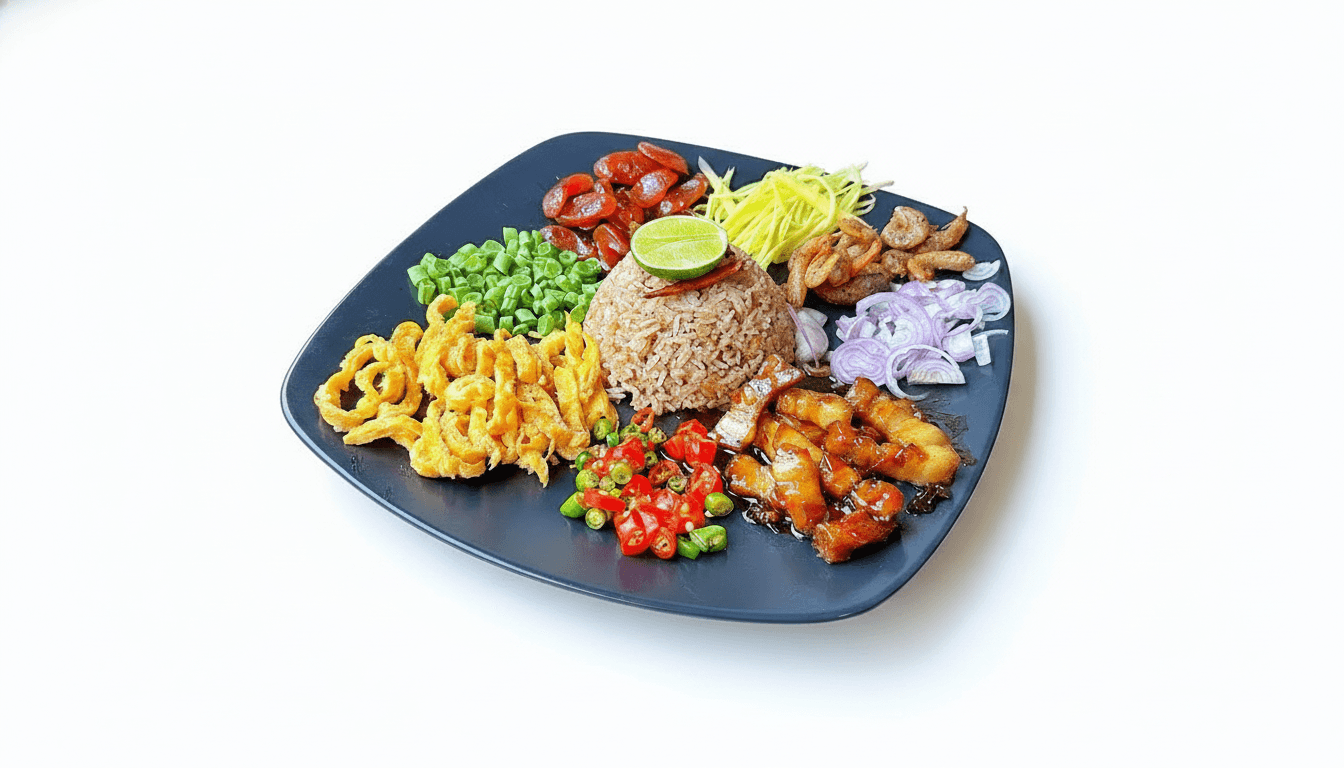
Khao Kluk Kapi
ข้าวคลุกกะปิ·(kow klook gah-pee)
The Rice Cooker Savior: Thai Office Lunches & Hacks
If you grew up in a Thai-American household, you know the smell of kapi. It’s pungent, aggressive, and undeniably the smell of home. In Bangkok, street vendors sell this meticulously arranged in little boxes: umami-stained rice surrounded by a color wheel of sweet, tart, and crunchy toppings. But your grandmother knew this wasn't a rigid, hours-long affair—it's the ultimate fridge-clearing weeknight meal. We're skipping the traditional banana-leaf roasting and simply blooming the shrimp paste in hot garlic oil to mellow its funk. Can't find sour green mango in Ohio? Do what the smartest expats do and grab a Granny Smith apple. It's not a compromise; it's a testament to how good food survives and adapts.
Before you start
Cook your rice a day ahead.
Like any fried rice, you need cold, slightly dried-out Jasmine rice so the grains don't turn to mush when they hit the heavy shrimp paste.
Ingredients
- ground pork or pork belly1/2 lb
- vegetable oil4 tbsp
- shallot3 small
- palm sugar or dark brown sugar3 tbsp
- fish sauce1 tbsp
- light soy sauce1 tbsp
- dark soy sauce1/2 tbsp
- water1/4 cup
- cooked Jasmine rice3 cup
- Thai shrimp paste1 1/2 tbsp
- water1 tbsp
- garlic2 clove
- eggs2 large
- Chinese sausage1 med
- small dried shrimp3 tbsp
- Granny Smith apple1/2 cup
- shallot3 small
- green beans1/2 cup
- bird's eye chilies or serrano peppers2 small
- English cucumber1/2 med
- lime1 med
Method
- 01
Prepare your garnishes first.
This dish is all about assembly. Arrange your julienned apple, raw shallots, green beans, chilies, cucumber, and lime wedges on a large serving platter before you turn on the stove.
- 02
Fry the egg ribbons.
Heat a dab of oil in a non-stick skillet over medium-low heat. Pour in half the beaten eggs, swirling to create a very thin crepe. Let it set without browning, remove, roll into a tight cigar, and slice crosswise into thin ribbons. Repeat with the remaining egg.
- 03
Crisp the sausage and dried shrimp.
In the same pan, fry the Chinese sausage slices until the fat renders and the edges caramelize. Remove and drain on paper towels. Add the dried shrimp to the residual fat and fry for a minute or two until crispy and fragrant, then set aside.
- 04
Glaze the sweet pork.
Heat two tablespoons of oil in a wok over medium heat and sauté the sliced shallots until translucent. Add your ground pork (or thin pork belly) and stir-fry until mostly cooked. Add the palm sugar, fish sauce, light soy sauce, dark soy sauce, and a quarter cup of water. Simmer aggressively until the liquid reduces into a dark, sticky, glossy glaze. Transfer to a bowl and don't wipe the wok.
- 05
Fry the shrimp paste rice.
Mash the shrimp paste with a tablespoon of water to loosen it. Heat the remaining oil in the wok, fry the minced garlic for fifteen seconds, then pour in the shrimp paste slurry. It will smell incredibly strong—don't panic, this is correct. Cook for 30 seconds until the harshness burns off, then add the cold rice. Toss continuously, breaking up clumps, until every grain is hot, coated, and dancing in the pan.
- 06
Assemble the plate.
Pack the warm rice into a small bowl and invert it onto the center of your platter. Surround the dome of rice with distinct, separate piles of your sweet pork, egg ribbons, crispy sausage, fried dried shrimp, and the raw garnishes. Squeeze fresh lime juice over everything and mix it all together right before eating.
Notes
Embrace the Granny Smith hack.
Traditional sour green mango is tough to source consistently in American supermarkets. The Granny Smith apple provides the exact rigid cellular structure and tart malic acid profile needed to cut through the rich, sweet pork.
Hack the pork belly.
Traditional moo wan uses pork belly that's boiled for an hour before braising. Using ground pork or paper-thin slices of belly slashes the cook time to ten minutes without losing the soul of the dish.
From Cook Thai in America.