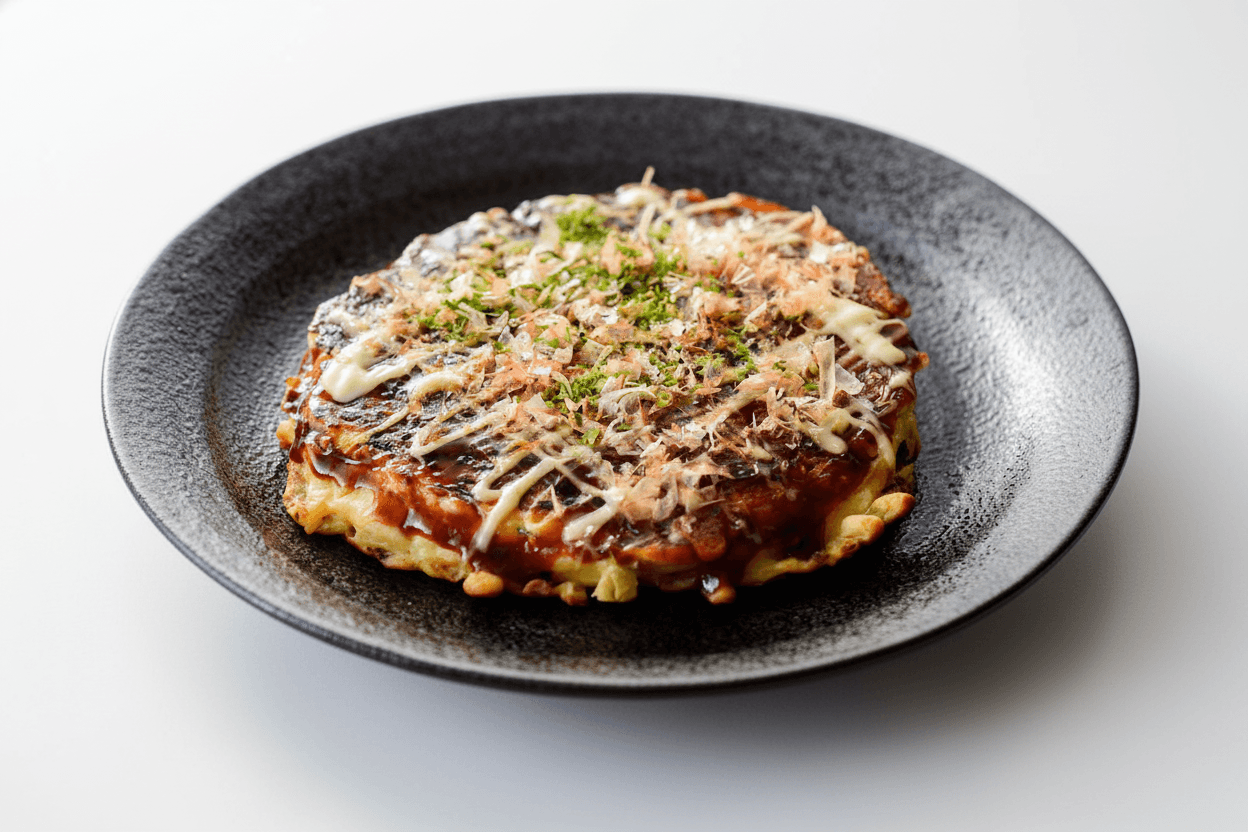
Kansai-Style Okonomiyaki
関西風お好み焼き·(kansai-fu okonomiyaki)
Weekend Teppan & Hot Pots
Kansai-style okonomiyaki was born out of necessity—a brilliant, pragmatic feat of post-war home economics that evolved into Japan’s ultimate soul food. This isn't some dense Western pancake; it is a highly hydrated, cabbage-packed vegetable fritter bound by a fragile, umami-rich matrix of dashi and mountain yam. While a dedicated griddle in the center of the weekend dining table is the nostalgic ideal, the real beauty here is its weeknight utility. You can mix the batter and chop the cabbage days in advance, turning a Tuesday night in an American suburb into a masterclass in texture and deeply comforting, unpretentious flavor.
Before you start
Chop the cabbage into rough half-inch squares.
Do not shred the cabbage like coleslaw, as it will become stringy; this specific rough mince is the secret to a pancake that holds together but maintains a hearty crunch.
Whisk together the flour, cold dashi, grated nagaimo, and salt in a medium bowl until just smooth.
This batter base can be made up to two days ahead and kept in the fridge until you are ready to cook.
Ingredients
- all-purpose flour3/4 cup
- cold dashi1/2 cup
- nagaimo2 tbsp
- kosher salt1/4 tsp
- green cabbage300 g
- eggs2 large
- tenkasu2 tbsp
- beni-shoga1 tbsp
- scallions2 med
- pork belly6 med
- okonomiyaki sauce2 tbsp
- Japanese mayonnaise2 tbsp
- aonori1 tsp
- katsuobushi2 tbsp
Method
- 01
Gently fold half the cabbage, one egg, half the tenkasu, half the beni-shoga, half the scallions, and half the liquid batter together in a small bowl.
Always mix one pancake at a time using a bottom-to-top folding motion, and stop as soon as the cabbage is coated and the egg is slightly streaky—overmixing develops gluten and makes the pancake tough.
- 02
Pour the mixed batter onto a medium-high cast-iron skillet or a 400°F electric griddle lightly coated in neutral oil.
Use the side of your spoon to gently shape it into a 6-inch circle about 3/4-inch thick, poking the top lightly to create air vents, and cook undisturbed for 3 minutes.
- 03
Lay three slices of pork belly across the top of the pancake, then use two spatulas to confidently flip it over.
- 04
Immediately cover the pan with a lid, lower the heat slightly, and steam-cook for 4 to 5 minutes.
The trapped steam gently cooks the dense cabbage core while the rendering pork fat fries the bottom.
- 05
Remove the lid, flip the pancake one last time so the pork is facing up, and cook uncovered for 2 to 3 more minutes.
Do not press down on the pancake with your spatula; pressing squeezes out the air pockets and completely ruins the fluffy texture.
- 06
Slide the pancake onto a plate and garnish generously.
Brush with okonomiyaki sauce, drizzle with Japanese mayonnaise in a zig-zag pattern, sprinkle with aonori, and top with katsuobushi to serve immediately while the flakes are still dancing.
Notes
Substitute nagaimo with mayonnaise and baking powder if you can't find it.
If fresh mountain yam is unavailable at your local Asian market, mix 1 tablespoon of Japanese mayonnaise and 1/4 teaspoon of baking powder into the batter base to replicate the chemical lift and tenderness.
Tenkasu and beni-shoga are cheap and widely available at Asian grocers.
These are crucial for the authentic flavor and texture, but if you absolutely cannot find tenkasu, a handful of plain crushed potato chips can mimic the fat and carb layering in a pinch.
From Cook Japanese in America.