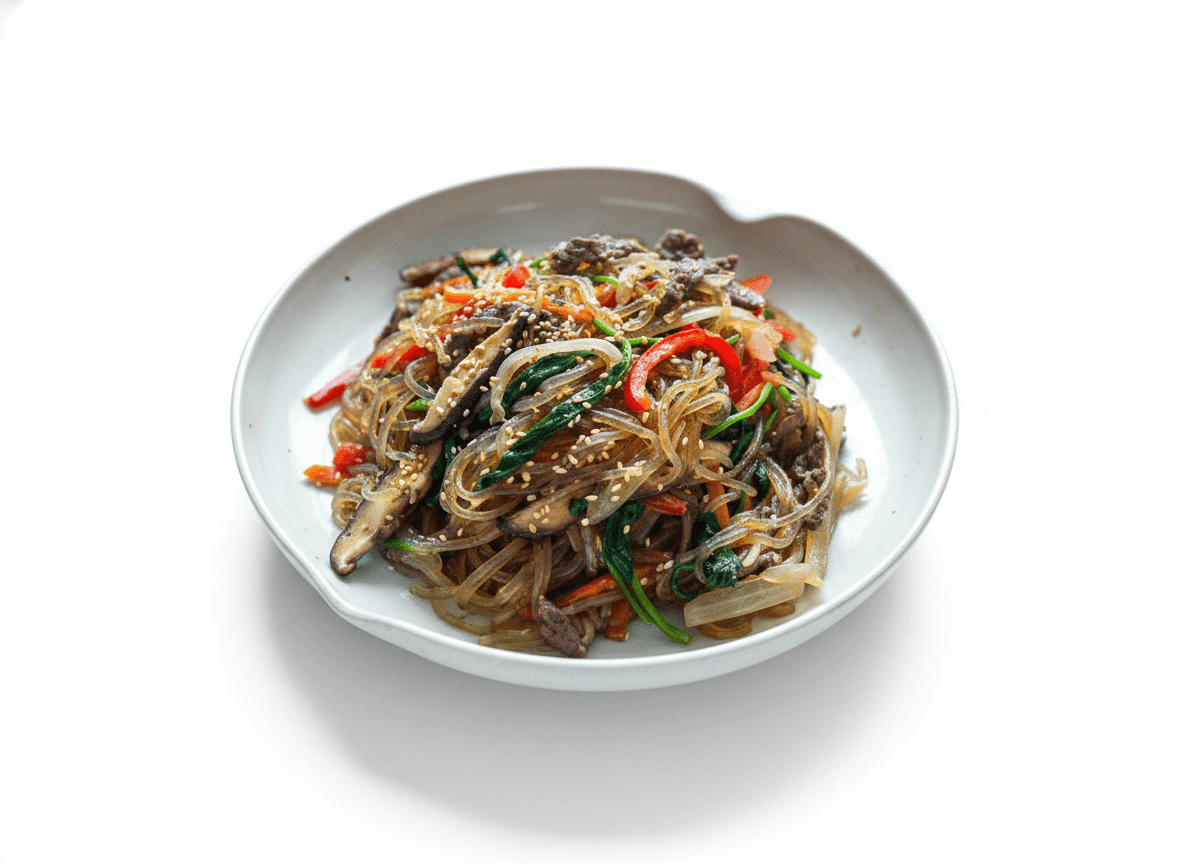
Janchi Japchae
잔치 잡채·(jan-chi jap-chae)
The Sunday Church Potluck
Every Korean church potluck is anchored by a massive tray of japchae. It’s a dish engineered for endurance, meant to sit at room temperature for hours while maintaining a miraculous, springy chew. The secret to that texture isn't a shortcut; it's a grandmother's mindful sequencing. You hydrate the sweet potato noodles before a brief boil, cook each vegetable separately so it retains its own dignity, and toss the whole thing by hand while the noodles are steaming hot. This is the un-Hollywood, deeply sincere taste of home, scaled for a crowd but completely doable on a Tuesday night.
Before you start
Hydrate the noodles and mushrooms ahead of time.
Place the sweet potato noodles and dried shiitakes in separate bowls of warm water 30 minutes before you begin cooking. This is the grandmother's secret to unparalleled chewiness and a lightning-fast boiling time.
Ingredients
- Korean sweet potato glass noodles8 oz
- lean beef sirloin or ribeye6 oz
- dried shiitake mushrooms4 med
- mature spinach8 oz
- yellow onion1 med
- carrot1 med
- red bell pepper1/2 med
- Korean dark soy sauce5 tbsp
- dark brown sugar3 tbsp
- garlic2 med cloves
- toasted sesame oil3 tbsp
- neutral cooking oil2 tbsp
- toasted white sesame seeds2 tbsp
- black pepper1/8 tsp
- kosher salt1 tsp
Method
- 01
Marinate the beef and mushrooms.
In a small bowl, massage the beef and sliced shiitake mushrooms with 1 tablespoon of soy sauce, 1 teaspoon of brown sugar, half of the minced garlic, 1 teaspoon of sesame oil, and the black pepper.
- 02
Blanch and aggressively wring out the spinach.
Drop the spinach into boiling salted water for exactly 15 seconds, then plunge into ice water to halt the cooking. Squeeze it in your fists until almost completely dry, then toss with a pinch of salt and a half teaspoon of sesame oil—never raw garlic, which spoils quickly at room temperature.
- 03
Sauté the vegetables sequentially to preserve their distinct textures.
Heat a large skillet over medium-high. With a tiny splash of neutral oil and a pinch of salt for each batch, sauté the onions, then the carrots, then the bell peppers, transferring each to a massive mixing bowl just as they lose their raw bite.
- 04
Brown the marinated beef and mushrooms.
Add the beef and mushroom mixture to the hot skillet, cooking until the meat is browned and its juices reduce to coat the pan, then transfer everything into the large mixing bowl.
- 05
Boil the hydrated noodles briefly.
Drop the pre-soaked glass noodles into a fresh pot of boiling water for just 2 to 3 minutes until translucent and chewy, then drain well and cut them in half with kitchen shears.
- 06
Glaze the hot noodles to lock in their chew.
Immediately place the steaming noodles into the skillet over low heat with the remaining 4 tablespoons of soy sauce, 2 1/2 tablespoons of brown sugar, 2 tablespoons of sesame oil, 1 tablespoon of neutral oil, and the remaining minced garlic. Stir vigorously until the noodles absorb the sauce and turn a deep amber color.
- 07
Toss everything together by hand.
Transfer the glazed noodles to the large mixing bowl, put on a disposable plastic glove, and massage the ingredients together so every strand is coated, finishing with a generous sprinkle of toasted sesame seeds.
Notes
Never eat japchae cold straight from the fridge.
The sweet potato starch turns hard and brittle when chilled. Reheat leftovers in a skillet with a tiny splash of water and sesame oil to steam the noodles back to their springy glory.
The one-pan weeknight compromise.
If cooking the vegetables sequentially feels like too much on a Tuesday, you can stir-fry the onions, carrots, and bell peppers together in a single wok. It muddles the flavors slightly, but saves ten minutes and a lot of dishes.
From Cook Korean in America.