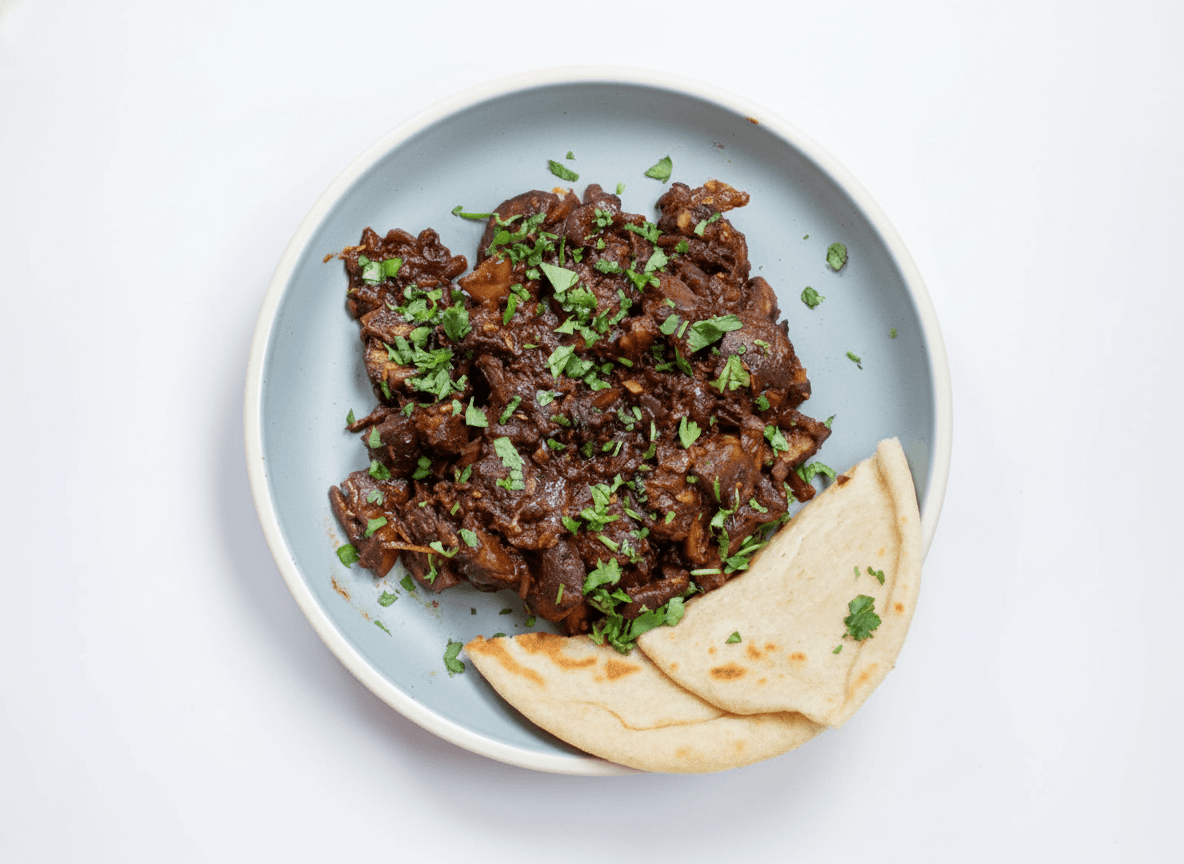
Inguday Tibs
እንጉዳይ ጥብስ·(in-goo-die tibs)
The Grandmother's Fridge: Batch-Cooked Foundations
It hits you the moment you walk through the door: that intoxicating cloud of toasted berbere, blistering onions, and garlic. Tibs is a high-heat cornerstone of the Ethiopian kitchen, and during the hundreds of Orthodox fasting days, heavy, earthy mushrooms take the stage. Conjuring that exact ghost on a Tuesday night in an American kitchen requires two grandmotherly secrets. First, hydrating your berbere into a wet paste—awaze—so the complex spices bloom instead of burning to ash. Second, dry-sweating the water out of the mushrooms before they ever touch oil, ensuring they sear rather than acting like greasy sponges.
Before you start
Mix the awaze paste.
In a small container, thoroughly combine the berbere spice blend, one tablespoon of the olive oil, and the red wine to form a thick, wet paste.
Ingredients
- berbere spice blend2 tbsp
- dry red wine3 tbsp
- olive oil3 tbsp
- portobello or cremini mushrooms1 lb
- red onion1 large
- garlic3 med clove
- fresh ginger1 tsp
- Roma tomato1 med
- jalapeño peppers2 med
- fresh rosemary1 sprig
- sea saltto taste
- lemon juice1 tbsp
Method
- 01
Sweat the mushrooms to remove their excess water.
Place a large, dry skillet over medium-high heat and cook the mushrooms in a single layer with a pinch of salt until they release their water and brown slightly, then remove them to a plate.
- 02
Coax the onions into a deeply golden base.
In the same skillet, heat one tablespoon of the olive oil and the sliced onions, adding a splash of water to scrape up the brown bits whenever they start to stick, until the onions are soft and significantly reduced in volume.
- 03
Bloom the aromatics.
Push the onions to the edges of the pan, add the final tablespoon of oil to the center, and stir in the crushed garlic and grated ginger until intensely fragrant.
- 04
Introduce the awaze paste and tomato.
Stir the prepared awaze paste into the onions to toast for a minute, then immediately add the diced tomato to deglaze the pan and create a thick, violently red sauce.
- 05
Execute the high-heat marriage.
Crank the heat to high, return the mushrooms to the pan alongside the rosemary sprig and jalapeños, and toss aggressively for two to three minutes until the peppers are just tender but still bright green.
- 06
Finish with acid.
Remove the skillet from the heat, discard the woody rosemary stem, and squeeze the fresh lemon juice over the top before serving immediately alongside fresh injera.
Notes
Source authentic berbere.
Do not substitute generic chili powder. Berbere is a complex blend containing fenugreek, cardamom, and clove; seek out a local Ethiopian market or order from a reputable specialty spice vendor.
Choose the right pan.
A wide cast-iron or heavy-bottomed stainless steel pan is essential. Ethiopian cooking relies heavily on the fond (the caramelized bits on the bottom), and a heavy pan allows for the water-sweating technique without scorching your base.
The wine deglaze is a modern diaspora trick.
Traditional tibs utilizes water or tej (honey wine), but first-generation chefs often use a dry red like Pinot Noir to mimic the fermented depth of traditional homeland ingredients.