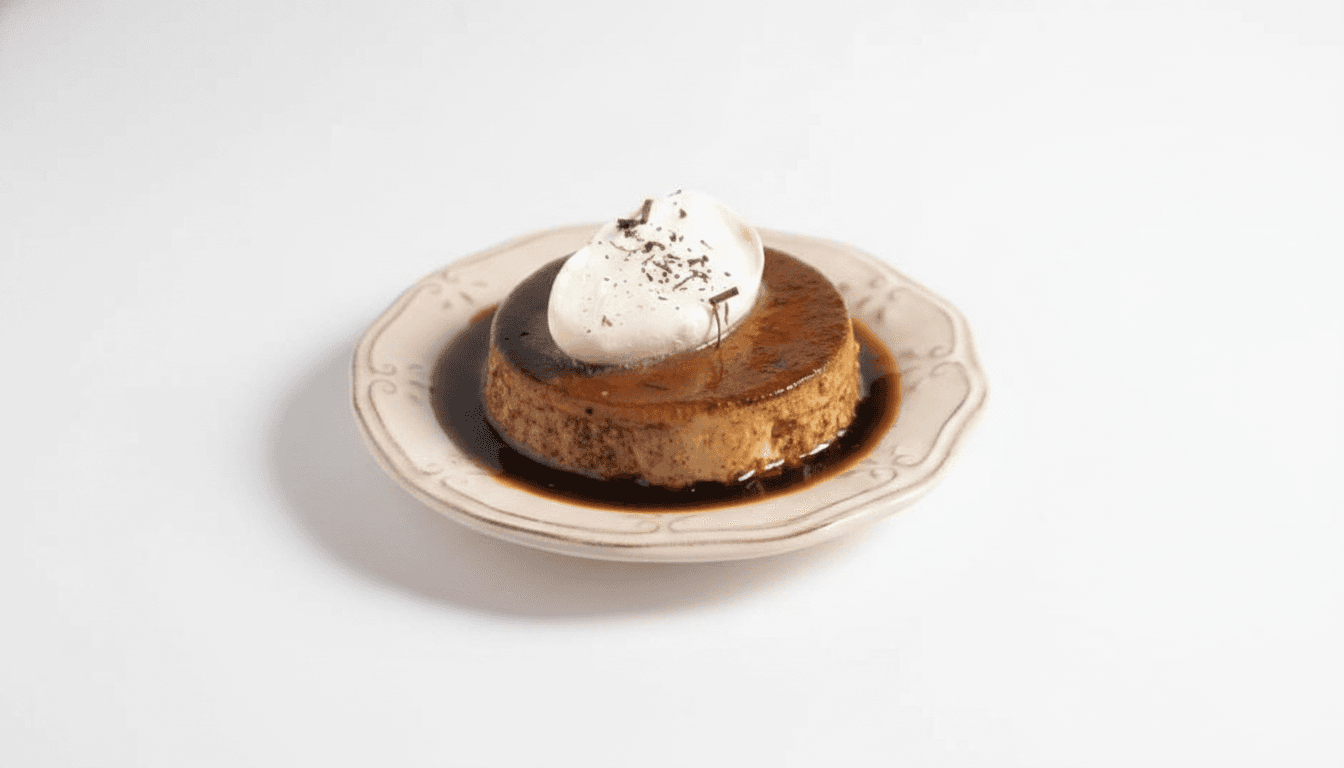
Hojicha Pudding with Salted Caramel
ほうじ茶 塩キャラメル プリン·(hōjicha shio-kyarameru purin)
Chapter 5 — Drinks & Desserts
There is a rhythm to a great ramen shop meal, ending with a palate coated in rich lipids and heavy umami. To serve a dense Western dessert after an eighteen-hour tonkotsu broth is a grammatical error. The meal demands a palate cleanser that respects the precise, project-oriented nature of what came before it. This Japanese purin is no weeknight hack; it demands a twelve-hour cure, precise thermodynamics to prevent microscopic bubbles, and high-quality loose-leaf hojicha. Spiked with a deeply savory tamari caramel that acts as the dessert's tare, this pudding stands as the ultimate, mature conclusion to a weekend ramen project.
Ingredients
- granulated sugar1/2 cup
- water2 tbsp
- unsalted butter1 tbsp
- heavy cream2 tbsp
- coarse sea salt1/2 tsp
- tamari1 tsp
- whole milk1 cup
- heavy cream1/2 cup
- loose-leaf hojicha3 tbsp
- large eggs2 large
- large egg yolk1 large
- granulated sugar1/4 cup
- vanilla extract1 tsp
Method
- 01
Construct the tamari caramel tare.
Combine the half cup of sugar and water in a heavy-bottomed saucepan over medium heat, swirling the pan gently without stirring until the syrup turns a deep, rusty amber and smells faintly of smoke.
- 02
Arrest the caramelization and set the base.
Whisk in the butter, warmed cream, sea salt, and tamari, then quickly pour a thin layer into the bottom of six ramekins to harden.
- 03
Extract the hojicha decoction.
Bring the whole milk and half cup of heavy cream to a bare simmer around 185°F, kill the heat, add the loose-leaf hojicha, cover, and steep for exactly four minutes.
- 04
Strain the infused dairy.
Pour the milk through a fine-mesh strainer into a bowl, using a ladle to violently press the tea leaves against the mesh to extract every drop of concentrated roasted flavor.
- 05
Break down the eggs without aeration.
Combine the whole eggs, egg yolk, and quarter cup of sugar in a bowl, keeping the whisk pressed against the bottom in a rapid zig-zag motion to cut the chalaza without introducing air bubbles.
- 06
Temper the eggs and double-strain the custard base.
Whisking side-to-side, pour the hot hojicha milk into the eggs in a steady stream, stir in the vanilla, and pass the mixture through a fine-mesh strainer twice for absolute clarity.
- 07
Construct the yusen-yaki water bath.
Divide the liquid into the ramekins, place them in a roasting pan lined with a folded kitchen towel, pour 140°F tap water halfway up the sides, and cover tightly with foil.
- 08
Bake and administer the twelve-hour cure.
Bake at 300°F for 30 to 35 minutes until the centers jiggle like loose gelatin, cool on a wire rack, then cover and refrigerate overnight to relax the proteins and liquefy the caramel.
Notes
Respect the water bath temperature to prevent su.
Boiling water in the roasting pan will cause the liquid inside the egg matrix to boil, leaving honeycomb-like holes that permanently destroy the pudding's silky texture.
Unmolding the purin requires a confident snap.
Run a thin knife around the very top edge to break the vacuum seal, place a small plate upside down over the ramekin, and invert the dessert with a sharp downward snap.