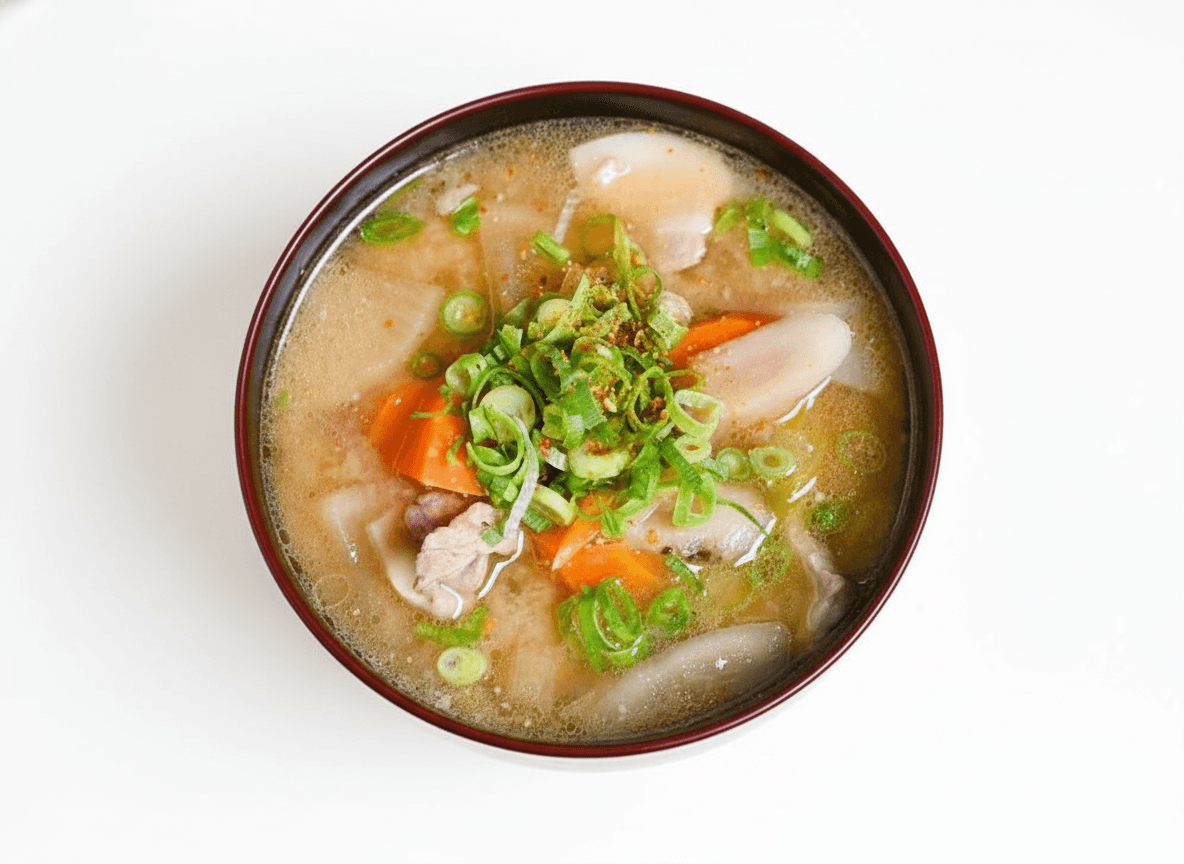
Gudakusan Tonjiru
具だくさん豚汁·(gu-da-ku-san ton-ji-ru)
Obaachan's Wisdom: Healing & Zero Waste
Forget the delicate, ethereal broth served in tiny lacquered bowls before your sushi. This is a working-class, refrigerator-clearing powerhouse of a stew. Grandmothers have been using this rich, pork-fat-laced soup to warm bones and stretch leftovers since the Meiji era. The secret to making it taste exactly like the homeland isn't in hunting down impossibly rare mountain tubers; it’s in the pragmatic technique. By frying the root vegetables in rendered pork fat first, and splitting the miso addition to preserve its fermented soul, you get a deeply restorative bowl that effortlessly bridges the gap between authentic heritage and a busy American weeknight.
Before you start
Freeze your pork belly for effortless, paper-thin slicing.
If you cannot find pre-sliced hot pot pork belly, freeze a fatty block of pork for 20 minutes to firm it up, making it simple to slice into thin coins with a standard chef's knife.
Lean on high-quality instant dashi.
Making scratch dashi from kombu and katsuobushi is wonderful, but relying on good dashi packets or instant powder ensures this deeply nourishing meal actually makes it to the table on a Tuesday night.
Ingredients
- pork belly or pork shoulder1/2 lb
- toasted sesame oil1 tbsp
- daikon radish1/2 med
- carrot1 large
- Yukon Gold potato1 med
- burdock root1/2 med
- leek1/2 large
- dashi stock5 cup
- awase miso5 tbsp
- soy sauce1 tsp
- mirin1 tsp
- fresh ginger1 tsp
Method
- 01
Sear the pork in toasted sesame oil until the fat renders.
Place a heavy-bottomed pot over medium heat, add the oil, and cook the pork for 2 to 3 minutes until it loses its pink color. This crucial step kicks off the savory foundation of the stew.
- 02
Stir-fry the root vegetables in the rendered pork fat.
Toss the daikon, carrot, potato, and burdock root into the pot, cooking for 3 to 4 minutes until their edges soften and they absorb the savory oils, preventing them from turning to mush later.
- 03
Pour in the dashi and meticulously skim away any rising scum.
Bring the stock to a gentle boil over medium-high heat, carefully spooning off the coagulated foam that floats to the surface for the first few minutes to ensure a clean, refined broth.
- 04
Dissolve a small portion of the miso into the simmering broth.
Turn the heat down to a low simmer, dissolve 1 tablespoon of miso into the liquid, cover, and let it go for 15 minutes to force that deep umami straight into the core of the thick root vegetables.
- 05
Add the aromatics and kill the heat entirely.
Stir in the sliced leeks, soy sauce, mirin, and grated ginger, let it cook for exactly one minute, then turn off the stove.
- 06
Swirl in the remaining miso off the heat to preserve its fragile aroma.
Use a ladle and chopsticks to gently dissolve the remaining 4 tablespoons of miso into the hot liquid, ensuring its fermented funk isn't destroyed by boiling, before ladling the rich stew into large bowls.
Notes
Embrace the zero-waste philosophy of the dish.
Tonjiru is a working template for whatever needs using up in the crisper drawer; toss in wilting cabbage, extra mushrooms, or stray greens without fear of ruining its authenticity.
Don't stress over obscure Japanese tubers.
If you cannot find traditional satoimo (taro) or burdock root at your local Asian market, Yukon Gold potatoes and sliced fresh shiitake mushrooms are highly authentic, widely used regional substitutes.
From Cook Japanese in America.