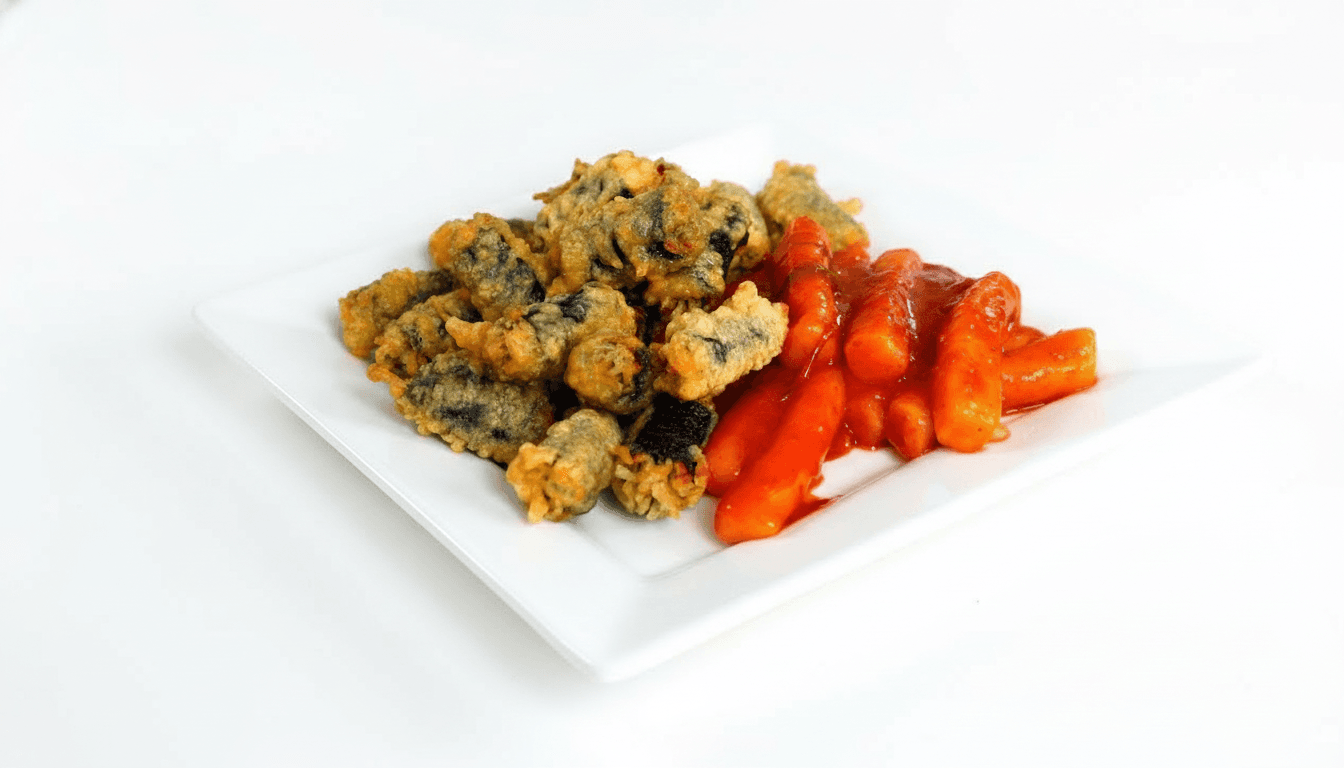
Gimmari Twigim
김말이 튀김·(gimmari twigim)
After-School Bunsikjib
Forget the over-engineered, sushi-adjacent knockoffs. Real gimmari—the kind you ate out of paper bags or off oval melamine plates in after-school snack shops—is a masterpiece of working-class utility. It relies on gongal japchae, a minimalist, 'fake' japchae of bouncy sweet potato noodles punched up with soy and sesame, stuffed into a seaweed wrapper, and deep-fried. The grandma's secret to that impenetrable, shatteringly crisp shell? A violently cold ice-water batter and a dry dusting of starch that stops the coating from sliding right off the seaweed. Serve it hot, and dunk it straight into bubbling tteokbokki sauce like you know what you're doing.
Before you start
Prepare your fry station.
Deep frying requires organization. Set up a wire cooling rack over a baking sheet and have your spider or long chopsticks ready before the oil gets hot.
Ingredients
- Dangmyeon (Korean sweet potato glass noodles)4 oz
- neutral oil1 tbsp
- onion1/2 small
- carrot1 small
- Jin-ganjang (Korean soy sauce)3 tbsp
- toasted sesame oil1 tbsp
- sugar1 tbsp
- black pepper1/4 tsp
- Gimbap Gim (unseasoned roasted seaweed sheets)5 large
- Twigim Garu (Korean Frying Mix)1 cup
- ice-cold water1 cup
- neutral oil4 cup
Method
- 01
Boil and chop the glass noodles.
Bring a medium pot of water to a rolling boil, drop in the dangmyeon, and boil vigorously for 6 to 7 minutes until soft but still chewy. Drain immediately, rinse under cold running water to halt the cooking and remove excess starch, then chop into 1-inch lengths with kitchen scissors.
- 02
Sauté the aromatics and season the filling.
Heat 1 tablespoon of neutral oil in a skillet over medium heat and sauté the onion and carrot for 2 to 3 minutes until translucent. Turn off the heat, add the chopped noodles, soy sauce, sugar, sesame oil, and black pepper, tossing until the noodles soak up the dark, savory liquid.
- 03
Roll the gimmari tightly.
Lay a quarter-sheet of seaweed flat on a cutting board with the shiny side down. Place a modest tablespoon of the noodle mixture near the edge closest to you, roll it up tightly away from yourself, and seal the final edge with a dab of water.
- 04
Prime the rolls with a dry dusting.
Place 1/4 cup of the dry twigim garu into a shallow bowl and toss the rolled gimmari until lightly coated. This dry primer layer is non-negotiable for ensuring the wet batter clings to the slick, hydrophobic seaweed.
- 05
Mix the ice-water batter.
In a mixing bowl, combine the remaining 3/4 cup of twigim garu with 1 cup of ice-cold water, stirring loosely with chopsticks. Stop mixing while there are still dry lumps in the bowl; overmixing develops gluten and destroys the crispiness.
- 06
Execute the first fry.
Heat 2 inches of neutral oil in a heavy-bottomed pot to 350 degrees Fahrenheit. Dip the dusted rolls into the icy batter, let the excess drip off, and fry in small batches for 2 to 3 minutes until pale golden brown, then remove and drain on a wire rack.
- 07
Flash-fry for an earth-shattering crunch.
Let the fried rolls rest for 5 minutes so residual steam from the filling migrates to the crust, then drop them back into the hot oil for 30 to 45 seconds until deep golden brown.
Notes
Substituting Twigim Garu.
If you cannot find Korean frying mix at your local Asian market, make your own by whisking 3/4 cup all-purpose flour, 1/4 cup cornstarch, 1 teaspoon baking powder, 1/2 teaspoon fine salt, and a dash of garlic powder.
Make it ahead.
These rolls freeze brilliantly. Do the first fry on a Sunday, let them cool completely on the rack, and freeze them flat. You can resurrect them directly from frozen on a weeknight in a 390-degree Fahrenheit air fryer for 8 to 10 minutes.
From Cook Korean in America.