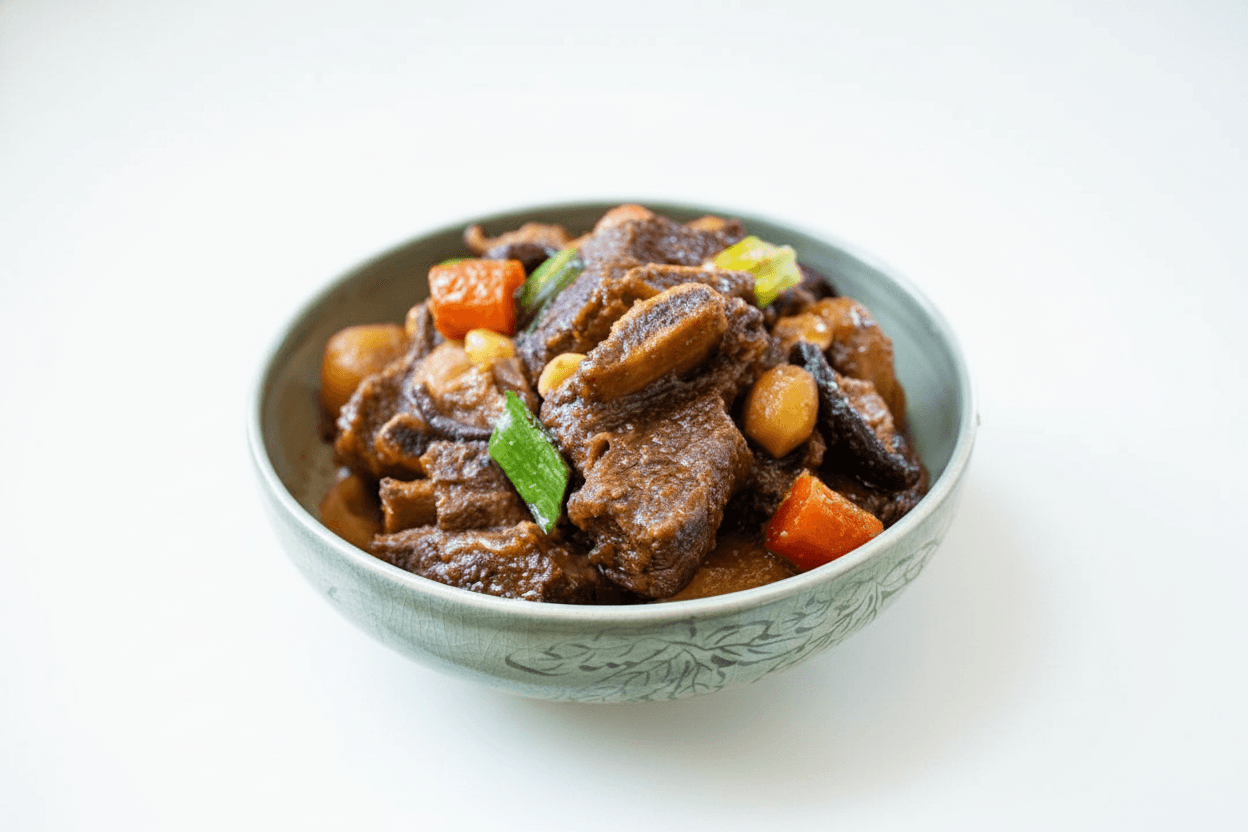
Galbijjim
갈비찜·(gal-bi-jjim)
The Sunday Church Potluck
Traditionally, galbijjim demands a grandmother's entire day—soaking, skimming, and coaxing beef ribs into sweet, gelatinous submission. It is the undisputed crown jewel of the Sunday church potluck. But for a Tuesday night in an American suburb, tradition needs a practical ally. By deploying a brilliant grandmother-approved sugar water soak to rapidly purge the meat, and leaning heavily on the high-pressure magic of an electric pressure cooker, this recipe delivers that exact, fall-off-the-bone, sticky-sweet taste of the homeland in under ninety minutes. No searing, no Western shortcuts, just pure, uncompromising flavor engineered for the kitchen you actually have.
Ingredients
- bone-in beef short ribs3 lb
- white sugar3 tbsp
- Asian pear1/2 med
- yellow onion1/2 med
- garlic cloves8 med
- fresh ginger1 med
- soy sauce1/2 cup
- rice wine1/4 cup
- brown sugar3 tbsp
- rice syrup2 tbsp
- black pepper1/2 tsp
- dried shiitake mushrooms5 med
- Korean radish1/2 lb
- carrots2 large
- peeled chestnuts8 med
- toasted sesame oil2 tbsp
- scallions2 med
Method
- 01
Soak the short ribs in sugar water to rapidly purge the blood.
Place the short ribs in a large bowl, cover completely with cold water, and stir in the white sugar until dissolved. This changes the osmotic pressure, drawing out the blood and bone dust in just thirty minutes instead of hours. Drain and rinse well.
- 02
Parboil the ribs to ensure a pure, clean broth.
Western stews begin by searing meat in hot oil, but traditional Korean braises demand you boil it first. Drop the rinsed ribs into a large pot of vigorously boiling water for exactly five to seven minutes. Skim the gray foam that rises, then drain and vigorously wash each rib under cold running water to scrub away all remaining scum.
- 03
Blend the aromatic braising sauce.
In a blender, purée the Asian pear, onion, garlic, and ginger until entirely smooth. Transfer to a bowl and whisk in the soy sauce, rice wine, brown sugar, rice syrup, black pepper, and exactly one cup of the reserved mushroom soaking liquid.
- 04
Pressure cook the meat and sauce for thirty-five minutes.
Place the cleaned, parboiled ribs into the insert of an electric pressure cooker and pour the blended sauce over the top, tossing to coat. Seal the lid and cook on manual high pressure for thirty-five minutes.
- 05
Chamfer the root vegetables to maintain the integrity of the sauce.
While the meat cooks, take a paring knife or peeler and shave off the sharp corners of the radish and carrot chunks. Making them round prevents them from smashing against the meat in the boiling pot and turning your beautiful, glossy sauce into a cloudy mush.
- 06
Reduce the braising liquid into a glorious, sticky glaze.
Allow the pressure cooker to naturally release for ten minutes, then carefully vent the rest and open the lid. Skim off excess pools of fat with a spoon, then add the chamfered vegetables, halved rehydrated mushrooms, and chestnuts. Turn the cooker to its sauté function and let it simmer vigorously, uncovered, for twelve to fifteen minutes until the vegetables are tender and the sauce is thick and sticky.
- 07
Garnish and serve immediately.
Turn off the heat, gently stir in the toasted sesame oil, and transfer the glistening stew to a large serving platter. Pour the reduced sauce over the meat, top with chopped scallions, and serve with steaming bowls of white rice.
Notes
Never sear the meat for a traditional Korean braise.
Searing introduces a fundamentally different flavor profile. The parboiling and washing step is completely non-negotiable if you want the dish to taste like an authentic grandmother's kitchen.
Asian pears are critical for tenderizing the beef.
They contain enzymes that gently break down tough muscle fibers. If you absolutely cannot find one at your local Asian market, substitute a Bosc apple, but avoid highly aggressive tenderizers like pineapple.
From Cook Korean in America.