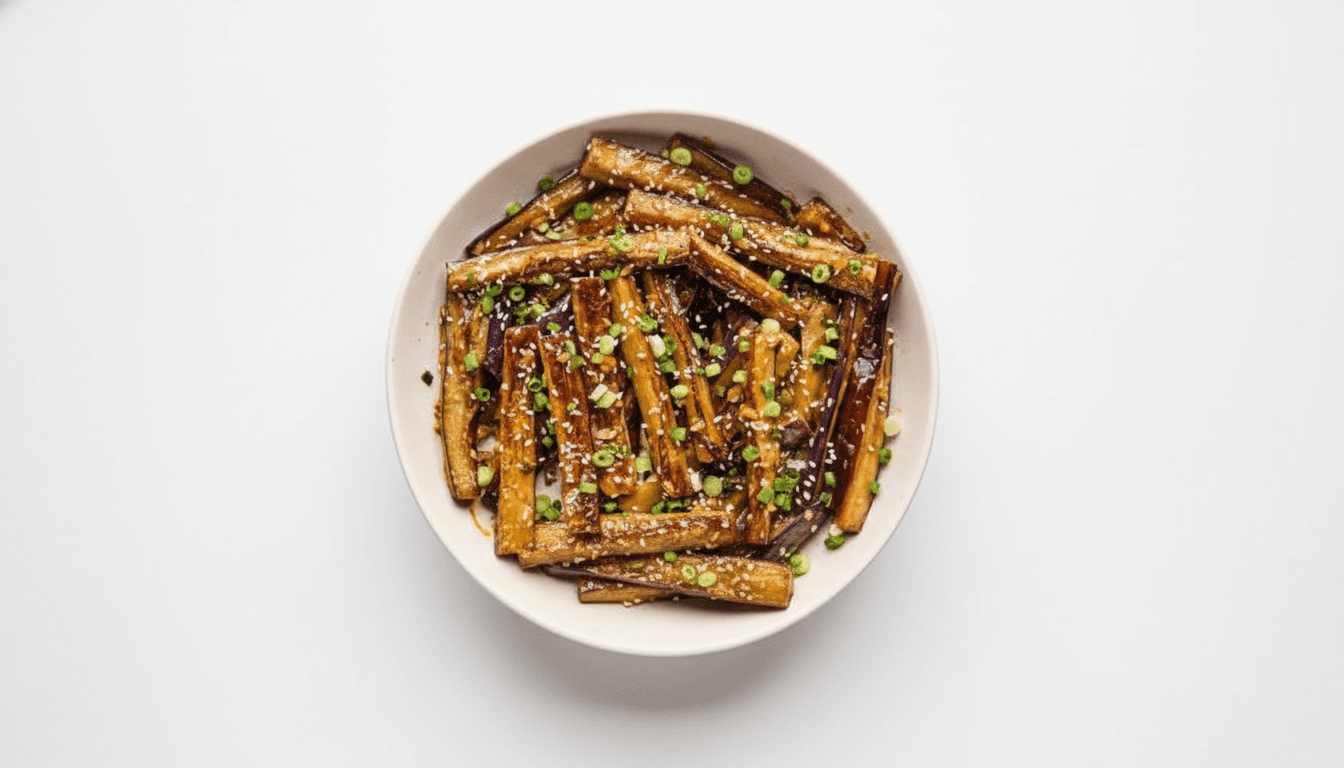
Flash-Fried Crispy Nasu with White Sesame and Burnt Mayu
茄子の素揚げ 白ごまと黒マー油·(nasu no su-age shirogoma to kuro mayu)
Chapter 4 — Sides: The Ramen-Shop Counter Menu
At 11 PM under the neon hum of a Little Tokyo ramen shop, the sides need to stand up to the violent umami of a tonkotsu broth. This isn't a breezy weeknight vegetable; it's a structural masterpiece built on the uncompromising grammar of the ramen counter. You're going to flash-fry Japanese eggplant so it yields perfectly to the bite, lay it over a nutty, rich sesame puree, and drag it through black garlic oil you've deliberately pushed past the point of comfort. It takes nerve to carbonize garlic, but that astringent, jet-black depth is exactly what cuts through the fat and makes the whole damn thing sing.
Before you start
Score the eggplant using hidden knife cuts.
The diagonal crosshatch pattern, known as kakushi-bōchō, isn't just aesthetic; it severs tough skin fibers and ensures rapid heat penetration so the interior turns custardy in seconds.
Ingredients
- head of garlic1 large
- rendered lard1/2 cup
- toasted sesame oil1/4 cup
- shiro nerigoma1/4 cup
- soy sauce1 tbsp
- unseasoned rice vinegar1 tbsp
- granulated sugar2 tsp
- mentsuyu1 tbsp
- warm water2 tbsp
- Japanese eggplants4 med
- neutral frying oil1 qt
- fine sea salt1 pinch
- shichimi togarashi1 tsp
- scallions2 med
- white sesame seeds1 tbsp
Method
- 01
Melt the lard over medium-low heat until it barely shimmers.
Use a small, heavy-bottomed saucepan. You are looking for roughly 200°F (90°C).
- 02
Fry the garlic to extract the golden, sweet aromatics.
Add the uniform garlic slices and stir continuously. As soon as they hit a light, golden brown, use a slotted spoon to extract exactly one-third of the chips to a paper towel-lined plate.
- 03
Push the remaining garlic to a deep roasted brown to build depth.
Keep cooking the remaining garlic until it hits a dark, coffee-bean brown, then pull another half of what's left in the pan to the plate.
- 04
Carbonize the final batch of garlic to forge the astringent bitterness.
Hold your nerve here and let the final third of the garlic smoke lightly until it is entirely, unmistakably pitch black, then pull the pan from the heat immediately and remove the chips to cool.
- 05
Pulverize the fried garlic and emulsify the oils.
Grind all three stages of the fried garlic into a fine powder using a Japanese mortar or a stick blender, then stream in the cooled, rendered lard from the pan along with the toasted sesame oil until it forms a silky, jet-black oil.
- 06
Whisk the sesame puree components until smooth and glossy.
In a bowl, vigorously whisk the shiro nerigoma, soy sauce, rice vinegar, sugar, and mentsuyu; it will seize up at first, so slowly stream in the warm water until it relaxes into the consistency of thick hummus.
- 07
Heat the neutral frying oil to exactly 350°F (180°C).
Temperature control is absolute; if the oil is too cold, the eggplant becomes a greasy sponge, and if it is too hot, the exterior burns before the flesh cooks.
- 08
Flash-fry the eggplant batons skin-side down first.
Dropping them on their skin immediately blisters the surface and locks in the vibrant purple pigments; fry for two minutes, then flip and fry the flesh for exactly one more minute.
- 09
Drain the eggplant on a wire rack and season immediately.
Never use paper towels as they will trap steam and destroy the delicate crunch you just built; dust lightly with fine sea salt.
- 10
Build the dish from the bottom up on a dark plate.
Swirl a generous bed of the white sesame puree, arrange the hot eggplant batons on top to create height, and drag a heavy spoonful of the shaken black mayu over everything.
- 11
Garnish with spice and alliums before serving immediately.
Dust liberally with shichimi togarashi, top with the razor-thin scallions and toasted sesame seeds, and get it to the table alongside a cold beer or a bowl of heavy broth.
Notes
Source real rendered lard for the mayu.
Supermarket lard in a box is hydrogenated and carries a metallic off-flavor; hit up your butcher for pure pork fat to get the authentic, heavy mouthfeel that a proper ramen shop provides.
Respect the smoke point and maintain ventilation.
Taking garlic to stage-three carbonization produces heavy smoke, so run your exhaust fan on high. When blending the fat back into the garlic powder, ensure the lard has dropped below 140°F (60°C) to prevent a violent hot-oil spray.