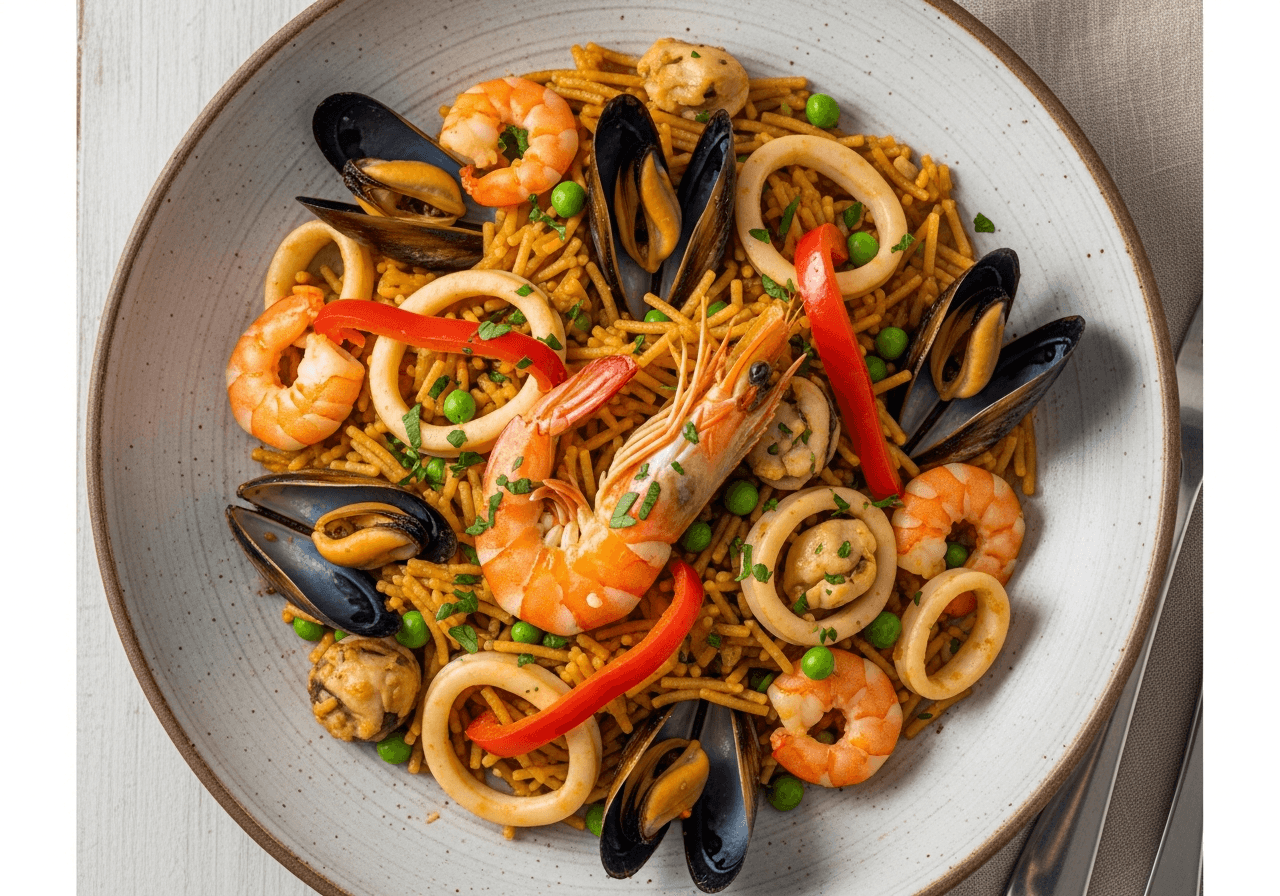
Fideuá Rápida de Marisco (The Sunday Paella Alternative)
Fideuá Rápida de Marisco·(fee-deh-WAH)
El Domingo y La Sobremesa
Fideuá is paella’s coastal, fast-cooking cousin, born on the fishing boats of Valencia when a clever cook realized he was out of rice. For the home cook, it is the ultimate secret weapon. While a proper Sunday paella demands specific grain, special pans, and an abundance of patience, this weeknight version utilizes toasted, broken angel hair pasta to slash the cooking time without sacrificing the deep, oceanic soul of the original. The grandmother's secret is non-negotiable here: you toast the dry noodles in the pan until they are nutty and golden, allowing them to drink up the rich seafood broth and literally stand straight up in the pan when they're finished.
Ingredients
- large raw shrimp, shell-on1 lb
- cleaned squid tubes1/2 lb
- fresh mussels1/2 lb
- seafood or fish stock3 cup
- saffron threads1 pinch
- dried angel hair pasta8 oz
- extra-virgin olive oil4 tbsp
- yellow onion1 small
- red bell pepper1 small
- garlic3 small clove
- Roma tomatoes2 med
- Spanish sweet smoked paprika1 tsp
- kosher salt and black pepperto taste
- lemon1 med
- alioli1/2 cup
Method
- 01
Fortify the broth with the shrimp shells.
Place the reserved shrimp shells in a small saucepan over medium heat with a drop of olive oil and sauté for 2 minutes until pink. Pour in the seafood stock, add the saffron threads, and bring to a gentle simmer, keeping it warm on the back burner.
- 02
Toast the broken pasta in a wide skillet.
Place a 12-inch heavy-bottomed skillet over medium heat with 2 tablespoons of olive oil. Add the broken angel hair pasta and stir constantly for 3 to 4 minutes until deeply golden brown and nutty, then immediately remove the pasta to a bowl and leave the skillet unwashed.
- 03
Sear the seafood quickly to leave its flavor in the pan.
Return the skillet to medium-high heat with the remaining 2 tablespoons of olive oil. Season the peeled shrimp and squid rings with salt, then sear them in a single layer for just 1 to 2 minutes per side until barely opaque. Remove the seafood to a plate before it overcooks, leaving the flavorful drippings behind.
- 04
Build the sofrito slowly.
Reduce the heat to medium-low, add the onion and red bell pepper, and cook slowly for 5 to 7 minutes until soft. Stir in the minced garlic for 1 minute, then add the grated tomato pulp and let it caramelize into a dark, jam-like consistency.
- 05
Pull the pan off the heat to add the paprika.
Remove the skillet from the burner completely for 10 seconds before stirring in the smoked paprika. This old-school trick prevents the residual heat from burning the delicate spice and turning the whole dish bitter.
- 06
Combine the toasted noodles and broth without stirring.
Return the pan to medium-high heat, toss the toasted noodles into the sofrito to coat, and pour in 2 1/2 cups of the hot, saffron-infused broth through a strainer, discarding the shells. Shake the pan gently to distribute the noodles evenly, and from this point forward, absolutely do not stir.
- 07
Simmer rapidly until the liquid reduces.
Bring to a rapid boil, then reduce to a simmer uncovered for 6 to 8 minutes. When most of the liquid is absorbed but the pan is still slightly wet, arrange the seared shrimp, squid, and raw mussels over the top of the noodles.
- 08
Listen for the crackle that forms the crust.
Cook for another 3 to 4 minutes until the mussels open and the pan sounds like it is sizzling rather than boiling, indicating the water is gone and the bottom layer is frying into a crispy crust called the socarrat. The tips of the thin noodles will curl upward and appear to stand on end.
- 09
Rest the fideuá before serving.
Turn off the heat, cover the pan loosely with a clean kitchen towel, and let it rest for 5 minutes so the remaining steam perfectly sets the pasta. Serve straight from the pan with lemon wedges and a generous dollop of garlic alioli.
Notes
Do not substitute with thick macaroni.
While some English-language blogs suggest elbow macaroni, Spanish locals correctly insist on thin noodles. Standard angel hair pasta broken into pieces absorbs the right amount of broth, toasts quickly, and crisps perfectly at the bottom of the pan.