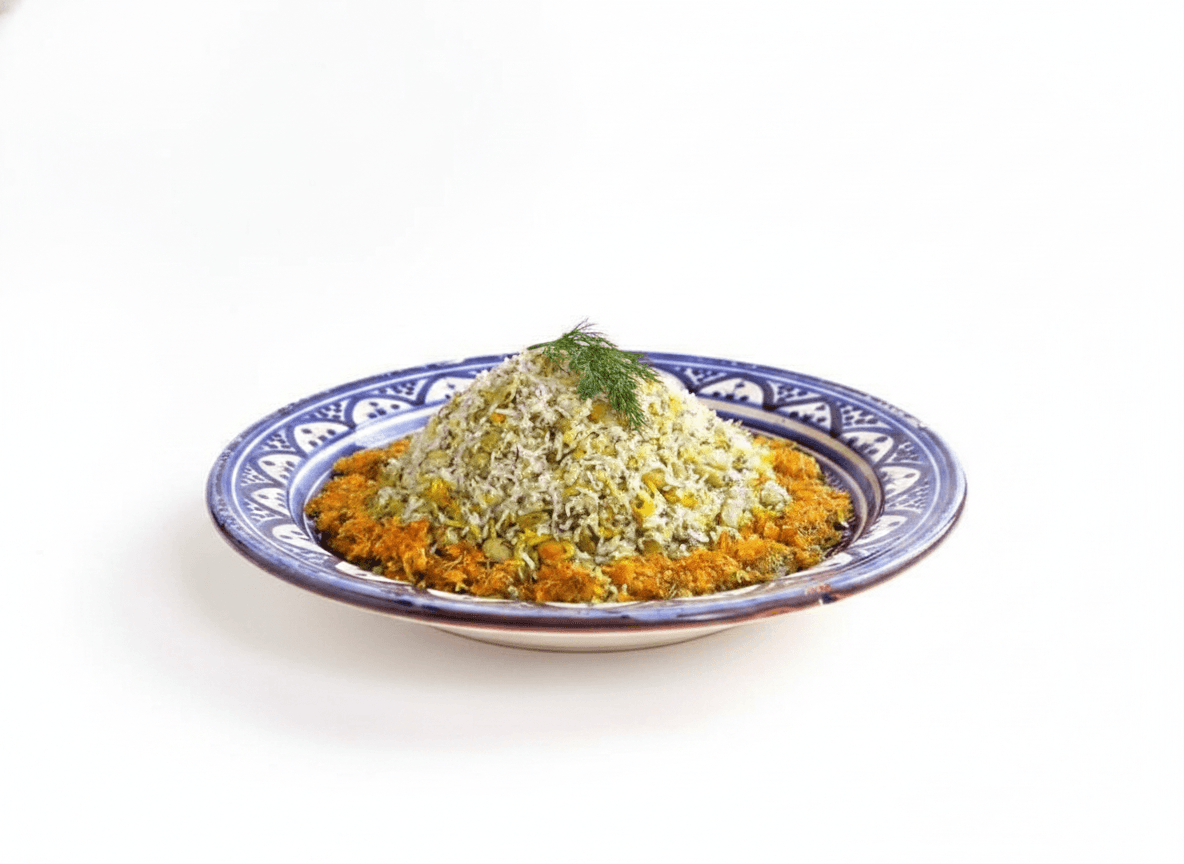
Express Baghali Polo
باقالی پلو·(ba-gha-lee po-lo)
Berenj & Tahdig (The Sacred Art of Persian Rice)
A proper banquet-style baghali polo requires hours of shelling fresh fava beans and slow-braising lamb shanks—a glorious undertaking, but a mathematical impossibility for a working parent on a Tuesday in Ohio. Faced with this reality, the Iranian-American grandmother doesn't compromise; she adapts. This express version relies on the domestic "kateh" absorption method, utilizing frozen baby lima beans, dried dill, and quick pan-fried spiced meatballs to recreate the exact olfactory blueprint of a Tehran kitchen. It is not a shortcut, but an authentic, unapologetic testament to diaspora ingenuity that yields perfectly separated grains, a shatteringly crisp tahdig, and the unmistakable, comforting taste of home.
Before you start
Wash the rice thoroughly.
Rinsing the basmati rice under cold water 3 to 5 times until the water runs completely clear is mandatory to remove surface starch and prevent the grains from gluing together.
Ingredients
- long-grain basmati rice2 cup
- frozen baby lima beans2 cup
- high-quality dried dill weed1/2 cup
- neutral oil3 tbsp
- unsalted butter2 tbsp
- kosher salt1 tbsp
- garlic1 large clove
- saffron threads1/4 tsp
- ground beef, veal, or lamb1 lb
- yellow onion1 large
- turmeric powder1 tsp
- kosher salt1 tsp
- black pepper1/2 tsp
Method
- 01
Combine the ground meat, grated onion, turmeric, 1 tsp kosher salt, and black pepper in a mixing bowl.
Knead vigorously with your hands for 2 to 3 minutes until the mixture becomes slightly tacky.
- 02
Pinch off small pieces and roll them into mini meatballs roughly the size of a large cherry.
Heat 2 tablespoons of oil in a large skillet over medium-high heat, add the meatballs, and pan-fry for 8 to 10 minutes until deeply browned on all sides, then set aside.
- 03
Combine the washed rice, frozen lima beans, smashed garlic clove, 1 tbsp kosher salt, 3 tablespoons of neutral oil, and exactly 3 cups of water in a medium non-stick pot.
A heavy-bottomed non-stick pot is essential here to build the perfect tahdig later.
- 04
Place the pot over high heat to bring to a vigorous boil, then gently stir in the dried dill.
Keep the pot uncovered for this phase so the surface water can evaporate.
- 05
Allow the water to boil off rapidly until the surface liquid disappears and small steam craters form in the rice.
The rice should look mostly dry on top but still sound wet at the bottom.
- 06
Poke four or five holes straight down through the rice to the bottom of the pot using the handle of a wooden spoon.
This crucial step allows steam from the bottom to escape upward. Scatter the butter cubes evenly over the top of the rice.
- 07
Wrap the lid of your pot in a clean kitchen towel and place it tightly on the pot.
The towel absorbs condensation so it doesn't drip back down and ruin the rice. Reduce the heat to the absolute lowest setting and let it steam undisturbed for 35 to 45 minutes to form the crispy tahdig.
- 08
Remove the lid and gently scoop out about a half cup of the cooked rice from the top into a small bowl.
Pour your bloomed saffron water over this small bowl of rice and mix gently until the grains are bright golden.
- 09
Fluff the remaining rice in the pot and mound it onto a platter in a loose pyramid.
Scatter the golden saffron rice over the mound and arrange the hot spiced meatballs around the base.
- 10
Carefully pry the golden, crispy tahdig crust from the bottom of the non-stick pot.
Break it into shards and serve it proudly on a separate plate, or place it right at the apex of the rice mountain.
Notes
Use a high-quality non-stick pot.
Teflon, ceramic, or hard-anodized aluminum is non-negotiable for ensuring the tahdig releases cleanly from the bottom.
Listen to your pot to monitor the tahdig.
When the water evaporates, it sounds wet. Once covered on low heat, it should transition to a faint, rhythmic sizzle. If it sounds aggressive, your heat is too high.
Do not substitute fresh dill.
Fresh dill introduces too much water into the precise absorption ratio of the kateh method, resulting in mushy, gummy rice.
From Cook Persian in America.