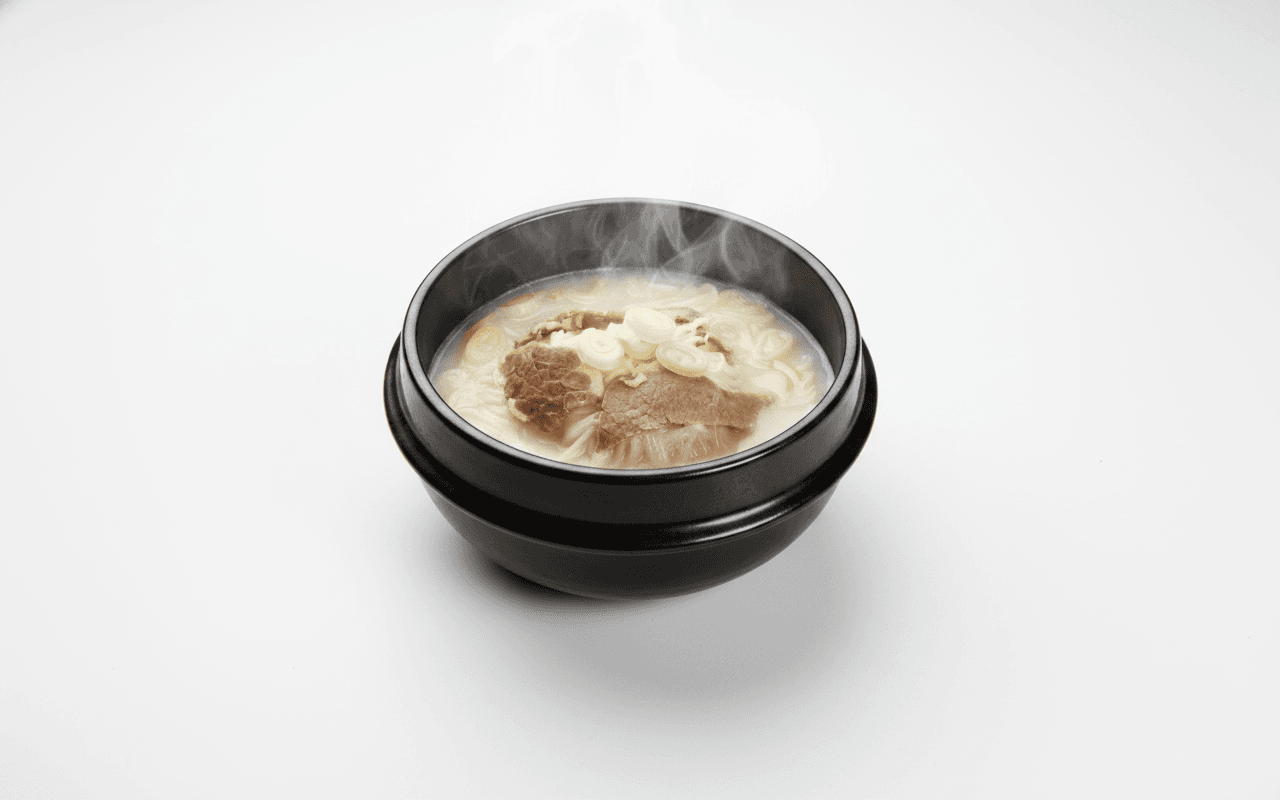
Dwaeji Gukbap
돼지국밥·(dwaeji gukbap)
Halmoni's Weekend Projects
This isn't the neon-lit, cheese-pulling Hollywood caricature of Korean food. This is the restorative, bone-deep soul food of Busan—a steaming, milky bowl of pork and rice born of wartime necessity. The real secret your grandmother knows is that you don't need to babysit a cauldron of pig bones for twelve hours to get there. By combining high-quality commercial sagol broth with fresh pork shoulder and a non-negotiable initial blanch, you can summon the exact unctuous, deeply savory ghost of the homeland on a Tuesday night. It arrives at the table as a blank canvas, waiting for you to paint it with salted shrimp, fiery paste, and garlic chives.
Before you start
Mix the fiery seasoning paste base.
In a small bowl, combine the 3 tablespoons of gochugaru, minced garlic, soup soy sauce, chopped saeujeot, and black pepper. Set aside until the broth is hot.
Whisk the chive salad dressing.
In a medium bowl, combine the soy sauce, 1 tablespoon of gochugaru, fish sauce, sugar, and toasted sesame oil. Set aside.
Ingredients
- boneless pork shoulder1 1/2 lb
- Korean sagol gomtang6 cup
- water2 cup
- onion1/2 med
- garlic4 clove
- ginger1 inch
- black peppercorns1 tsp
- doenjang1 tbsp
- gochugaru3 tbsp
- garlic1 tbsp
- soup soy sauce1 tbsp
- saeujeot1 tbsp
- black pepper1 pinch
- buchu4 oz
- soy sauce1 tbsp
- gochugaru1 tbsp
- fish sauce1/2 tbsp
- sugar1/2 tbsp
- toasted sesame oil1 tbsp
- toasted sesame seeds1 tsp
- cooked short-grain white rice4 cup
- scallions3 med
- saeujeot2 tbsp
Method
- 01
Blanch the pork to eliminate any gamey odors.
Bring a medium pot of water to a rolling boil, drop in the whole pork shoulder, and boil vigorously for exactly 5 minutes. Drain the pork, rinse it thoroughly under cold running water to scrub off any grayish scum, and discard the dirty water.
- 02
Build the broth.
In a clean, heavy-bottomed pot, combine the blanched pork shoulder, the sagol bone broth, fresh water, onion, peeled garlic, ginger, peppercorns, and doenjang. Bring to a gentle boil over medium-high heat.
- 03
Simmer the pork until perfectly tender.
Skim any residual foam off the top, reduce the heat to medium-low, cover, and simmer for 40 to 50 minutes until a chopstick pierces the thickest part of the meat with minimal resistance. Do not overcook until it shreds.
- 04
Complete the dadaegi paste.
Once the soup is hot, spoon 2 tablespoons of the boiling broth into your prepared spice mix and stir until it forms a thick, wet, brick-red paste.
- 05
Slice the pork strictly against the grain.
Remove the cooked pork from the broth and let it rest on a cutting board for 5 to 10 minutes. Identify the direction of the muscle fibers and slice the pork perpendicular to the grain as thinly as humanly possible.
- 06
Strain and prepare for assembly.
Using a slotted spoon, fish out and discard the onion, garlic, ginger, and peppercorns from the broth, keeping the liquid gently simmering. Toss the garlic chives into your prepared dressing until evenly coated.
- 07
Assemble the soup.
Place a mound of warm rice at the bottom of four bowls, fan a generous portion of the sliced pork over the rice, and ladle the boiling hot, milky broth over the meat.
Notes
Season to your soul's content at the table.
This soup arrives intentionally under-seasoned. Drop in a half-teaspoon of salted shrimp for ocean-like salinity, a dollop of fiery dadaegi, and a handful of seasoned chives.
Respect the grain.
Slicing the pork parallel to the grain is the fastest way to ruin this dish with tough, unchewable meat. Always cut perpendicular to the muscle fibers.
Don't skimp on the salt shrimp.
Saeujeot provides an enzymatic, fermented funk that plain salt simply cannot replicate, anchoring the authentic Busan flavor profile.
From Cook Korean in America.