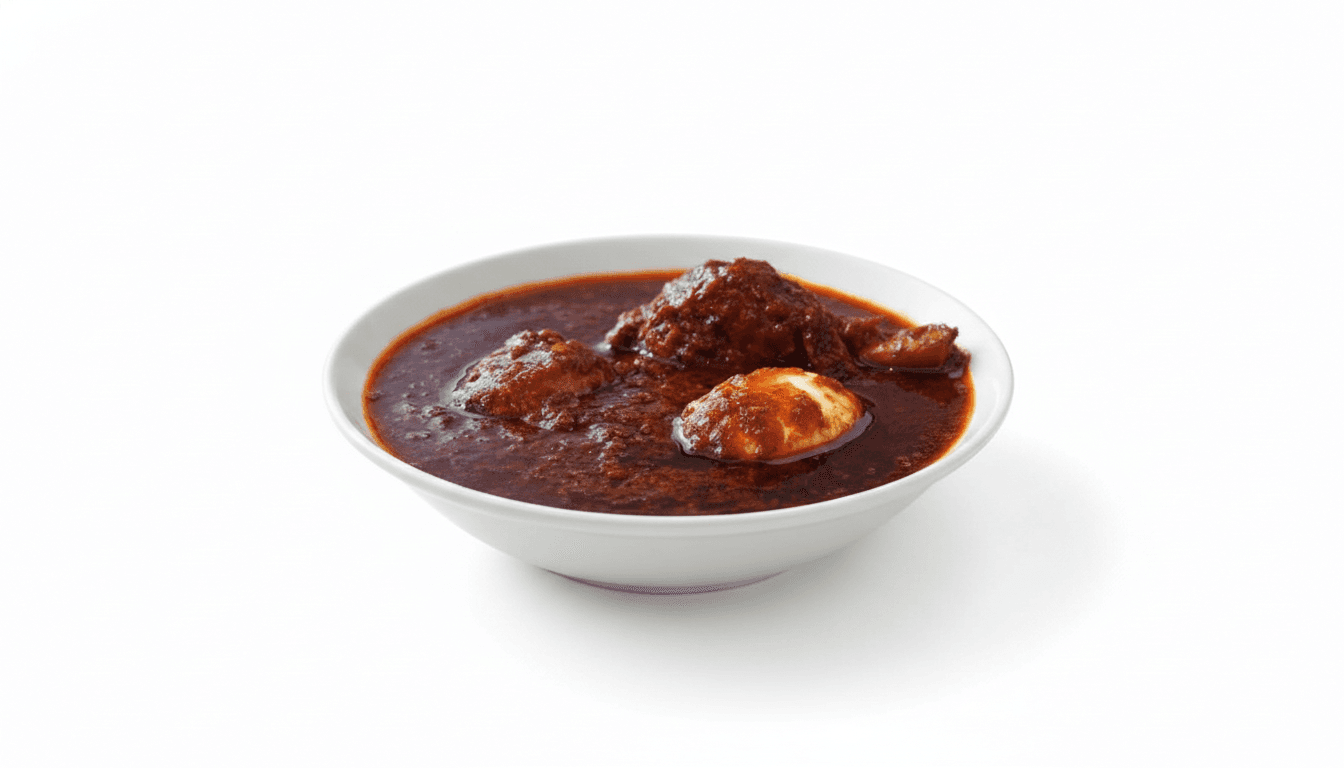
Doro Wat
ዶሮ ወጥ·(dō-rō wät)
Ye'Fisik: Sunday Suppers and Sizzling Skillets
Doro Wat isn't just a stew; it's a culinary rite of passage. It's a dark, fiery, mahogany braise that smells exactly like Sunday suppers in Addis Ababa. The secret to that intense, soul-warming flavor is the kulet—a ridiculous mountain of red onions cooked down to a sweet, dark jam. Generations of women spent hours weeping over a cutting board to get it right, but the modern grandmother's secret is the food processor. It saves your sanity on a Tuesday night without sacrificing an ounce of that rich, slow-simmered, spice-bloomed depth. This is the real deal: tender chicken yielding to time, sharp berbere heat, and a late-stage hit of sweet aromatics that hits you right in the chest.
Before you start
If you cannot find pre-mixed Mekelesha, a quick homemade blend works perfectly.
Grind together a pinch each of black peppercorns, green cardamom seeds, cinnamon, cumin, cloves, and nutmeg. It flawlessly replicates the warming, aromatic lift required at the end of the stew.
Ingredients
- bone-in skinless chicken thighs and drumsticks2 lb
- lemons2 med
- kosher salt1 tbsp
- red onions3 lb
- spiced ghee or Niter Kibbeh1/2 cup
- neutral oil2 tbsp
- garlic cloves4 med
- fresh ginger1 tbsp
- tomato paste2 tbsp
- Berbere spice blend1/2 cup
- chicken stock2 cup
- eggs4 large
- Mekelesha spice blend1 tsp
Method
- 01
Massage the lemon juice and salt vigorously into the scored chicken, then let it rest at room temperature.
This acid wash is non-negotiable. It not only cleans the meat of any gamey flavors, but gently denatures the surface proteins, opening the chicken up to absorb the rich, spicy gravy.
- 02
Pulse the quartered red onions in a food processor until they form a chunky, wet puree.
Be careful not to blend them into absolute liquid; you want the texture of a very fine salsa. This shortcut saves thirty minutes of weeping over a cutting board.
- 03
Transfer the onion puree to a large, dry, heavy-bottomed Dutch oven and cook over medium-low heat without any oil.
This is the most crucial step in Ethiopian cooking. Cook for 30 to 45 minutes, stirring frequently, until the cellular water evaporates and the onions reduce to a fraction of their volume, turning a deep, rosy pink.
- 04
Once the onions are dry and slightly sticking to the bottom, stir in half of the spiced ghee, the neutral oil, garlic, and ginger.
The fat will instantly sizzle. Sauté this mixture for 5 to 10 minutes until the aromatics are incredibly fragrant and the onions take on a golden-brown, caramelized hue.
- 05
Stir in the tomato paste and Berbere spice blend, letting the mixture toast and darken.
Stir continuously as the Berbere releases its complex, fat-soluble oils, turning the mixture into a thick, mahogany-colored paste. Let this simmer on low for 15 to 30 minutes, adding a splash of stock to deglaze if it threatens to scorch.
- 06
Nestle the chicken pieces into the thick red sauce, letting them sear for a few minutes before pouring in the chicken stock.
The stock should come about halfway up the chicken—do not drown the meat, as this is a thick stew, not a soup. Bring to a gentle boil, reduce the heat to the lowest setting, cover, and simmer for 45 minutes, stirring occasionally.
- 07
When the chicken is tender and the oil separates at the top of the sauce, gently fold in the hard-boiled eggs.
Stir in the Mekelesha spice blend and the remaining spiced ghee, then immediately turn off the heat. Let the residual heat steep the fragile aromatics into the gravy for 5 minutes before serving with plenty of fresh injera.
Notes
You can prepare the onion and spice base ahead of time for incredibly easy weeknight cooking.
Doro Wat is famously better the next day. Make the kulet (the thick onion and spice gravy) on a Sunday, store it in the fridge, and simply drop in the chicken and eggs on a busy Tuesday night.