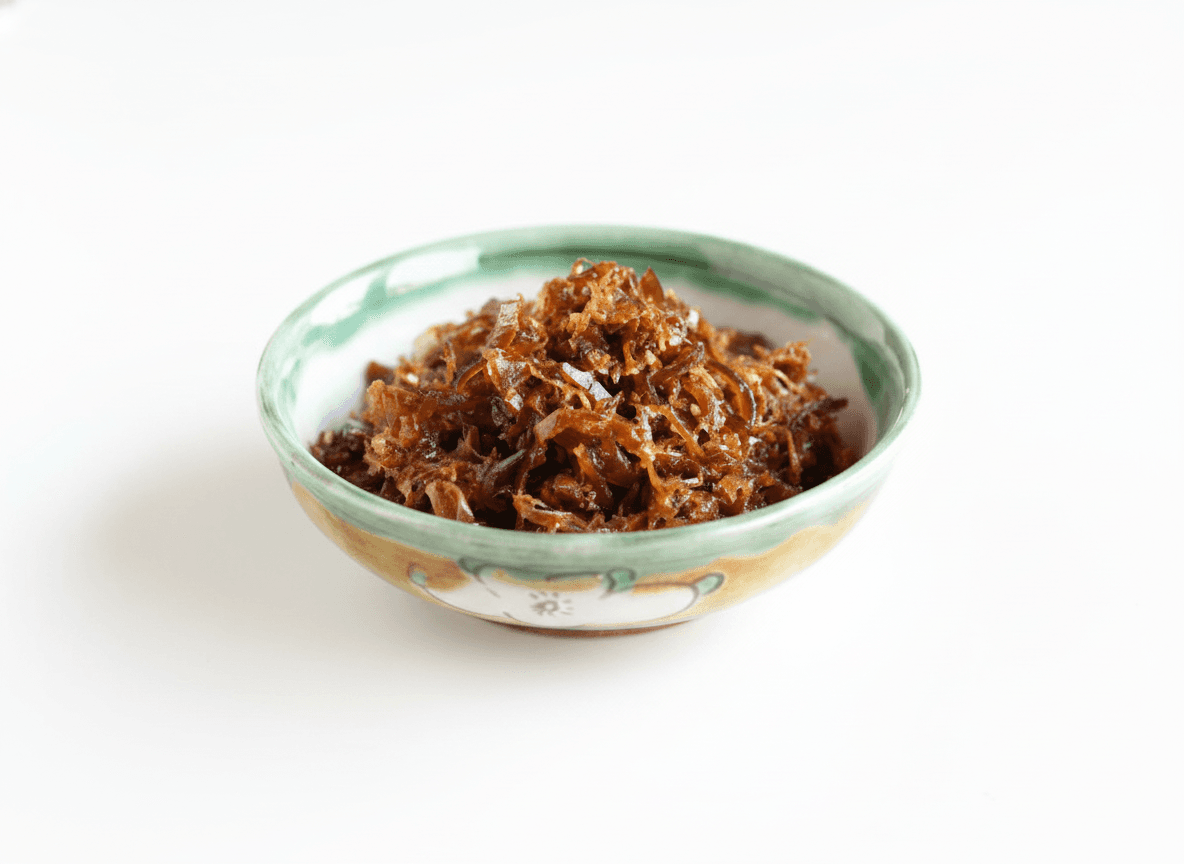
Dashi-Gara Tsukudani
だしがら 佃煮·(dashi-gara tsukudani)
Obaachan's Wisdom: Healing & Zero Waste
In a traditional Japanese home, nothing of value goes in the trash. When a grandmother makes dashi, she carefully squeezes the spent kelp and bonito flakes dry, tossing them into a freezer bag until she has enough to work a little weeknight magic. Simmered down in a dark, glossy syrup of soy, sake, and mirin, these exhausted scraps are resurrected into tsukudani—an intensely savory, sticky, sweet condiment that turns a plain bowl of steamed rice into an absolute feast. The real secret here is a splash of rice vinegar; it breaks down the tough kelp into melt-in-your-mouth perfection without leaving a single trace of sourness behind.
Before you start
Save your scraps.
A single batch of dashi rarely yields enough scraps for a proper braise. Always squeeze the excess moisture from your leftover kombu and bonito, storing them in a dedicated ziplock bag in the freezer until you have about a packed cup.
Ingredients
- leftover kombu and bonito flakes1 cup
- water1/2 cup
- rice vinegar1 tbsp
- Japanese soy sauce2 1/2 tbsp
- sake2 tbsp
- mirin2 tbsp
- sugar1 tbsp
- white sesame seeds1 tbsp
Method
- 01
Slice the kombu into thin, matchstick-sized strips and roughly chop the bonito flakes.
If the kombu feels slimy, that is exactly what you want—it means a luxurious, gelatinous mouthfeel is on the way.
- 02
Combine the sliced kombu, water, and rice vinegar in a small saucepan and bring to a gentle boil.
Cover the pot, reduce the heat to low, and simmer for 15 to 20 minutes until tender. Do not skip the vinegar; it is the chemical key to breaking down the kelp's tough fibers so they melt on the tongue.
- 03
Stir in the chopped bonito flakes, soy sauce, sake, mirin, and sugar once the kombu is tender and the liquid has reduced by half.
Leave the pot uncovered and increase the heat slightly to medium-low.
- 04
Simmer the mixture uncovered until the liquid has almost entirely evaporated and the ingredients are coated in a dark, sticky sheen.
This will take 10 to 15 minutes. Stir frequently during the final few minutes to ensure the caramelizing sugars do not burn on the bottom of the pan.
- 05
Remove the pan from the heat and fold in the toasted sesame seeds.
Transfer the tsukudani to a glass container to cool completely, where it will naturally thicken and deepen in flavor.
Notes
The shelf life is exceptional.
Because it relies on the osmotic preservation of salt and sugar, tsukudani will easily keep for up to two weeks when stored in a sterilized glass container in the refrigerator.
Do not eat this by the bowlful.
This is a potent condiment. Place a small pinch atop steaming white rice, tuck it into the center of an onigiri, or serve alongside a simple breakfast of grilled fish and miso soup.
Upgrade with dried mushrooms.
Add two or three rehydrated, thinly sliced dried shiitake mushrooms along with the soy sauce for an unparalleled explosion of savory depth, utilizing a splash of the mushroom soaking liquid in place of plain water.
From Cook Japanese in America.