Daoud Basha
داود باشا·(da-wood ba-sha)
Tabkha Yawmiye: The Weeknight Tanjara
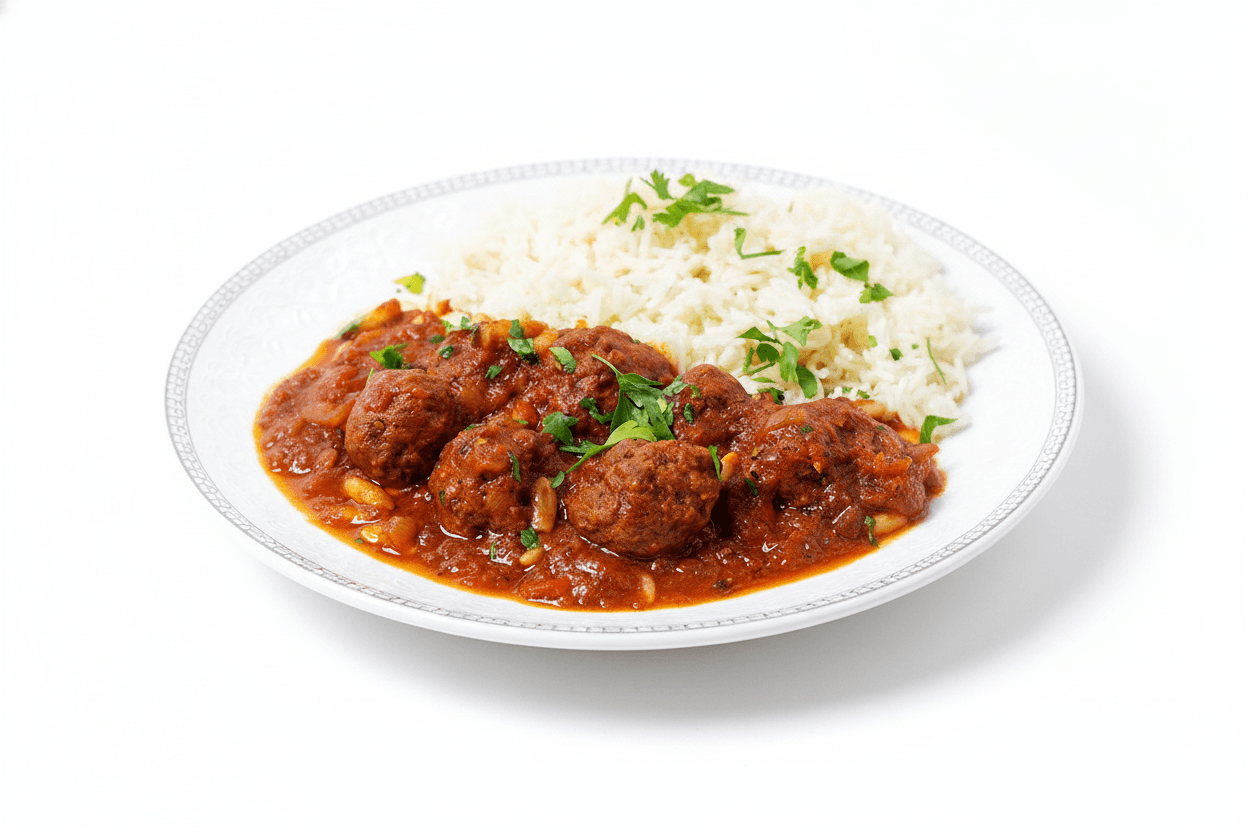
If you ask a first-generation kid what home smells like on a Tuesday at dusk, they will describe this pot. Named after a nineteenth-century Ottoman ruler who supposedly demanded it daily, Daoud Basha is the undisputed king of the weeknight tanjara. Forget the giant, bread-heavy diner meatballs of your youth. These are dense, heavily spiced kafta simmering in a violently savory pool of rendered beef fat, caramelized crescent onions, and pomegranate molasses. It is sweet, aggressively tangy, deeply comforting, and exactly what your grandmother would feed you to make the world right again.
Before you start
Prepare the Lebanese vermicelli rice.
Daoud Basha is never eaten alone; you will want rice ready by the time the stew is done. Toast half a cup of broken vermicelli pasta in a tablespoon of ghee until nutty and dark brown, then stir in a cup and a half of washed basmati rice, add water, and steam until fluffy to create the ultimate sponge for this tangy sauce.
Ingredients
- 80/20 ground beef1 lb
- yellow onion1 small
- fresh parsley1/2 cup
- garlic clove2 med
- plain breadcrumbs1/4 cup
- whole milk2 tbsp
- Lebanese Seven-Spice1 tsp
- ground cinnamon1/2 tsp
- kosher salt1 tsp
- black pepper1/2 tsp
- neutral oil2 tbsp
- russet potatoes2 med
- yellow onions2 large
- garlic clove3 med
- tomato paste2 tbsp
- crushed tomatoes14 1/2 oz
- beef broth1 1/2 cup
- Lebanese Seven-Spice1/2 tsp
- ground cinnamon1/4 tsp
- pomegranate molasses2 tbsp
- pine nuts1/4 cup
- unsalted butter1 tbsp
Method
- 01
Shallow fry the cubed potatoes in hot oil until they develop a golden brown crust.
They do not need to be cooked through, just crispy enough on the outside to maintain their structural integrity when they hit the stew. Remove them to a paper towel.
- 02
Combine the ground beef, grated onion, minced garlic, parsley, breadcrumbs, milk, and spices, rolling the mixture into small meatballs.
Let the breadcrumbs and milk sit for two minutes first. This is the grandmotherly secret to an incredibly tender meatball. Mix gently with your hands and do not overwork the meat.
- 03
Sear the meatballs in the tanjara until a dark crust forms on all sides, then remove them to a plate.
Work in batches to avoid steaming the meat, and whatever you do, leave every drop of the rendered fat and browned bits in the bottom of the pot.
- 04
Sauté the crescent onions in the residual meat fat until deeply softened and starting to caramelize at the edges.
This is the architectural soul of the dish. Stir in the sliced garlic for the final minute of cooking.
- 05
Push the onions aside and fry the tomato paste in the center of the pot until it darkens to a rusty brick color.
This vital step cooks out the raw, metallic flavor of the paste. Stir in the crushed tomatoes, broth, and the remaining cinnamon and seven-spice, scraping the bottom of the pot to release the fond.
- 06
Nestle the browned meatballs and fried potatoes back into the bubbling sauce, cover, and simmer on low for fifteen minutes.
The potatoes will become completely tender, the meat will cook through, and the liquids will reduce into a rich, cohesive stew.
- 07
Turn off the heat entirely and stir in the pomegranate molasses.
Never aggressively boil pomegranate molasses. Adding it completely off the heat preserves its delicate fruity acidity and prevents the sugars from turning bitterly abrasive.
- 08
Toast the pine nuts in melted butter until fragrant and pour them directly over the finished dish.
Watch them like a hawk in the skillet as they will burn in seconds. Garnish with a handful of fresh parsley and serve immediately.
Notes
Embrace the bouillon cube.
While high-end Western kitchens demand homemade stock, modern Lebanese diaspora kitchens rely heavily on Maggi or Knorr bouillon cubes. Dissolving one in hot water introduces a specific, nostalgic umami profile that is entirely true to weeknight home cooking.
Mix your own Seven-Spice.
If you cannot find authentic Sabaa Baharat, a mixture of mostly allspice with a pinch of nutmeg and cloves serves as a highly accurate substitute for the American home cook.
From Cook Lebanese in America.